![MaritimeJournal[Seawork]](https://www.maritimejournal.com/wp-content/uploads/2026/09/MaritimeJournalSeawork.svg)






Fuel’s gold: How maritime’s green rush misses real diesel deal
The maritime industry is in ‘an abusive relationship’ with regulators over the race to cut emissions, says one innovator in an exclusive interview with Maritime Journal.
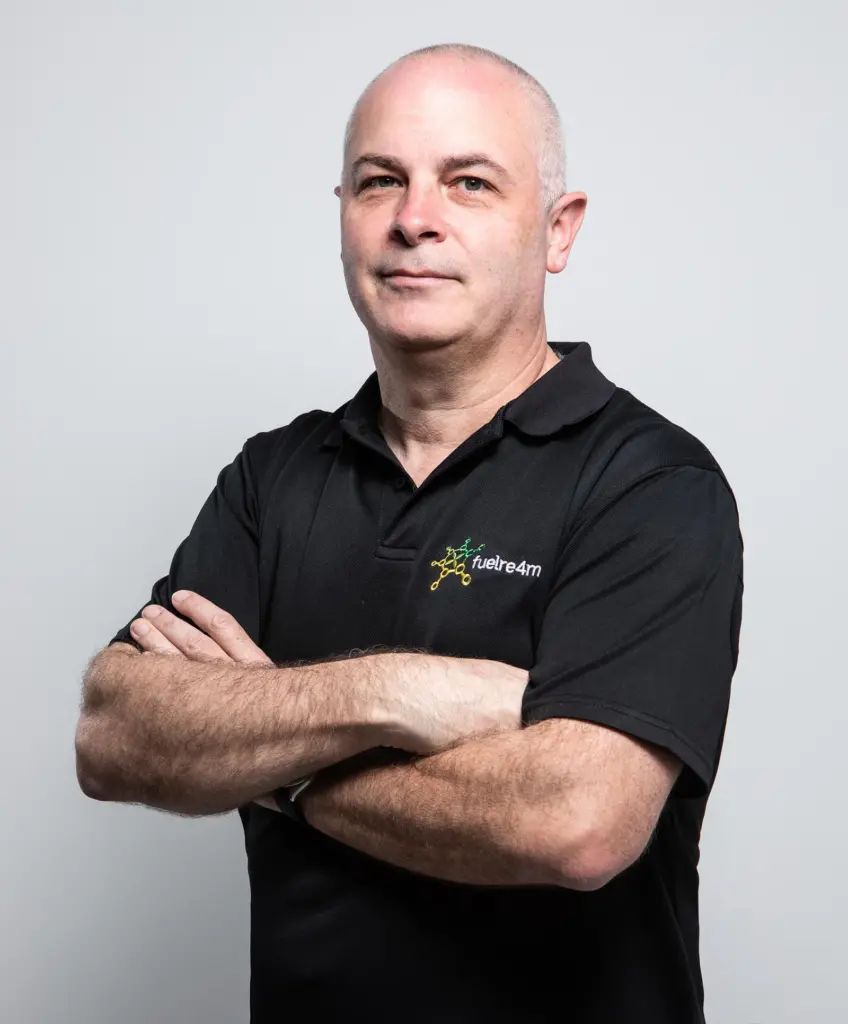
As the IMO looks to double down on carbon penalties, Rob Mortimer, CEO of a company whose product re-engineers diesel to deliver 20% savings, warns that shipping is wasting its time on alternative fuels while smarter diesel reform could deliver immediate, measurable emission cuts.
And in racing towards what is being dubbed a greener future, in doing so the industry not only risks careering off course, it also fails to achieve its environmental goals.
Rob Mortimer is the CEO of the FuelRe4m Group, which has come up with a proven fuel-conditioning technology that saves up to 20% of diesel. Rather than spending fortunes on alternative fuels that do not pass muster yet, why not put as much effort into improving what is already the best maritime fuel there is, he asks.
As well as explaining his ‘Re4mx’ product to Maritime Journal, Mortimer was outspoken about how decision makers will live to regret making rash moves now without fully understanding what they are doing, and how the new fuels held aloft as saving the planet (methanol, hydrogen, ammonia) are far from being the Holy Grail.
“People need to start understanding that they’re doing more damage making the wrong decision than not making a decision,” he says. “They’re not doing it because it’s having any impact. It’s all for marketing nonsense.”
The International Maritime Organisation (IMO) is currently meeting in London to discuss how far to penalise the sector for not cleaning up quickly enough: the ‘Net Zero Framework’ was adopted in April by the Marine Environment Protection Committee (MEPC), with members expected to officially vote it through this week despite pushbacks from the US and Saudi Arabia.
And while at this stage affecting vessels over 5,000GT, this is likely to come down to those above 400GT, thus affecting larger workboats and tugs within a couple of years: the IMO’s own FAQs state that “Ships under 5,000 GT are currently not covered, but discussions are under way to possibly include ships between 400GT and 5,000GT in the future.”
Alternative fuel mirage

Of the new alternative fuels being named as diesel’s successor, or at least complement, methanol has almost become the industry’s darling, and is often named as a realistic alternative fuel for vessels like offshore support vessels, tugs and other workboats as well as the larger container ships.
However the benefits of methanol do not stand up to scrutiny, Mortimer says.
“Take something like methanol that is now being touted as quite a good fuel,” he says. “Yet the methane slip you’ve got in the production, distribution and storage of methanol is thousands of times more damaging than NOx, thousands of times more damaging than CO₂, but because it looks as though the combustion is cleaner, it hits the green spot and everyone wants to go that way.
“CO₂ is not the problem, it’s all of those other emissions, and every time we change fuel we’re changing the problem and we’re not measuring to see the problem we have created.”
Methanol is 2.4 times less energy dense than diesel, which means vessels have to burn a lot more of it to achieve the same output – and in doing so, carbon dioxide is released anyway.
Hydrogen and ammonia, says Mortimer, are a joke, and a dangerous one.
“They think there’s a utopian energy source out there somewhere, so let’s make all the decisions to make it look as though we’re going that way without knowing where it is we’re going.
“Who the hell, for instance, is deciding that we’re going to put ammonia on ships? Five millilitres is enough to wipe out the crew. If a ship carrying ammonia sinks, that’s the whole reef wiped out. The most toxic substance to sea life is ammonia, and somebody’s bright idea is to put it on ships? If you want to use ammonia, use it onshore next to a power plant where it’s safe. Don’t put it on ships.
“Nothing compares to diesel. So the one thing you can do properly is make sure you optimise that diesel. And this is where the world is going wrong. You can’t move away from fossil fuel, so let’s optimise it.”
Dual fuel options?
What about dual fuels? Wouldn’t that be the best of both worlds?
“If you’re going to go to dual fuel, let’s make it so you are at least using the second fuel,” says Mortimer. “There are so many of these engines out there that are dual-fuel ready, but that’s a nonsense because nobody is using the second fuel yet they’re getting credit for having a dual fuel-ready engine.
“In fact it’s worse because the secondary fuel means the engine’s not as efficient. So the engine itself will not perform as well on the primary fuel because it’s had to be adapted to be able to accept the secondary fuel – and if you want to switch over to the secondary fuel you have to bring it into port and spend two days cleaning up the engine.
“And because there’s no guarantee of getting a bunker of the secondary fuel, people don’t want to use it.”
Early adopters need to stop, Mortimer says, for five to seven years, until more vital work has been done to confirm whether the candidates are feasible options or not.
A smarter alternative: Re4mx
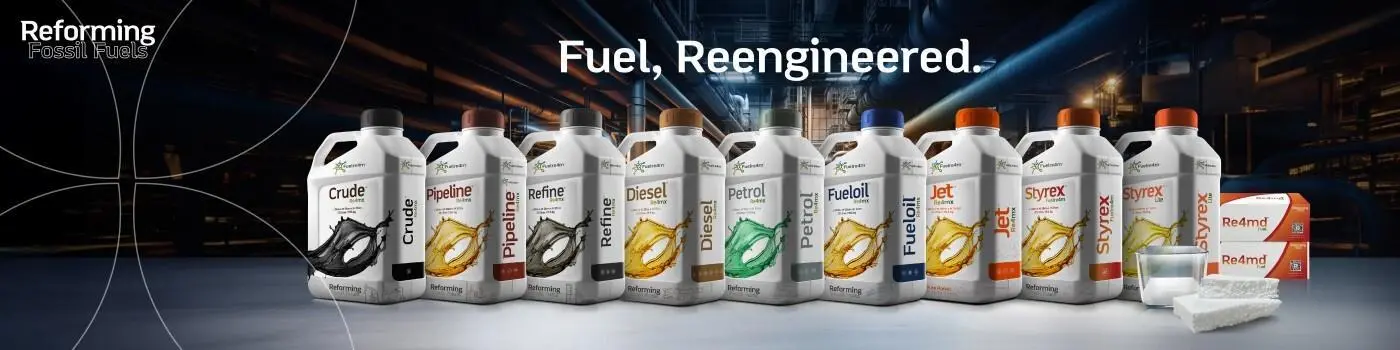
Instead of replacing diesel, FuelRe4m’s technology, Re4mx, improves its combustion efficiency by 15-20%, a huge number, given that savings of up to 5% are considered hard to achieve.
“We’re taking the fuel and making it combust better,” Mortimer says. “The biggest thing is that you have potential energy from the fuel, but not all of it is unlocked quickly enough to push the piston. Anything past pushing the piston is wasted energy and creates emissions. We’re not adding anything to the fuel, we’re just unlocking the molecules so they can’t stick back together again.
“All we have done is improve the quality of the fuel so more of the energy can combust. If you’re now operating that vessel at its rating, it means that you’re using a lot less fuel and producing a lot fewer emissions. This is not anecdotal any more — it’s proven.”
FuelRe4m’s product is a vegetable-oil-based reformer as opposed to an additive and one litre will treat 800 litres of diesel, he says.
The results are both environmental and economic. “If you’re saving 15% of your fuel, that’s 100% emissions reduction off your scope one, because you’re not having to declare as much fuel being used. You get your return on investment within a month – and you get all the emissions reduction for free.
“The whole process is 100% natural vegetable oils and esters, so we’re sequestering carbon at the same time as manufacturing. We use solar heating, recycle all the water, reuse all containers – it’s a very sustainable footprint all the way through.”
In essence, FuelRe4m doesn’t fight the existing system – it fixes it.
“If you consume fuel, you produce CO₂. It doesn’t matter what the fuel is. But if you use less of it for the same power, that’s the only real emission saving there is.”
One of Fuelre4m’s clients is the Holcim Group, a building company that has adopted Re4mx at commercial scale and sees consistent results across a wide range of use cases, according to CEO Lee Sleight.
“This is about measurable outcomes, not promises, and FuelRe4m has delivered both the data and the support to back it up,” Sleight said.
Industry blind spots
The problem, Mortimer says, lies as much in governance as in technology.
“The maritime industry has been hiding the fact for too long that when it talks about SFOC – specific fuel oil consumption – it’s not specific,” he says. “Every vessel we’ve been on, the chief engineer and captain are overstating how much fuel they consume. Everyone keeps a buffer. If you just took that 5-10% buffer off by accurately recording everything, you’d reduce emissions by 5-10% overnight.

“What is the industry driving at? Who’s gaining from this? It’s almost as though the IMO is now pushing towards more commodity trading – carbon dioxide, NOx – instead of regulation. There’s more benefit in carbon capture than in emissions reduction because you can put a number on it to sell it. And this is where it’s getting crazy.”
The result, he warns, is a cascade of sketchy decisions.
“OK, you’re making decisions now because you’ve got to tick boxes. But how are you going to feel standing by those decisions in seven years’ time when it’s seen that the decision you made was wrong?”
Abusive relationship
Rob Mortimer says what he believes needs to be said to stop what he calls ‘an abusive relationship’ between the regulators’ chase for green fuels and the shipping industry.
“We shouldn’t all be going along with it and just accepting it. It’s almost like an abusive relationship and we need to get out of it and change it,” he says.
“All fuels are valid, viable, and valuable. What we should be doing is not looking at how we can put square pegs in round holes, but making sure we are optimising every fuel source. The fuel has to be application specific, and we need to optimise it in that application.
“We have the answer right now – diesel. What we need to do is make sure that we’re using that answer to its fullest.
“You can’t drive change if you don’t know where you are. And that’s where we are at the moment: the industry does not know where it is, yet it’s trying to drive change. But is it better or is it worse? Nobody knows. Everything is being based on the best of new fuels versus the worst of diesel and we’ve got to move away from it. We’re facing it with the unknown of the best of the future fuels that are coming out. Why don’t we level it up a little bit and say, OK, let’s look at the best-case scenario of diesel versus the best-case scenario of one of these other future fuels?
“The decisions that people are making now are being made in the knowledge that they’re probably not going to be around to have to defend them in 25 years’ time. I couldn’t live with myself if I was making a sketchy decision without all the facts. But that’s what we’re doing.
“We’re making hundreds of sketchy decisions to try and get somewhere and we don’t even know where we’re trying to go.”