



Is the maritime industry ready for the hydrogen era?
With carbon penalties looming, there’s a lot of work going on to find alternatives to diesel, which still has no real competitor when it comes to cost, availability or performance.

The drive to decarbonise transport is reshaping every sector, and maritime is no exception.
With the International Maritime Organization (IMO) aiming for net-zero emissions by around 2050 and mandates to reduce the reliance on fossil fuels, the pressure to adopt cleaner vessels is mounting. Although electrification is progressing quickly in passenger mobility, it is not a universal solution, as battery-electric propulsion remains impractical for most maritime applications.
For working vessels such as tugs, pilot and patrol boats, offshore wind support vessels and harbour service craft, duty cycles demand high energy density, fast turnaround and rugged durability. These requirements mean internal combustion engines (ICEs) will still have an essential role to play for the foreseeable future, but only if they evolve to run on zero-carbon fuels.
Why ICE still matters at sea
Maritime operations place unique demands on propulsion, from long duty cycles to variable loads. While electrification is advancing, it cannot yet meet all of these challenges.
- Range and endurance: Batteries alone cannot provide the energy needed for vessels that spend long hours on the water, often at variable loads, far from charging points.
- Rapid turnaround: In commercial ports and offshore operations, vessels must be ready to redeploy quickly. While charging can tie a boat up for hours, hydrogen refuelling can be completed in minutes.
- Infrastructure realities: Many working vessels operate beyond the reach of shore power, whether in offshore wind farms or small harbours. For these situations, fuel remains the most reliable energy source.
- Space and weight constraints: Large battery packs reduce cargo, passenger or equipment capacity, directly impacting operational flexibility and cost.
The shipbuilding industry needs to consider continuing to use ICEs. However, as net-zero targets come closer, these need to be reimagined with hydrogen and alternative fuels in mind.
Rethinking combustion for hydrogen
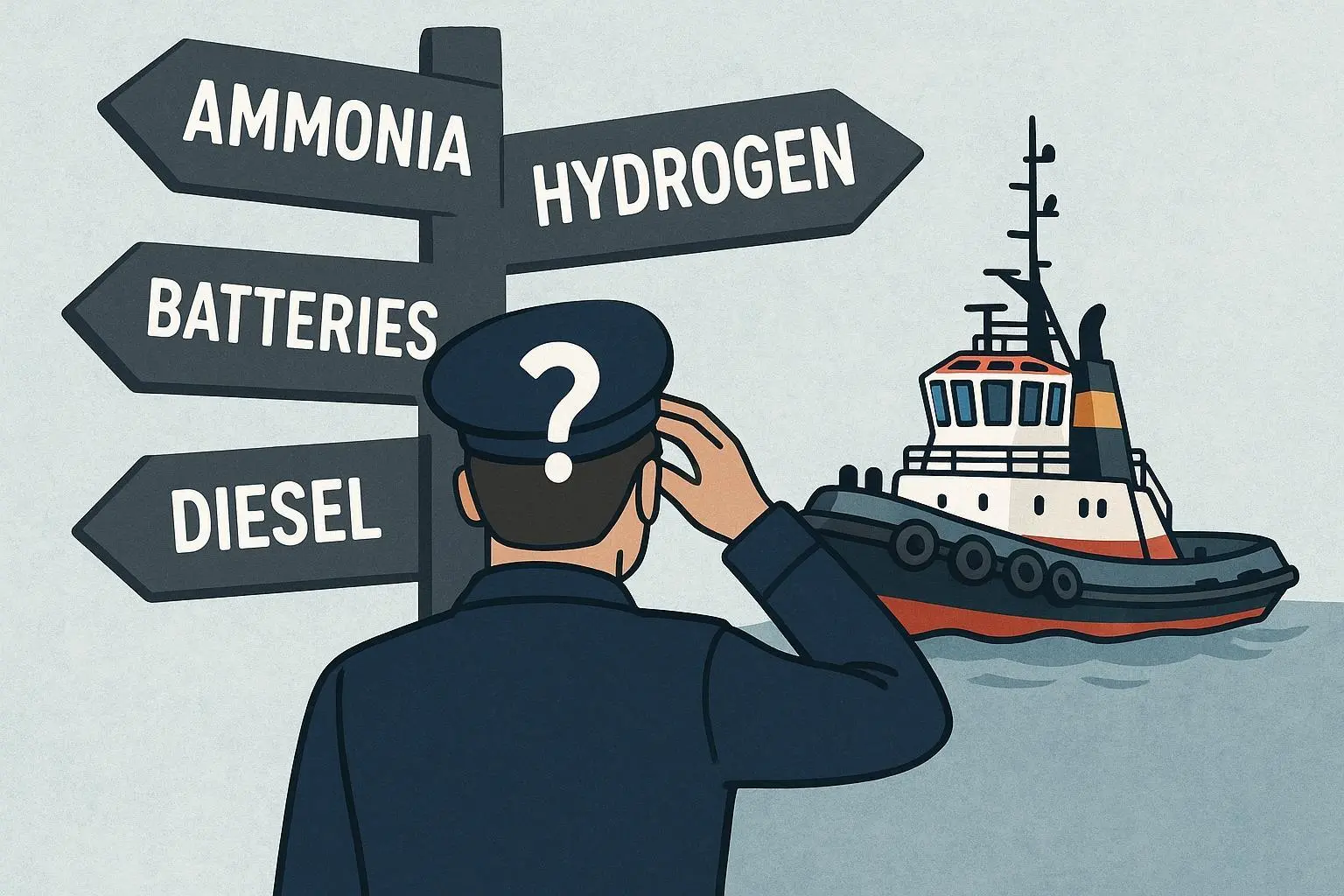
Hydrogen offers a credible, near-zero-carbon pathway for working vessel applications that travel short distances, whereas ammonia is preferred for deep-sea shipping due to easier storage and higher volumetric energy density.
A hydrogen-fuelled ICE provides the familiarity, robustness and serviceability operators expect, while delivering low emissions and fast refuelling. Operators, such as Norway’s Torghatten Nord, are already ordering large hydrogen-powered ferries, showing how rapidly the fuel has moved from concept to commercial reality.
And the same is happening for smaller boats, with hydrogen-powered tugs already being launched. But achieving this requires engineering adaptation:
- Preventing accidental ignition: Hydrogen ignites easily, and two main risks must be managed: pre-ignition from oil-control issues and unintended “ghost” sparks. Solutions include ignition systems and spark plugs that are specifically designed for H2.
- Lean fuel operation: Running a lean operation reduces combustion temperatures, minimising NOx emissions and improving efficiency.
- Special ignition systems: Pre-chamber ignition allows the engine to operate leaner, delivering stable combustion while further reducing NOx emissions.
- Advanced turbocharging: Lean hydrogen reduces exhaust energy, so variable-geometry turbochargers are required to maintain performance.
- Direct fuel injection: Injecting hydrogen directly into cylinders prevents backfire, increases power and maintains safety.
Together, these adaptations make hydrogen engines as reliable and powerful as conventional marine engines.
Building engines for durability
Hydrogen can make metals brittle and it can leak through seals, especially under the high pressures needed for onboard storage. For marine applications, where vessels face constant vibration, saltwater exposure and long service intervals, this makes material selection even more critical.
Engines and fuel systems must use hydrogen-resistant alloys, protective coatings and advanced sealing solutions designed for high-pressure, marine-grade operation. Getting this right is essential to deliver the durability and reliability operators expect from maritime vessels, many of which may run continuously for decades in demanding coastal and offshore environments.
Smarter combustion for the next generation of vessels
There will be no single pathway to maritime decarbonisation. Short-range ferries and passenger craft may successfully adopt batteries. But for workboats, offshore support and harbour vessels requiring long endurance and rapid turnaround, the ICE, rethought for hydrogen, will be crucial for future propulsion.
By engineering ICEs around hydrogen, the maritime sector can retain performance, range and operational resilience.
Related Articles
 OPINION
 FEATURES & VIDEOS
 INSURANCE, LEGAL & FINANCE