




Tidal Current Breakthrough in Orkney with Sea Snail
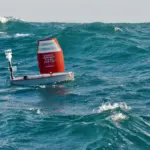
The Robert Gordon University Sea Snail , designed as a support system for tidal current energy devices, was towed out of Stromness Harbour last month and successfully installed in Burra Sound, Orkney.
The Snail, through its use of reversible hydrofoils to produce downforce, is intended to tackle what many believe to be the biggest technical obstacle to the economic development of tidal current power, the difficulty of attaching energy extraction devices in energetic flows where the seabed does not allow conventional anchorage.
Referring to project leader Alan Owen, Professor Ian Bryden, who originally conceived of the Sea Snail said, ‘Alan has made a huge breakthrough for the economic development of tidal current power. Use of the Snail will allow the development of small energetic sites which would not have been accessible to more conventional fixing concepts.’
Tidal currents offer a substantial and predictable source of renewable energy.
The Scottish resource alone, if developed effectively, could provide enough electricity to support a population of 15 million.
At present, the potential to use tidal energy is limited by installation methods for turbines, which require firm attachment to the seabed. This is very expensive and currently requires turbines to be placed in water depths greater than 25m and less than 50m.
The full size Snail is a prefabricated tidal device that can be cheaply installed in shallow and deep water, significantly increasing the number of suitable sites for turbines and reducing installation costs.
The potential export market for prefabricated tidal current devices which can be installed without specialist hardware is considerable. Given the potential of the technology for the Scottish economy, the project has received £158,000 from Scottish Enterprise’s Proof of Concept Fund.
MJ Information No: 20769
Related Articles
 MARINE CIVILS
 MARINE CONSTRUCTION
 EQUIPMENT