



Vessel Launch: The quietly powerful Almaciga P
The latest of the new generation Seaward Nelson 42 pilot boats has completed its acceptance trials at Cowes, Isle of Wight.
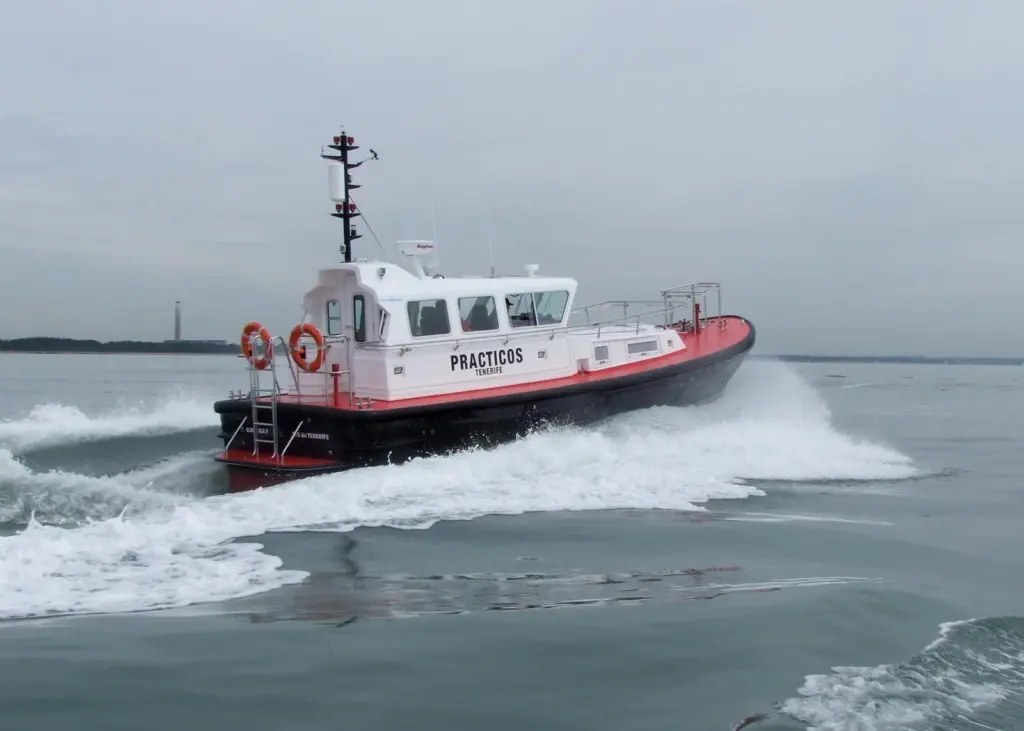
The craft Almaciga P was built to comply with the requirements of the Spanish Regulatory Authorities for Pilot Boats and under Lloyds Register survey for the GRP construction certificate.
The craft is based on the Nelson 42 hull with Seaward’s new design deck and resilient mounted wheelhouse that has been designed to reduce noise levels for the crew and passengers. The wheelhouse is a watertight module sitting over a watertight self draining well in the deck moulding. This provides two structural barriers for which the unwanted engine and structure borne noise has to pass through to reach the crew. The attachment of wheelhouse to deck is via eight laminated rubber/fabric resilient mounts that are through bolted with isolating sleeves and pads.
When compared to the Nelson 40 the main differences between the two craft include a greater beam/length ratio to carry the heavier displacement resulting from larger engines, a higher fuel capacity (of up to 2,600 litres) and a larger resilient mounted wheelhouse to carry up to eight persons.
The Tenerife pilots chose a layout that included seating for four people on Cleeman sprung seats plus two settee seat lockers at the aft end of the wheelhouse for another four. One of the settee seat lockers has a built in Cruisair air conditioning unit powered either by the ship’s Fischer Panda generator or from shore supply.
There is a wide choice of engines available for this craft and in this case the owners chose the option of a pair of in-line 6 cylinder MAN D2866LXE40 with a rating of 279 bkW (380mhp) at a continuous 1,800 rpm. These drive 710mm 4-blade propellers via Twin Disc MG 5114A 1.48:1 reduction gearboxes and conventional shaft drives.
The machinery dpace is located forward of the wheelhouse with normal access from the wheelhouse or forward store and offers full standing headroom and good service access. A large removable hatch is installed in the coachroof above the engines to facilitate their removal for overhaul without major disruption.
Part of the owners design brief was to ensure the craft was built with a really good engine room ventilation system suitable for the local climate and capable of preventing salt spray entering the machinery space. For this requirement Seaward chose the Premaberg louvered vent system whereby water droplets are separated from the airflow and directed downwards and back out through built in drain channels. Seaward fitted a secondary baffle within a self draining trunking located between the Premaberg vents and the machinery space, the secondary trunking has the effect of directing the spray free air entering the engine room downwards towards the engine air intakes. Further air flow circulation is by way of a pair of Elta 250mm diameter extraction fans exhausting through Premaberg outlet grilles.
Engine room fire monitoring and suppression is the FM200 system supplied by Sea-Fire. In the event of an engine room fire the fuel supply valves and air flaps are closed by control cables operated from the wheelhouse prior to the release of the FM200 manually by way of safety pin and pull cable. A viewing window is included in the wheelhouse to engine room fire door to enable the crew to be sure of fire rather than a sensor fault prior to activating the suppression system.
Fuel oil is carried in a pair of 1300 litre integrally moulded keel tanks – one forward and one aft. These tanks extend from the forward store to the aft end of the void space. The arrangement maintains an even weight distribution and running trim whether the tanks are near full or at low levels whilst keeping the centre of gravity as low as possible.
Steering is the mechanical torque tube type by Whitlock connected to large cast nickel aluminium bronze airfoil section rudders providing good directional stability in following sea conditions.
Wynn straight line wipers with variable speed controls keep forward vision clear for heavy weather.
The new boat will be a welcome addition to the Tenerife port that has seen an increase in traffic particularly for bunkering. Many vessels sailing from the Far East to Europe now prefer to sail around South Africa rather than through the Suez Canal to avoid the pirate activity on the east coast of Africa.
Related Articles
 ELECTRICAL SYSTEMS
 VESSELS
 INDUSTRY NEWS