![MaritimeJournal[Seawork]](https://www.maritimejournal.com/wp-content/uploads/2026/09/MaritimeJournalSeawork.svg)


Amphibious Walrus opens access to stranded turbines
When Scroby Sands Offshore Wind Farm was commissioned off Great Yarmouth in 2004, few could have predicted that one of its greatest operational challenges would emerge not from the turbines themselves, but from the seabed beneath them.
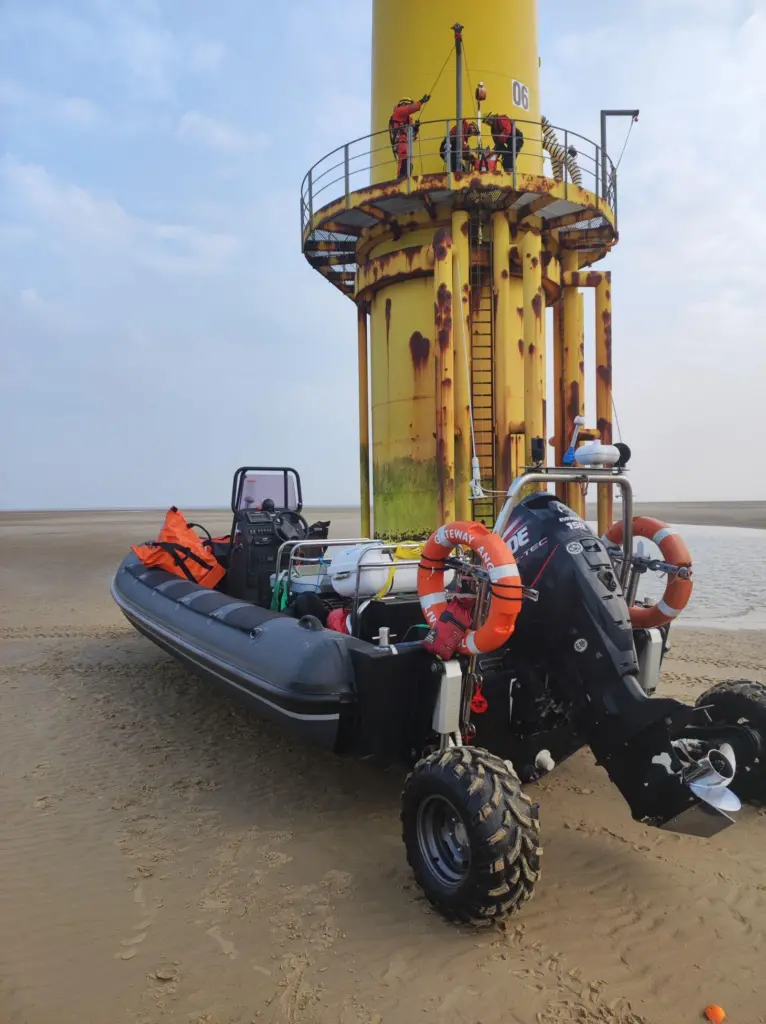
Built on a prehistoric sandbank just 2.5km offshore, the 60MW wind farm was among the UK’s first generation of commercial offshore wind projects. Over the following two decades, natural sediment movement and coastal processes gradually reshaped the site. Sand levels rose around several turbines, leaving them increasingly difficult, and eventually impossible, to reach using conventional crew transfer vessels.
What began as a marine access problem would ultimately drive the development of one of the most unique vessels ever deployed in the offshore wind sector.
At the centre of that story is Commercial Rib Charter’s director and co-owner Stuart Hedges, who we managed to catch up with at a busy Seawork 2026.
CRC’s involvement at Scroby Sands began long before the arrival of the bespoke amphibious crew transfer vessel CRC Walrus. The company had already established a reputation for operating in shallow-water environments and recognised that traditional access solutions were becoming increasingly ineffective as the sandbank evolved.
“The problem didn’t appear overnight,” Hedges said. “Every year the site changed a little more. Turbines that had once been straightforward to access were gradually becoming isolated by drying sandbanks.”
First forays
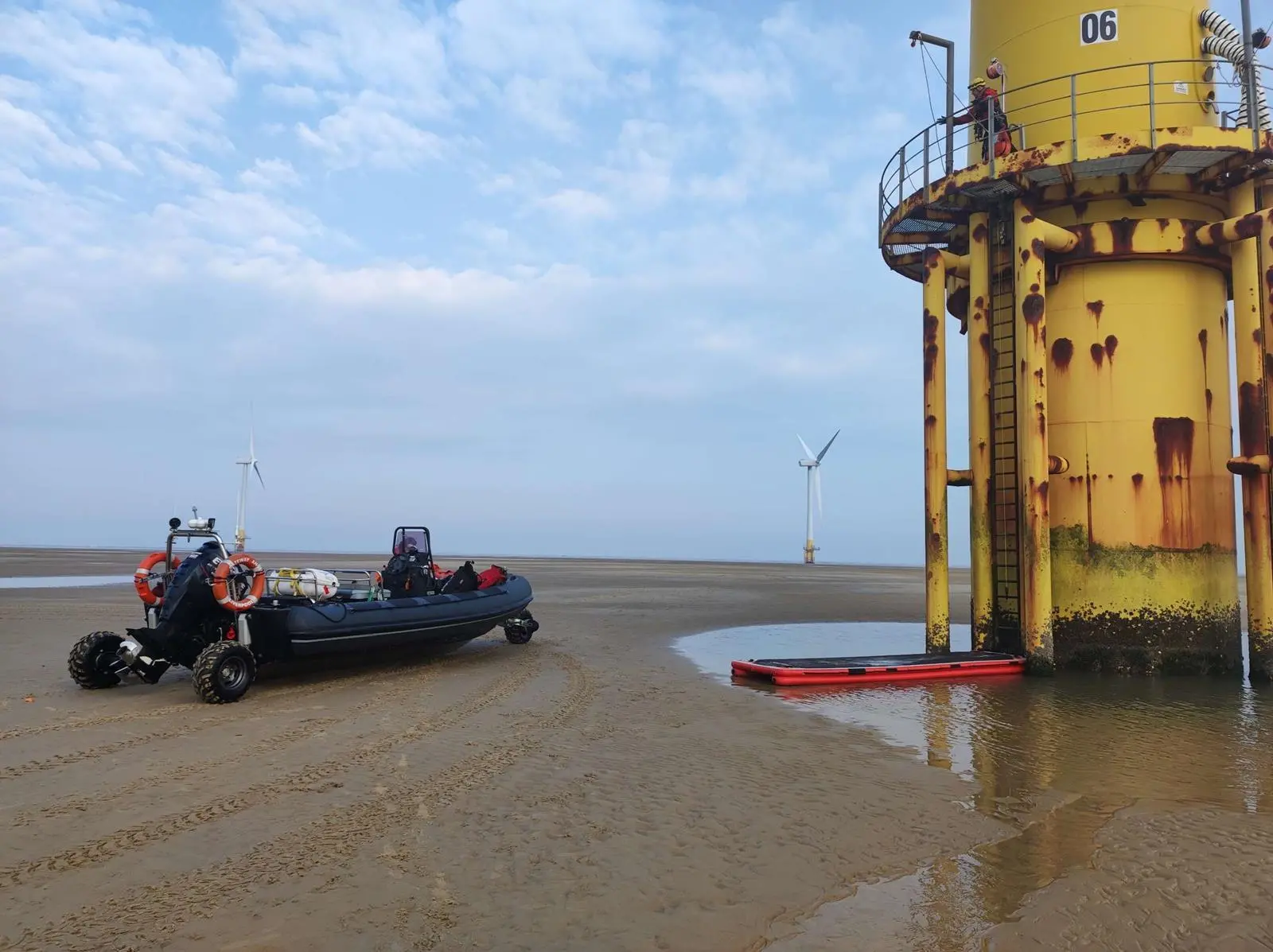
CRC was already operating two conventional aluminium-hulled catamaran CTVs at Scroby, so knew the lie of the land. Rather than immediately pursuing a bespoke vessel design to access the problem turbines, CRC initially adapted existing amphibious technology, deploying three New Zealand-designed and built 7.7m Sealegs RIBs, using their retractable wheel systems to bridge the gap between water and exposed sand.
The Sealegs boats proved remarkably capable within their operating envelope. Yet they were never designed specifically for the harsh daily realities of offshore wind support.
“The Sealegs RIBs use a non-marinised, effectively a lawnmower, engine to power the hydraulic pump that raises and lowers the wheels and runs the hydraulic wheel motors,” said Hedges. “This air-cooled petrol engine is in a box on deck, which is not particularly suited to having the decks awash regularly.”
The operations area was also far from predictable.
“The sand at Scroby is very changeable and hard to predict,” said Hedges. “Soft, axle-deep sand in one place one day can be hard as concrete the next.”
CRC had to learn to be selective.
“We were and are very choosy about where we deploy the three Sealegs RIBs. On the right day they remain a fantastic asset.
“We knew amphibious access worked though. The challenge became how to combine that capability with a vessel that could meet the standards and operational requirements of a commercial offshore wind operation.”
Commercial solution
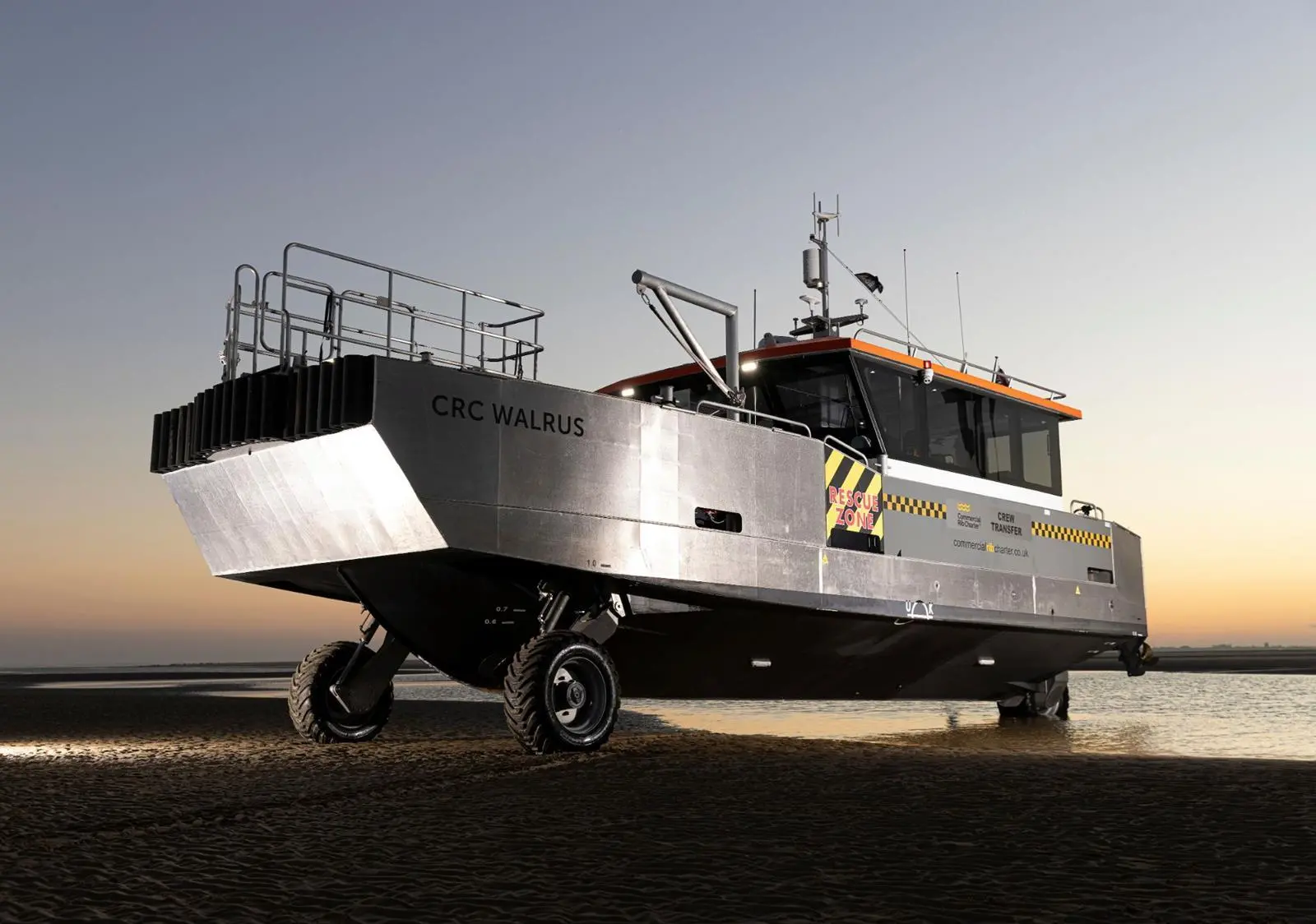
That realisation sparked discussions between CRC and RWE, owner and operator of Scroby Sands. Together they began exploring whether a purpose-built amphibious crew transfer vessel could be developed specifically for offshore wind maintenance. The objective was ambitious: create a vessel capable of operating as a conventional CTV offshore while retaining the ability to drive across exposed sandbanks and safely transport technicians and equipment to the stranded turbines.
The resulting project brought together RWE’s operational and innovation teams, CRC’s practical experience of amphibious marine operations, naval architects Chartwell Marine and Isle of Wight boatbuilder Diverse Marine.
Also key to the project was Aston Goddard, who had worked at Scroby Sands Offshore Wind farm from very early days, originally as a CTV skipper, when RWE owned their own vessels. Goddard is now a senior marine engineer and was involved with the original concept and design brief of a purpose-built amphibian working alongside Hedges. According to Hedges, Goddard had been involved in all of the shallow water operations and understood the environment on-site very well.
The collaboration moved from concept to construction in little more than a year. The result was CRC Walrus, a vessel unlike anything previously deployed within the offshore wind industry.
Officially unveiled in 2023, the 12-metre aluminium-hulled vessel was designed to transfer 10 technicians and two crew while carrying up to one tonne of cargo.
Unlike the smaller amphibious craft that preceded it, Walrus incorporated the features expected of a modern offshore wind support vessel, including enhanced crew comfort, improved operational capability and full commercial certification for the role.
A three-wheel arrangement allows the craft to transition between sea and land, enabling technicians to reach turbines that would otherwise remain inaccessible because of changing seabed conditions. The design effectively combines the functionality of a conventional crew transfer vessel with the flexibility of an amphibious platform.
For RWE, the vessel solved a growing maintenance challenge at a site where four turbines had effectively become stranded by rising sand levels. For CRC, it represented the culmination of years of operational learning gained through Sealegs deployments and practical experience in shallow-water environments.
“To come up with CRC Walrus’s land drive system we found a guy in Denmark who had built his own amphibious boat to access a holiday rental property he owned on an island,” said Hedges. “Despite its small-scale beginnings, this hydraulic drive system has proved to be one of the most robust aspects of the boat.”
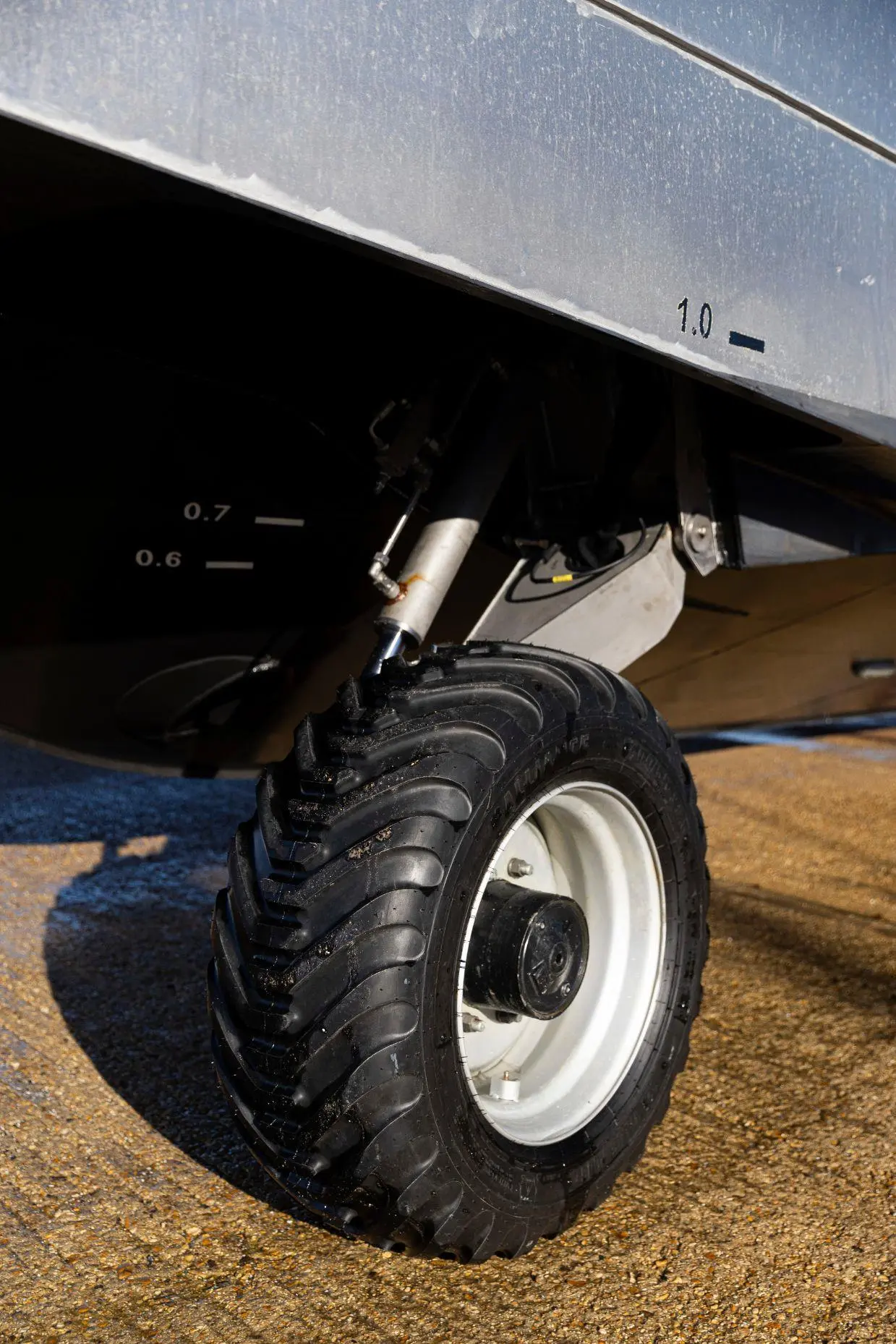
The resulting configuration differs significantly from many amphibious craft.
“For the land drive system we used a single steering wheel at the stern that folds back out of the way when in water mode,” said Hedges. “The front wheels fold up into housings, which are forward of where water meets the hull when the vessel is planing, so the wheel wells at the bow do not require complex hydrodynamic covers.”
Compromises
Every amphibious boat represents a balancing act between conflicting requirements. What works well on land can create penalties at sea, while optimising for offshore performance can make beach operations difficult or impossible.
Hull design is perhaps the most obvious example.
Conventional offshore RIBs and CTVs often employ deep-vee hulls to improve ride comfort and reduce slamming in rough conditions. Amphibious vessels rarely enjoy that luxury. Ground clearance requirements dictate a flatter hull geometry to accommodate wheels and drive systems. The CRC Walrus is no exception.
Hedges openly acknowledges that the relatively shallow deadrise can produce a firmer ride when conditions deteriorate. Compared with a dedicated offshore vessel, the boat can be noticeably more slam-prone in rough seas. Yet this is simply one of many trade-offs inherent in an amphibious design.
Practical experience
As with any specialist vessel, success comes from understanding the platform’s strengths and limitations and operating accordingly.
Those limitations have not prevented the Walrus from proving its worth. In fact, the vessel has attracted significant interest from operators facing similar challenges.
“We think CRC is the only company in the UK, possibly in the world, operating amphibious charter boats in the energy industry,” says Hedges.
That expertise has not gone unnoticed, with Commercial Rib Charter recently being honoured with the UK’s highest official business honour, The King’s Award for Enterprise, in the innovation category, for the development and operation of CRC Walrus.
After half a decade of experimentation, adaptation and engineering development, the company has carved out a niche few others have attempted to enter.
Not that Hedges is necessarily encouraging others to follow.
When asked what advice he would offer anyone considering a commercial amphibious vessel operation, his answer arrives without hesitation. “Don’t do it!” he said.
The wry smile that follows suggests there is more truth in the comment than he might care to admit. Amphibious boats are complicated, demanding and full of compromises. Yet for operators faced with seemingly impossible access challenges, they can also be exactly the right tool for the job.
Related Articles
 MERGERS & ACQUISITIONS
 ACCESSORIES & EQUIPMENT
 OTHER NEWS