




French partners full steam ahead with H2 and electric
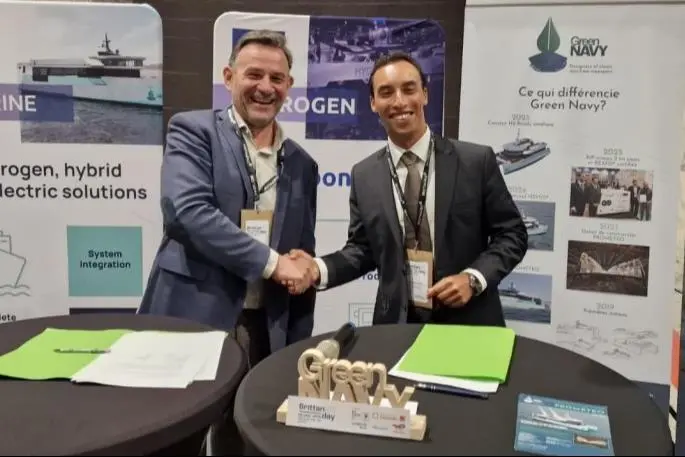
Two French companies have signed a long-term industrial partnership to develop, integrate and certify hydrogen propulsion systems for catamarans of up to 30 metres in length.

Green Navy, part of France’s Vallair Group, and SECO Marine, a Fétis Group company, have agreed to examine and develop hydrogen-electric vessels as a new standard for island connectivity, harbour transit and coastal tourism, they say.
“It signifies an expanded and strengthened partnership for the long term,” said Green Navy CEO Charles Cardi. “This is an extremely important step in consideration of the business opportunities we are working on.”
The Prometeo project
At the heart of this collaboration lies Prometeo, Green Navy’s concept vessel that it says demonstrates what clean, silent and vibration-free ships could look like.
The project brings together Green Navy’s naval architecture and SECO Marine’s hydrogen integration knowledge.
“The technical and human aspects surrounding the Prometeo project went particularly well,” Cardi says. “We have built a relationship based on trust, mutual respect for each other’s skills, and excellent complementary qualities. We also share common goals and the same strategic vision. Ultimately, it was a natural step forward – one that everyone involved wanted to see happen.”
SECO Marine, recognised this year by Bureau Veritas Marine & Offshore as France’s most advanced company in maritime hydrogen systems, brings to the table two decades of R&D experience. Its work across heavy mobility, off-road and maritime sectors was what set it up as partner for Green Navy’s ambitions.
“We evaluated various methodologies and consulted numerous integrators during the launch of Prometeo,” Cardi says. “We wanted to integrate two EODev REXH2 fuel cells and 200 kilograms of hydrogen at 350 bars on board. At SECO Marine, we found strong expertise thanks to their in-house R&D department. There were already ongoing hydrogen projects – some completed – and we immediately felt a shared vision and enthusiasm when we presented our concept.”
From design to deployment
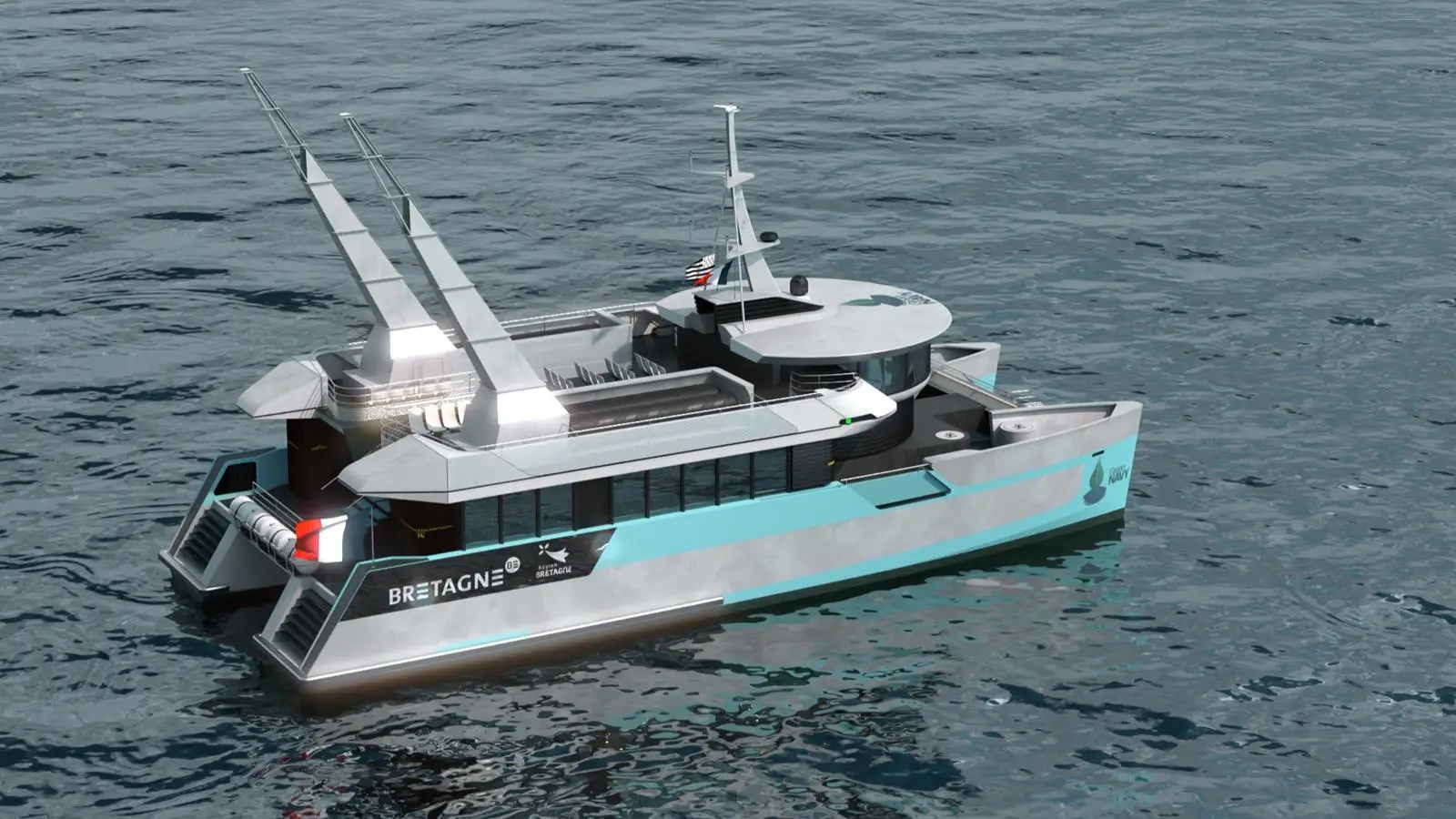
Green Navy’s approach focuses on commercial catamarans between 15 and 30 metres, designed for routes where vessels typically return to port each night, which allows them to recharge their batteries and will ultimately allow them to refuel with green hydrogen.
“It makes sense to use these energy vectors for ships of this size,” Cardi says. “Our strong, lightweight vessel platform can accommodate different superstructures to meet diverse needs – passenger, freight or mixed versions. It’s the type of ship you see in almost every harbour in the world.”
The company is working on ‘opportunities’ for 10 passenger vessels under 24 metres, though no firm orders have been signed yet.
Of those, six are fully electric, two are H2-ready, and two are full electro-hydrogen.
“By focusing on this range we leverage the knowledge and methodology obtained from Prometeo, with the goal of reducing costs and making this technology more competitive,” he says.
Safety first
Hydrogen, for all its promise, still carries a public perception problem – safety.
“This is indeed a key point that must be approached with great humility,” Cardi admits. He says Green Navy’s safety architecture has been developed with support from aerospace experts at Ariane Group, coordinated by SECO Marine, and verified by computational fluid dynamics (CFD) simulations.
“Our concept aims to make the upper deck available to passengers while also serving as a storage area for compressed hydrogen,” he says. “We reduce the pressure immediately at the bottle outlets so that only low-pressure circuits are on board. We then minimise risk zones –known as ATEX zones – by containing and ventilating them to a high level, without adding too much weight or energy consumption.”
Even the refuelling process is being rethought.
“The greatest risk is during bunkering, when no passengers are on board,” he says. “We are developing high safety measures such as specific connectors that can handle up to 1,500 bars. The catamaran hull gives us enough surface area and stability to accommodate these systems safely.”
Green Navy works closely with the French Maritime Administration and Bureau Veritas Marine & Offshore to verify designs and monitor compliance. Cardi says they expect to receive Approval in Principle Level 2 by early 2026.
Tackling the hydrogen paradox
Sceptics often point to hydrogen’s lower energy density compared to diesel as a deal-breaker. Cardi, however, calls it ‘a paradox’.
“Hydrogen is extremely light and diffuse,” he says. “Its volumetric energy density is around 0.003kWh per litre – much lower than diesel – but its mass energy density is far greater at 33kWh per kilogram, compared to diesel’s 12Wh. When compressed at 350 bars, we can store a lot of energy for a reasonable weight.”
He points to Prometeo’s configuration as proof. The vessel’s total energy capacity is 3,200kWh: 690kWh from batteries weighing 4.2 tonnes, and 2,500kWh from hydrogen systems weighing 6.8 tonnes.
“Hydrogen systems offer a ratio of 0.36kWh per kilogram, compared to 0.16 kWhfor batteries,” Cardi says. “Neither is better – both are needed, and they work perfectly together to ensure zero-emission operations.”
But the real challenge, he concedes, is economic. “For all this to be viable, we need green hydrogen at a competitive price. It’s a young, emerging, complex sector. But it can offer a new model for society, where regions become self-sufficient in decarbonised energy. That’s the real reward.”
Building the ecosystem
Cardi is frank about the realities of infrastructure. “The supply chain is key, and it’s not developing as quickly as we hoped in France and Europe,” he says. “Some electrolysers are operational, but quantities are insufficient to launch a viable economic transition.”
To keep projects moving, Green Navy has adapted. “We now offer vessels in their ‘H2-ready’ electric versions,” Cardi says. “Our systems are designed to accommodate a hydrogen range extender as soon as the ecosystem is ready. At the same time, we’ve redesigned our hydrogen concept to make it independent and plug-and-play. This allows shipowners to get closer to decarbonisation goals while staying flexible for the future.”
That future is already being shaped by projects like the Prometeo concept and a recent SECO H2 bunkering demonstration in Brittany by SECO.
“The system allows hydrogen to be compressed and transferred directly into a ship’s tanks,” says SECO Marine’s general manager David Bartoletti. “The objective was to collectively reflect on the safety, feasibility and acceptability of maritime hydrogen.
“Combining this important milestone with our partnership announcement cements a shared vision. The emerging technologies of today must work hand in hand to build the sustainable maritime industry of tomorrow.”
The business of clean shipping
Beyond the technical innovations, Green Navy’s model also aims to be commercially pragmatic. “Our H2-ready electric ships are immediately more financially attractive than their diesel equivalents,” says Cardi. “For some operators, they won’t yet meet 100% of their range needs – that’s where range extenders come in. The economic model surrounding hydrogen still needs refinement, but we’re moving in the right direction.”
Each vessel is expected to operate for around 3,500 hours per year. Traditional diesel engines typically last 15,000 hours – about four to five years – while Green Navy’s electric engines can operate for 15 years.
“Our batteries come with at least a 10-year warranty,” Cardi says. “The Toyota stack in our REXH2 fuel cells lasts 13,000 hours, and a new generation is being developed to push this further.”
The only area still under discussion with regulators is the maintenance schedule for hydrogen storage cylinders.
“They require periodic structural checks to ensure a perfect seal,” he says. “A standardised process doesn’t yet exist. We’re working with manufacturers and authorities to find the best compromise between safety, cost and ease of operation.”
Learning from past failures
Cardi is acutely aware of the pitfalls that can accompany early adoption of new technology. “Many electric and hydrogen vehicle projects failed because of wrong technological choices or over-optimistic market expectations,” he says. “It was this realisation that allowed us to pivot and adapt our concept. We don’t want to build demonstrators – we want to establish a new, virtuous and sustainable economic model.”
Grégoire Lebigot, CEO of Vallair Group, echoes the sentiment. “Because we have addressed these issues upstream,” he says, “we’ve forged great value together and are in a strong position to address market needs with pragmatism – matching the speed of energy transition and public investment.”
Based in Brittany, Green Navy works closely with the region’s environmental authorities and shipyards such as BMA Group (CIB and Merré). It’s an ecosystem Cardi believes is critical to Europe’s energy transition.
“In the past, shipyards could manage construction alone,” he says. “Today, decarbonisation projects require project managers, coordinators and naval architects who address these issues upstream. That’s Green Navy’s role. In turn, we rely on integrators like SECO Marine, who understand electrical systems, hydrogen safety and resilient design.”
As both companies continue to refine and certify their systems, the broader maritime world is watching closely. For an industry under pressure to reduce emissions and modernise its fleet, hydrogen-electric vessels may no longer be a distant dream but an emerging standard.
“Our goal,” Cardi says, “is to move forward at the right pace, strengthening both our technology and our partnerships. The ships we launch today will sail for the next 30 years – and we want them to be part of a truly sustainable future.”
Related Articles
 AUTONOMOUS VESSELS & TECHNOLOGY
 OTHER NEWS
 OTHER NEWS