


New SWATH design of CTV from Ad Hoc
A new SWATH design has been announced for a vessel order that will be built in Finland.
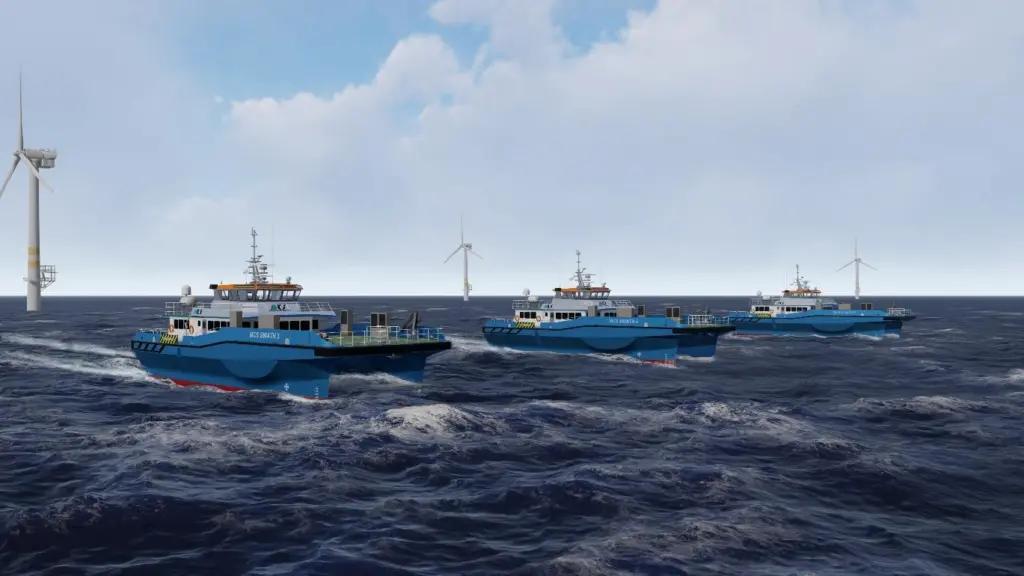
Ad Hoc Marine Designs (AHMD) has announced a new design of Small Waterplane Area Twin Hull (SWATH) crew transfer vessels (CTVs) for Maritime Craft Services (MCS).
Three vessels to the new design will be initially be built at Työvene yard in Finland.
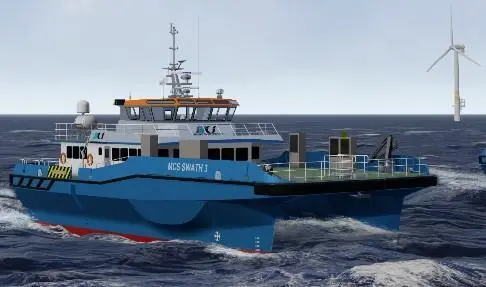
The SWATH design concentrates a large proportion of its floatation volume into bulb-like hull sections deep beneath the waterline.
These torpedo-submarine shaped flotation bulbs support the weight of the vessel through narrow, hydrodynamically efficient hull struts and in the case of the AHMD design have additional motion stabilisation with zero speed heave mode controllable fins .
The vessel’s engines, fuel and other heavy equipment are contained within the upper haunch region for easy access and maintenance from the main deck, allowing the struts to only require minimal wiring and plumbing to pass through them – thus enabling them to be made very narrow and hydrodynamically efficient.
The main advantages of a SWATH hull form over a more traditional monohull or catamaran are twofold – the efficiencies derived from a low waterplane area; and decreased vertical accelerations in rough sea conditions, which allow a wider window of operation with more comfort for passengers and crew.
Reduced waterplane area
The waterplane area is the part of a vessel’s hull that would be seen if it was sliced horizontally along the waterline. It is a major contributor to wave-making drag and hence a vessel’s overall drag, as well as the vessel’s natural period of motion.
A SWATH vessel design largely reduces the waterplane area by having only the two foil-shaped, knife-like support struts intersecting the waterline. A correctly designed SWATH hull offers significant CO2 reductions over a comparable catamaran or monohull, particularly at slow speeds.
At much higher speeds, monohulls and catamarans are able to use their hull shape to minimise resistance, whereas the efficiency advantages of the SWATH hull form begin to reduce with increasing speed.
It is also the reduced waterplane area that brings the improved seakeeping of a SWATH hull.
A vessel’s volume distribution and waterplane area are what causes it to heave and pitch as it passes through waves. Reduce the waterplane area and the designer reduces the heaving and pitching forces that waves can exert on the vessel.
Adding motion control fins to the SWATH hulls as in this design reduces these vertical accelerations even further, making for a supremely seakindly ride, at any speed and sea state.
Ad Hoc’s designs
While SWATH designs have been around for many decades, and even more on paper alone, the number of naval architects and shipyards worldwide that can routinely produce SWATHs that can deliver all the promised advantages can be counted on the fingers of one hand.
“For more niche designs such as SWATH hulls there is nowhere near as much prior art as there is for more conventional hull forms,” said John Kecsmar, naval architect at AHMD. “Ad Hoc Marine Designs has been involved in highly successful and proven SWATH designs for more than 30 years, and these range from 13m in size up to current SOV designs of 71m.
“Our back catalogue of designs spans from our first SWATH MV Patria in the late 1980s as well as the naval architecture design of the Lockheed Martin SLICE© SWATH, to our latest range of Typhoon Class of CTV SWATHs that are extending the North Sea operational window by more than three months per year.”
The vessels will carry 30 tonnes of deadweight along with 24 technicians in business-class seating with low risk of seasickness thanks to the extremely low motions of a SWATH hull form.
This new design is a larger version of the Typhoon Class of SWATHs currently operated by MCS, thereby pushing the safe operational envelope from their existing Hs(significant wave height capability) of 2.5m to 3m.
“The major advantage of the SWATH design is its superior response to high seas, allowing operation up to an extra 100 days a year over a conventional catamaran,” said Menno Kuyt, commercial director at MCS and operator of two AHMD SWATH CTVs.
The hull form also exhibits low resistance at low/loitering speeds and requires less than 50% of the power required by an equivalent size and displacement conventional vessel when operating at slow speed.