![MaritimeJournal[Seawork]](https://www.maritimejournal.com/wp-content/uploads/2026/09/MaritimeJournalSeawork.svg)


Right-side-up for Milford Haven pilot boat
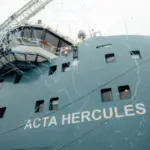
A new pilot boat at the UK’s largest energy port will bring stability, buoyancy and control, with a new hull form and other changes.
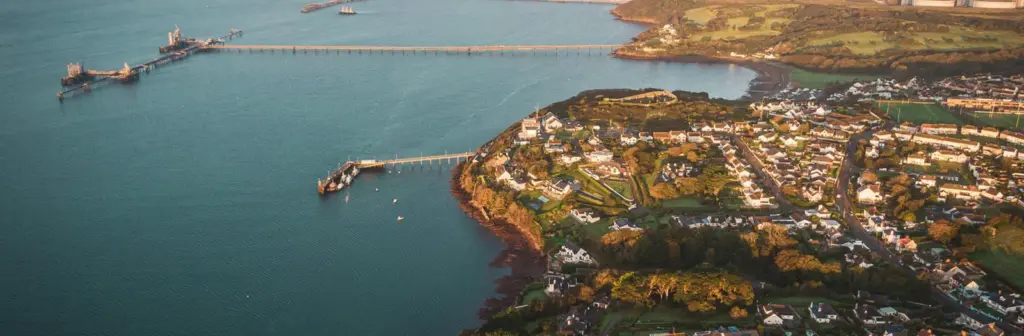
“Milford Haven Port Authority has (MHPA) used Camarc boats for many years – but since it operates in some of the most challenging pilotage conditions seen worldwide, it’s opted for our slower speed heavier steel designs in the past,” says Arran Roycroft, with workboat designer Camarc.
However, as the port is an international gateway that handles around a fifth of the UK’s energy cargo as well as bulk, breakbulk and heavy lift consignments, it has to be sure it can meet the needs of all its clients, no matter the pressure on ship moves or the weather.
This has led to it taking another look at all the requirements underpinning its pilotage services, says Roycroft.
“As a result, for this latest contract the port has elected to go with a larger higher speed solution, a 22m aluminium hull with waterjet propulsion that can deliver fully loaded speeds over 25 knots, offering more control in difficult seas.”
The design is developed from an already well proven series with vessels based in America and the Netherlands.
“This will be the first 22m waterjet pilot boat in the UK,” he says, because whilst propeller propulsion is the more efficient option, Milford Haven has both the will and the budget to provide a comprehensive offering.
Certainly, this type of propulsion offers some important advantages.
“Jets offer increased slow-speed manoeuvrability alongside the ship during boarding operations – and that’s what the port needs for its new heavy-weather boats. Debris can also be an issue for propellers, plus there’s the man-overboard safety as well.”
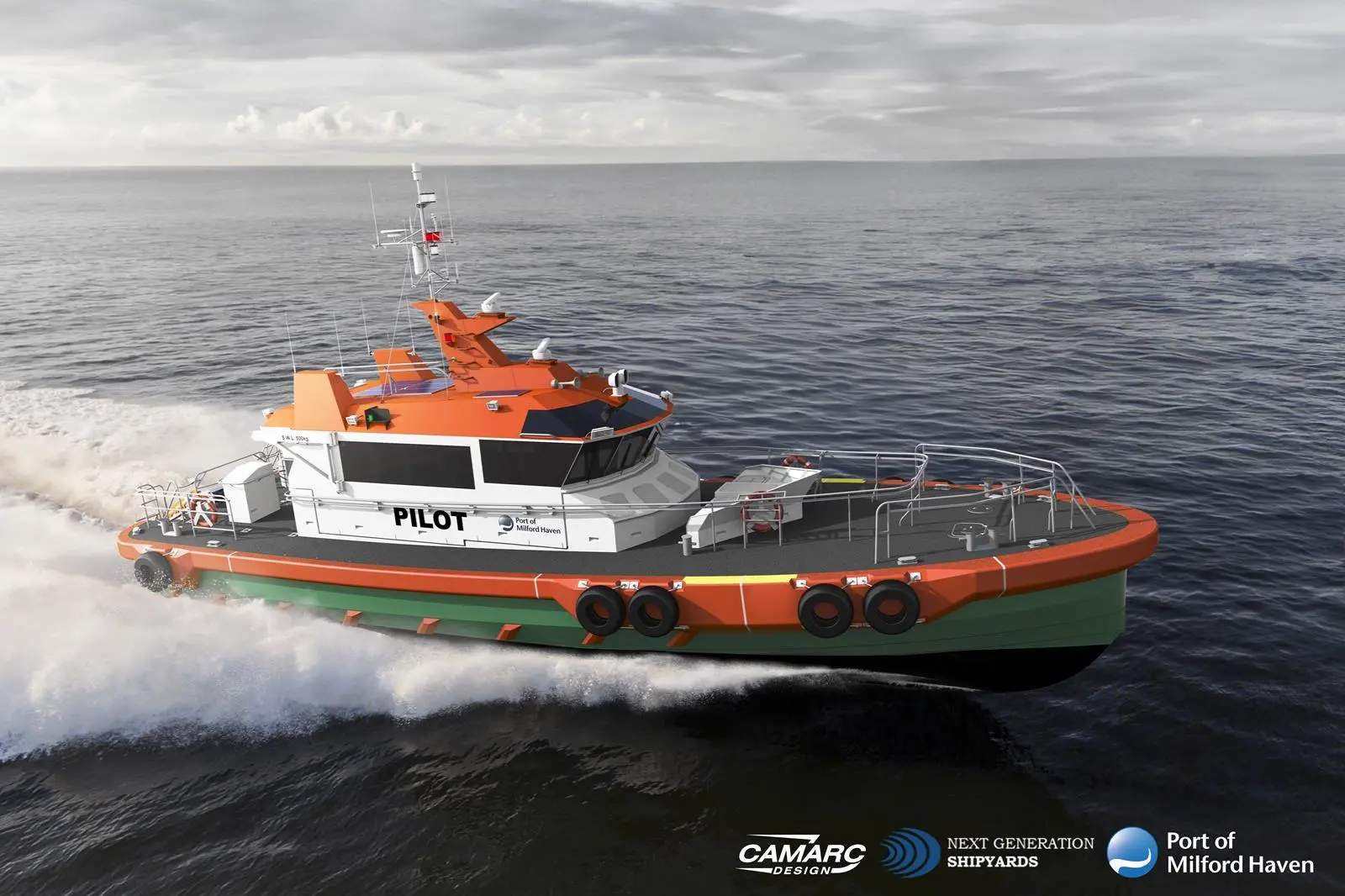
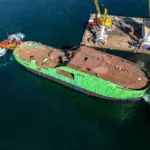
And worthy of note – this will also be the first Camarc self-righting pilot boat in the UK, Roycroft says.
Stability and buoyancy
“There’s a lot involved, but the core items are weight control to give you a low centre of gravity: that is the stability element. Then there’s the buoyancy in the wheelhouse when it’s inverted. This essentially gives you a lever which works in combination with the weight centre to turn the boat the right way up again.”
As a result, there are quite a number of systems to consider on the boat so that it doesn’t free flood when it stays in that inverted position – negating the superstructure’s positive buoyancy and the important ‘lever’ it provides.
That, in turn, requires special routing of the ventilation for the engines and subsidiary equipment, which are routed into what Camarc calls a ‘dry zone’ that remains free from flooding no matter its angle.
There’s more to the changes and challenges.
The pilot boat also takes advantage of Camarc’s latest hull design, says Roycroft.
“It’s not a radical departure and is more of an evolution. So, we’ve refined the forward area, extending the waterline length and making the forward sections finer.”
However, while this is brought to a vertical stem, it broadens as it reaches down into the water.
“That means we retain a curved forefoot which we see as being critical to achieving a balanced all-round sea-keeping capability. If you make that region too fine, then there’s the potential for it to lead to bow steering issues in following seas.”
While most new Camarc designs will now incorporate this hull form, for pilot boats there’s a special advantage since water pressure can bring two parallel hull sections together and keep them there.
“When you’re conducting pilotage operations, the curved forefoot helps the pilot boat hold an angle to the ship side whilst boarding as well as breaking away from the ship side once the operation is complete,” says Roycroft.
Even so, it was critical to make certain these changes did not compromise other just as necessary characteristics.
“With these refinements we also made a further 9% fuel saving and around a 10% reduction in slamming acceleration, measured over our already efficient platform,” he says.
The vessel, which will also take advantage of ride control to improve crew comfort, IMO Tier III engines and a nod towards future alternatives, is due to join Milford Haven’s pilotage fleet in 2025.