
22 day unmanned Atlantic mission accomplished
Sea-Kit’s 12m Uncrewed Surface Vessel ‘Maxlimer’ has returned to Plymouth after 22 days of remote survey operations on Europe’s continental margin.
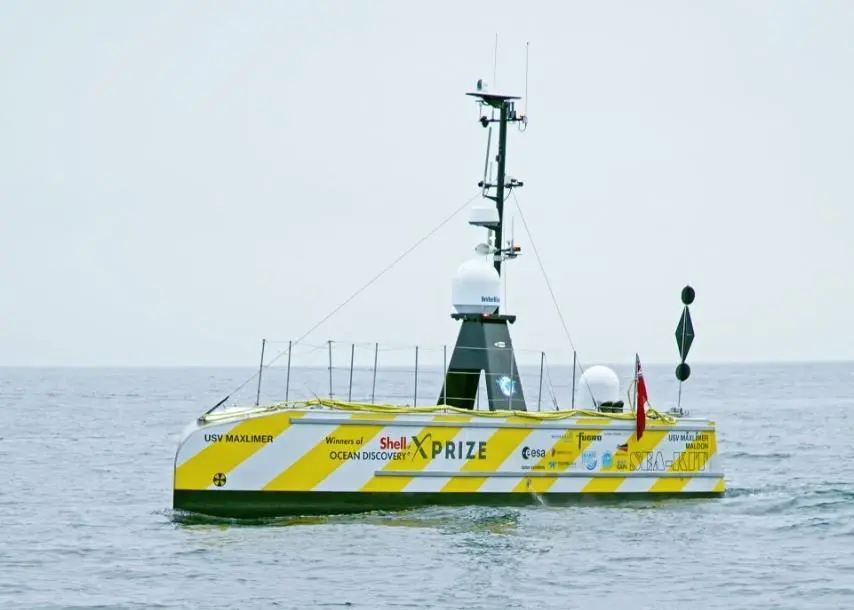
Since late July the USV has mapped over 1000sq km of ocean floor, controlled around-the-clock by Sea-Kit via satellite communications from its Remote Operation Centre in Essex. Notably, the uncrewed vessel returned to Plymouth with its fuel tank still around a third full.
The successful completion of this project is a major achievement for the British SME, clearly demonstrating the capabilities of their remotely-controlled USV design in terms of over-the-horizon (OTH) operation, endurance and ocean-going ability.
Peter Walker, Director of Technology at Sea-Kit, expressed delight at welcoming Maxlimer back to Plymouth: “It has been a tense but exciting few weeks. The project’s overall aim was to demonstrate the capabilities of current technologies to survey unexplored or inadequately surveyed ocean frontiers and we have absolutely done that. It is a ground-breaking achievement to prove true over-the-horizon capability and the team are elated to have successfully pushed the boundaries of our USV design once again.”
Named UTAS (Uncrewed Trans-Atlantic Survey) and co-funded by the UK Space Agency through the European Space Agency’s Business Application programme, the project was originally planned to be trans-ocean. However, due to travel restrictions and other planning complications resulting from COVID-19, this was ultimately not possible.
Sea-Kit worked collaboratively with a number of industry partners on the UTAS project. Fugro, Global Marine Group, Map the Gaps, Teledyne CARIS, Woods Hole Group and The Nippon Foundation-GEBCO Seabed 2030 project all played a part in its successful completion.
The Nippon Foundation/GEBCO Alumni through Map the Gaps, with their global distribution, allowed for 24 hour bathymetric surveying as they remotely operated the multibeam and ensured optimised data acquisition.
The proven ability to conduct remote survey operations with USVs has many beneficial applications across the offshore sector. For example, critical tasks such as trans-ocean cable route surveys, needed to meet the increase in demand for data communications, can be completed without risk to personnel and with significant savings on mobilisation and operational costs when compared to executing the same task with crewed vessels.
By Jake Frith