![MaritimeJournal[Seawork]](https://www.maritimejournal.com/wp-content/uploads/2026/09/MaritimeJournalSeawork.svg)





25 years of tugs and workboats
During the life of Maritime Journal enormous advances have been seen in the development of tugs and workboats and the companies that operate and build them.
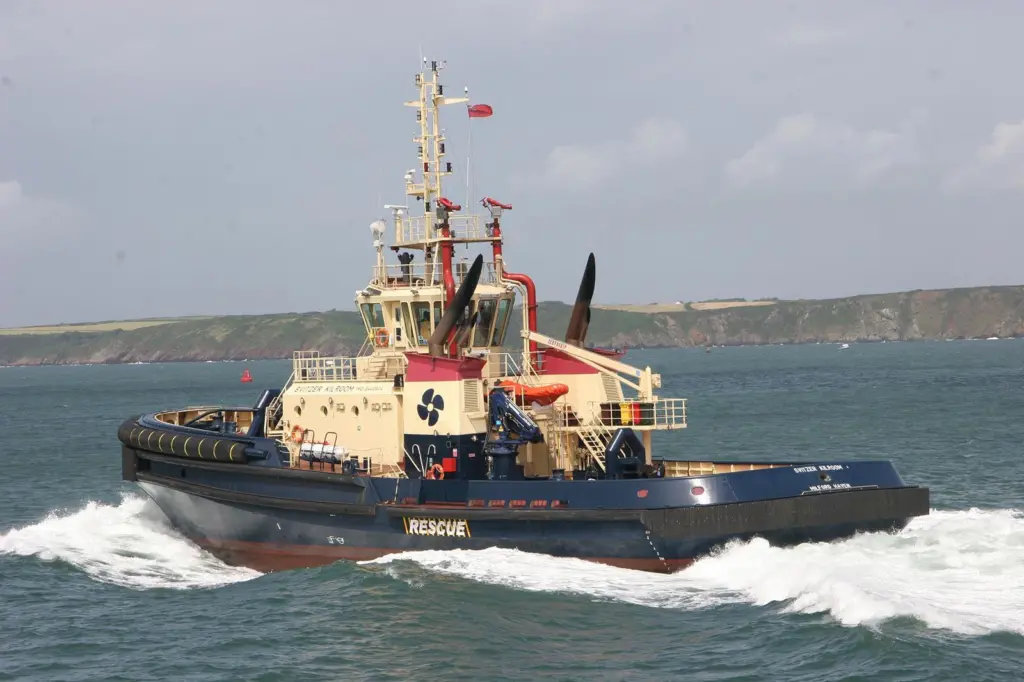
That is particularly true of the shiphandling and offshore sectors. Owners, operators, naval architects and specialist shipbuilders have worked hard to meet the ever changing demands made upon them in a highly competitive market. Regardless of the sector the rate of change in the technologies involved has been brisk and shows no sign of abating.
In 1987, the year Maritime Journal was first published, the shiphandling sector was still populated by large numbers of vessels with conventional single and twin screw propulsion systems. Alternative tractor designs, with both Voith Schneider and fully azimuthing propulsion units, were slowly gaining in popularity along with small numbers of azimuthing stern drive (ASD) tugs. Within the next couple decades the latter concept was to become the vessel of choice for the majority of operators.
As ships have grown in size, so has demand for ever higher bollard pulls and the ability to handle them in increasingly challenging conditions. Looking back 25 years, bollard pull figures of 25-35 tonnes were the norm in newly constructed shiphandling tugs. Since then bollard pull performance has continued to rise and new harbour tugs leaving the yards of specialist shipbuilders are commonly in the 45-65 tonnes range, with tugs designed for operation at oil and gas terminals achieving 65-90 tonnes. Tugs intended for escort work, first introduced in the early 1990s, are now being specified with a bollard pull performance of 90-110 tonnes, with line pulls of well over that figure towing in the indirect towing mode.
Achieving the high degree of manoeuvrability and stability required in such high powered vessels has been a major preoccupation for designers. The result has been a generation of extremely agile tugs capable of being rapidly positioned in order to apply power exactly where it is required and to operate in a ‘push-pull’ mode. Such performance has been made possible by adopting advanced hull designs and the use of propulsion systems capable of delivering thrust through a full 360°.
In the quest to achieve more efficient and inherently safe vessels for shiphandling and escort duties, a number of new concepts have emerged. To date, only the Rotor Tug, invented by KOTUG founder Ton Kooren, has made substantial progress. The first three examples of this new breed, RT Innovation, RT Pioneer and RT Magic, were introduced in 1999. The unique concept is based on a tractor configuration but with three fully steerable propulsion units, two forward and one aft, giving the tugs the ability to exert all of their 70 tonnes bollard pull whilst operating forward, aft and sideways. Rotor Tugs are growing in popularity and are now being constructed in significant numbers and to date vessels are in service in the Netherlands, Germany, France and Australia.
Among the most far reaching aspects of tug design and operation over the quarter century has been a proliferation of smaller ‘compact’ tugs and a general reduction in fleet size. Both are largely the result of tugowners’ determination to reduce operating costs and crewing levels in particular. In Europe a crew reduction of five down to two or three persons is common. Significantly smaller, more powerful, well utilised tugs are the order of the day in most fleets.
Readers of MJ will be well aware that the approach to design and construction has changed dramatically. Where practicable the emphasis now centres on standard designs suitable for series production. Netherlands based Damen Shipyards has used this philosophy since its inception in 1963 for tug and workboat design and construction. Interesting examples of their work regularly appears in these pages.
In 1993 Damen introduced its first standard built ASD Tug 3110, a product that sold over 100 vessels. A complete range of tugs is now available, from the compact 24m shiphandling ASD Tug 2411 with a 70 tonnes bollard pull to much large vessels such as the new ASD 3212 for terminal duties.
Damen Shipyards build tugs of all types in large numbers in the Netherlands, Russia, Poland, Romania, South Africa, China and Viet Nam. Many are built to order but a significant number are built for stock, enabling vessels to be purchased and delivered at very short notice.
Tug designs from the naval architects and consultants Robert Allan Ltd (RAL), based in Vancouver, are frequently mentioned in Tugs & Towing. The prolific output from this famous designer is now a global business. Design packages are produced for the construction of well researched standard tugs by any competent specialist shipyard. In one year alone an estimated that 200 tugs were being built worldwide to a wide range of RAL designs.
A major preoccupation for owners and designers is meeting the environmental targets gradually being introduced in ports around the world. Owners are still divided on the most appropriate fuel and technology. Diesel electric, diesel electric + batteries, or changing to LNG fuel for lean-burn engines are the main options. Two true ‘hybrids’ are in service in the USA and one (a Rotor Tug) in Europe along with two advanced diesel electric tugs in Svitzer’s Scandinavian fleet. Tugs& Towing will continue report on the advances.
In current day parlance the term workboat covers an even greater range of vessels than it did 25 years ago and includes among others, Rigid Inflatable Boats (RIBs), pilot boats, survey vessels, crew boats and a whole population of craft employed by the marine construction and dredging industries.
Among the harbour support craft a whole new generation of high performance pilot boats have been developed and several major suppliers such as Safehaven and Mustang have emerged. Operators demand, robust, fast, economical vessels capable of the safe delivery of pilots under more demanding conditions that ever before. The RIB has come of age and development continues, enabling what has become a highly sophisticated vessel performing duties as diverse as harbour service and patrol launches to small inter-island ferries.
It is the marine construction industry that has seen the greatest transformation in both floating plant and expertise. What was once an industry configured mainly to support dredging, reclamation and port construction has reinvented itself to take on new roles in shallow water oil exploration, offshore power generation and support services for both.
Also frequently described as workboats is a whole generation of shallow draft tugs, such as the Damen Shoalbusters and anchorhandling vessels from the Kooiman Shipyard have evolved not only to provide a wide range of support services on site but equipped and classed to carry out deepsea towing operations. Many similar European built vessels have found work in the Caspian Sea and similar locations.
A vessel that has perhaps seen the biggest transformation over 25 years is the ‘pontoon style’ multipurpose work vessel. It was originally a very simple craft of 14-20m LOA and 200-600 bhp configured for port construction and dredging support services. By comparison, a current state of the art, triple-screw, shallow draft vessel of 35m LOA by 15m beam will have a bollard pull of over 50 tonnes and, thanks to its massive reserve of buoyancy, a lifting capacity of 200 tonnes. In some vessels Dynamic Positioning systems are fitted, along with the requisite additional thrusters, a facility unthinkable in this type of craft 25 years ago. Such vessels are ideally suited to support wind farm construction.
In just a very few years the fast growing breed of high speed wind farm support vessels has appeared all round the coasts of Great Britain and western Europe. The installation and subsequent operation of offshore wind farms has generated a massive demand for purpose built craft to carry maintenance crews to individual wind turbines and other offshore installations.
Maritime Journal has been covering the growth of this new workboat sector since its inception. The vast majority of these fast support craft have been purpose designed catamarans of between 15 and 20m, constructed in marine grade aluminium alloy and fitted with twin water-jet propulsion systems and capable of 20-26 knots. A leader in the field has been the UK boatbuilder South Boats Special Projects, recently taken over by Alicat Workboats. Turbine Transfers, a wholly owned subsidiary of the Holyhead Towing Company Ltd, entered the wind farm sector at an early stage and now has a large fleet of purpose built support craft.
By Jack Gaston
Related Articles
 SPECIAL REPORTS
 TUGS & SALVAGE
 EQUIPMENT