![MaritimeJournal[Seawork]](https://www.maritimejournal.com/wp-content/uploads/2026/09/MaritimeJournalSeawork.svg)




Damen to build its first ever hybrid for Iskes
Damen Shipyards has been awarded a contract to build its first ever hybrid tug a by Iskes Towage & Salvage of Ijmuiden in the Netherlands.
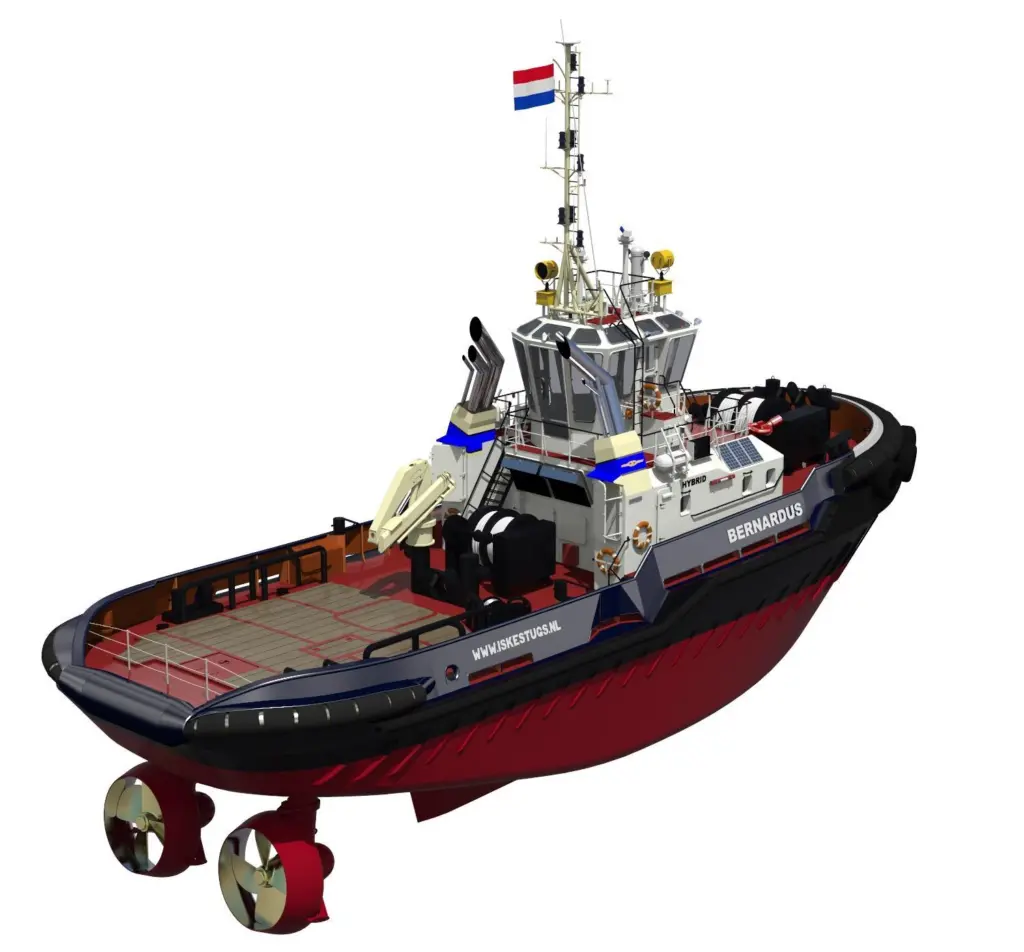
The tug will be a ‘Hybrid’ version of the popular ASD Tug 2810 with a bollard pull of 60 tonnes. The signing ceremony took place at the Offshore Energy event in Amsterdam on 23 October. Depending on the work in hand, the tug will be able to operate in the diesel-direct, diesel electric or battery electric modes and be capable of average fuel savings of between 10% and 30%, cutting local emissions by 20% to 60%.
Established in 1928, Iskes has been operating a conventional Damen ASD Tug 2810 since November 2011. Iskes owner and managing director Jim Iskes said: “We already had a very good experience with our existing Damen ASD Tug 2810, which is ideally suited to Amsterdam. We are very happy with its performance and so are the crew. It was a logical move to choose Damen for the Hybrid version. Damen welcomed our input and recognises that we know what we are talking about. Many of the things we require are not standard but Damen has worked with us to incorporate them.”
Damen design and proposal engineer Erik van Schaik stated: “In the past many green solutions were simply too expensive for the tugboat market. We were very mindful that this vessel had to cut fuel and emissions, but at the same time it had to be positioned at an attractive price for the market. We wanted to make being green commercially attractive too.
The Hybrid represents an extra investment of approximately 10% more than the regular ASD Tug 2810.”
Damen and Iskes, along with industry partners, have been working on environmentally friendly solutions for many years. Joint managing director Ronald Vergouwen explained: “Port authorities and many of our customers are looking for a greener way of running their business. Cuts in emissions are very important, particularly in ‘port cities’ such as Amsterdam. And in the future there is likely to be increasing regulation about emissions in ports. The port and city have welcomed our introduction of the Hybrid. It is great to be at the forefront of this green initiative.”
Iskes had previously been working on its own green solution together with Offshore Ship Designers, looking into the potential of a hydrogen hybrid tug.
Earlier this year Damen and its partners completed the three year ‘E3-project’ during which a conventional ASD Tug 2810 operating in the port of Rotterdam was monitored. The partners wanted to gather data on a typical harbour tug profile and see what was possible in terms of emissions and fuel reductions. During the monitoring period the E3 team found that the average load profile showed that tugs are running inefficiently for most of the time. For up to 80% of the day they can be running free, station keeping, under very light loads, making them less environmentally friendly and leading to higher operational costs.
The diesel electric propulsion system in the ASD Tug 2810 Hybrid delivers enough power to prevent the main engines of the diesel direct propulsion system from frequently running idle or at low loads. During the E3 project Damen’s Research Department made a computer simulation model to analyse various propulsion modes. Damen can use this simulation model to calculate the exact savings that are possible from the Hybrid in each individual case, based on the tug’s operating profile and running hours.
Based on the findings and after considering various battery, LNG, hydrogen and compressed natural gas solutions, the Hybrid emerged. NOx, HC, CO, SOx, CO2 and particulates all decrease substantially, along with fuel consumption.
Where possible Damen will use tried and tested technology for the ASD Tug 2810 Hybrid. An additional clutch and a 230kW water cooled electric propulsion motor will be added between each main engine and propulsion unit. A separate 695kW diesel engine is installed driving a generator to supply the electric propulsion motors or power the 1,200 m3/hr fire-fighting pump. That engine will be fitted with an exhaust gas after-treatment system incorporating a Selective Catalytic Reduction (SCR) system, a Diesel Oxidation Catalyst (DOC) and a Diesel Particulate Filter (DPF). This combination is fully compliant with the IMO Tier 3 regulations being introduced in 2016.
The Iskes Hybrid will also incorporate batteries, a feature that Damen offers in the standard Hybrid and the owner is keen to have. A 100kWh battery pack will allow the vessel to be alongside the quay for eight hours and sail for an hour at up to 5 knots, representing an anticipated 10% to 15% fuel saving.
The Damen ‘standard’ version will also incorporate solar panels fitted to the deckhouse on the standard Hybrid version and used to charge 24V battery packs for starting the engines and emergency power for navigation lighting and radio equipment. Other green initiatives on the vessel include LED lighting and a special paint coating, making the vessel more environmentally friendly and clean for at least five years.
Iskes’ ASD Tug 2810 Hybrid will be customised, with equipment for anchorhandling, double-drum winches fore and aft, wooden deck protection and an open stern with towing pins and forks.
No delivery date has been quoted but Damen reports that a second vessel will also be built for ‘stock’.
Related Articles
 SPECIAL REPORTS
 TUGS & SALVAGE
 EQUIPMENT