![MaritimeJournal[Seawork]](https://www.maritimejournal.com/wp-content/uploads/2026/09/MaritimeJournalSeawork.svg)




Closing and opening doors at Maasvlakte 2
A number of milestones have passed in recent months as Rotterdam’s major port development Maasvlakte 2 moves ever closer to opening for business and welcoming its first customers in 2014.
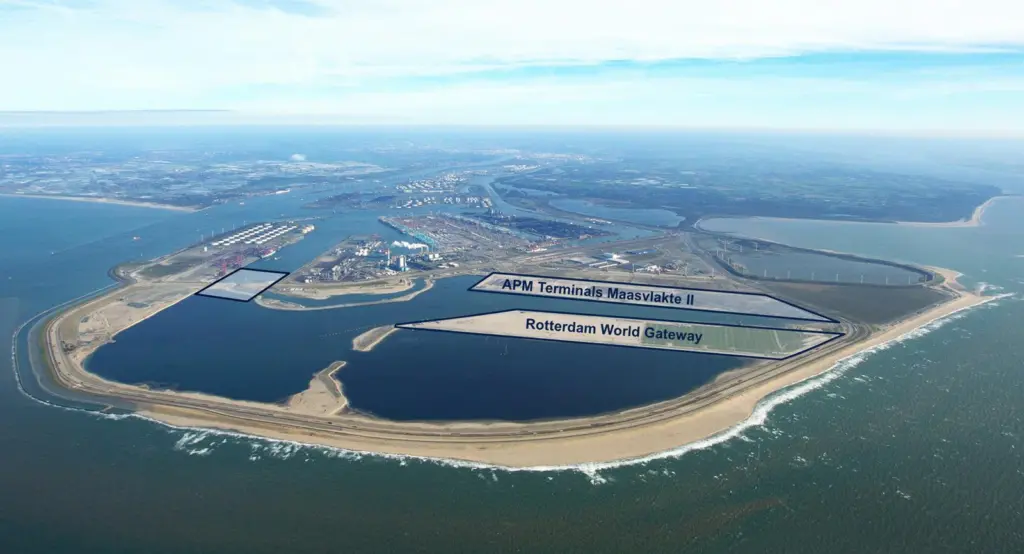
The shape of The Netherlands coastline changed forever in May 2009 when the first visible signs of the 240 million m3 of dredged sand for phase one of Maasvlakte 2 first appeared, at low water, from what was then the coast at Port of Rotterdam Authority’s (PRA) FutureLand Maasvlakte 2 visitor centre. A year later, eleven dredgers from the fleets of Boskalis and Van Oord transported 3.8 million m3 of sand to Maasvlakte 2 in just one week, a world record. Just two years later, the open sea was no longer visible from the same viewpoint, now several kilometres inland. Steady progress is now being made turning what initially were acres of deserted pristine sand into container terminals for Maasvlakte 2’s first tenants, APM Terminal Maasvlakte II (APMT MVII) and Rotterdam World Gateways (RWG).
Until recently, activity has taken place within the confines of a building site. Two recent land and sea milestones mean however the port’s existing users can now actually experience the layout of the new territory and adapt to the changes. Beware anyone who relies on an out of date satnav.
BREACHING THE DAM
In July 2012, and amid much publicity, what was described as the ‘back door’ to Maasvlakte 2 was shut when dredgers and landside diggers closed the gap in the outer seawall (MJ August 2012), the subsequently enclosed area then becoming an 800 hectare inland lake. This allowed work to continue on the remaining road and rail infrastructure connections (adjacent to the now completed seawall) to businesses to the north-west of the development. Once completed, contractor PUMA (Boskalis and Van Oord) were in a position to open the ‘front door’ by cutting through the existing Europaweg access route at the end of the Yangtzehaven. The inland lake is tidal once again, sea access to Maasvlakte 2 now being through the Yangtzehaven.
Prior to the actual day of breaching (25 November 2012), the cutter suction dredgers Edax (Boskalis) and Zeeland II (Van Oord) working from each side had gradually removed the bulk of the dam. PUMA adopted a method of dam breaching, described as a ‘seldom occurrence’ using the tidal cycle to control the rate of transition from non-tidal to tidal for the enclosed lake. With a 2m range in the Yangtzehaven, neap tides were chosen when tidal differences were smallest, allowing as much control as possible. Between high and low water on the day, the dam was excavated to approximately 50cm above NAP (the level of the interior lake).
On the incoming tide, water overflowed the dam, washing increasing amounts of sand into the enclosed lake, in turn creating a wider and deeper opening. The rate of flow was initially greater due to the small size of the opening and the two dredgers had to be securely anchored throughout. The flow rate reduced as the gap increased in size, eventually equalising between the new harbour and the sea. The sand carried into Maasvlakte 2 is being used to raise the levels of land within. Eventually this end of the Yangtzehaven will be 600m wide and 20m deep with Maasvlakte 2 on schedule to be able to receive ocean-going ships in the first quarter of 2013. PUMA will have then completed all of its main activities at Maasvlakte 2. The remaining sub-projects, primarily construction of road and rail links, will involve different contractors already selected by PRA.
TERMINAL CONSTRUCTION
In 2012 the completed quays and associated landside areas were handed over to the first two tenants of Maasvlakte 2, APMT and RWG.
APMT are on schedule with construction of their container terminal, the first phase covering 86 hectares with an annual capacity of 2.7 million TEU. The gantry cranes and ground equipment have now been ordered, the first crane components due to arrive from China during the spring of 2013. ‘Dry tests’ will follow, then testing with containers but no ships and finally full volume testing from vessels by mid-2014, with the opening of the terminal planned for November of that year.
Safety, sustainability and productivity are key words in APMT’s plans for Maasvlakte 2 and while automation is now commonplace within container terminals it will be taken a step further at Maasvlakte 2. The terminal will be capable of handling future ships with projected capacities up to 18,000 TEU, including Maersk’s new Triple E class container vessels. The subsequent height and size of gantry cranes has led to terminal operators reportedly reviewing traditional methods of operation, including the driver riding in a cab actually on the crane. Shippers nowadays demand faster container transfer speeds and the effects on crane driver’s bodies have come under the spotlight. APMT’s gantry cranes at Maasvlakte 2 will therefore be operated remotely by crane drivers on the fourth floor of a nearby building using screens and joysticks.
Further efficiencies will be gained with the lift automated guide vehicles, capable of carrying two containers at a time to storage racks, before being transferred to either storage areas or rail and road transport terminals by rail-mounted gantry cranes. All of this will be carried out automatically using remote sensors and GPS. The sustainability theme involves everything at the terminal eventually being electrically powered. When the battery voltage of lift AGVs drops, they will move to one of two robotic battery exchange stations where the batteries will be exchanged automatically. APMT state the terminal will be the first in the world to be operated with zero CO2 and NOx emissions.
Work on RWG’s terminal on the opposite side of the Prinses Amaliahaven is also progressing well, paving having commenced in summer of 2012. Covering an area of 108 hectares, an 1,150m deep-sea quay and 550m inland shipping quay will ultimately provide an annual capacity of 2.35 million TEU. Landside equipment will include eleven deep-sea vessel cranes, three cranes for inland vessels and around 50 stacking cranes and 60 AGVs. The cranes are due for delivery later in 2013 and as with APMT the terminal is on schedule to open for operations in the autumn of 2014. For PRA, a modal shift for container transport from road to rail and inland shipping has been a priority for Maasvlakte 2 and work is continuing at both terminals with the associated rail infrastructure.
INFRASTRUCTURE CHANGES
Breaching the dam has resulted in major changes to the road and rail layout on the peninsula. Road connection to businesses beyond the Yangtzehaven is now via Maasvlakteweg, the new 13km access road adjacent to the seawall, completed after the closing of the gap, and prior to the removal of the dam at Yangtzehaven. Maasvlakte 2 also now has over 12km of railway track, commissioned by PRA, ProRail, Keyrail, the Ministry of Infrastructure & Environment and contractors BAM and Volker Wessels.
Changes to the road layout around Mississippihaven and the Slufter are also being made in preparation for when container terminal operations get into full swing. Previously, road traffic serving the existing APM and ECT terminals and the Euromax terminal and businesses beyond used a traffic light controlled junction on the Europaweg. Euromax traffic no longer uses this route but road traffic to the second APM terminal will be via this junction and to prepare for this, contractor MNO Vervat will construct a flyover junction to be known as Coloradoviaduct, replacing the current junction. Another new junction, now completed, is the dune viaduct, Prinses Maximaviaduct,
Visitors to FutureLand will be familiar with the adjacent Prinses Margriethaven. In 2013 this will become a harbour for nautical service providers including tugs and boatmen along with waiting berths for inland shipping. Expansion of a port on a scale such as Maasvlakte 2 naturally requires adequate emergency services provision. Brandweer Rotterdam-Rijmond (the Rotterdam fire authority) has long had a central presence at Maasvlakte (1). With the imminent increase in activity from Maasvlakte 2 and changes to road access to businesses north of the Yangtzehaven, a new fire station has been built close to the areas of activities, including Euromax Container Terminal and Maasvlakte Olie Terminal.
Compensatory features for the effects on nature and the environment from Maasvlakte 2 have been a top priority since the very start. It is a testament to the efforts made by PRA along with stakeholders, NGOs, authorities and special interest groups that provisions for protection of nature and the recreational interests of the local population have resulted in vast improvements over what was previously in place. Three new beach zones for bathers and sun-worshipers, including provision for 1,500 car parking spaces were completed in time for the 2012 summer season, a year ahead of schedule. To the south, adjacent to the Slufter is a nature beach. Around the more exposed north-westerly contour of the seawall a 5km long sporting activity beach for use by kite surfers, kiters and fishermen has been provided, along with car parking facilities.
By Peter Barker
Related Articles
 FEATURES & VIDEOS
 MARINE CIVILS
 OTHER NEWS