![MaritimeJournal[Seawork]](https://www.maritimejournal.com/wp-content/uploads/2026/09/MaritimeJournalSeawork.svg)




River transport begets Blackfriars transformation
A transformation that many Londoners have been looking at with interest is the Blackfriars Bridge and Network Rail redevelopment, but even those watching may have underestimated the pivotal role of the River Thames.
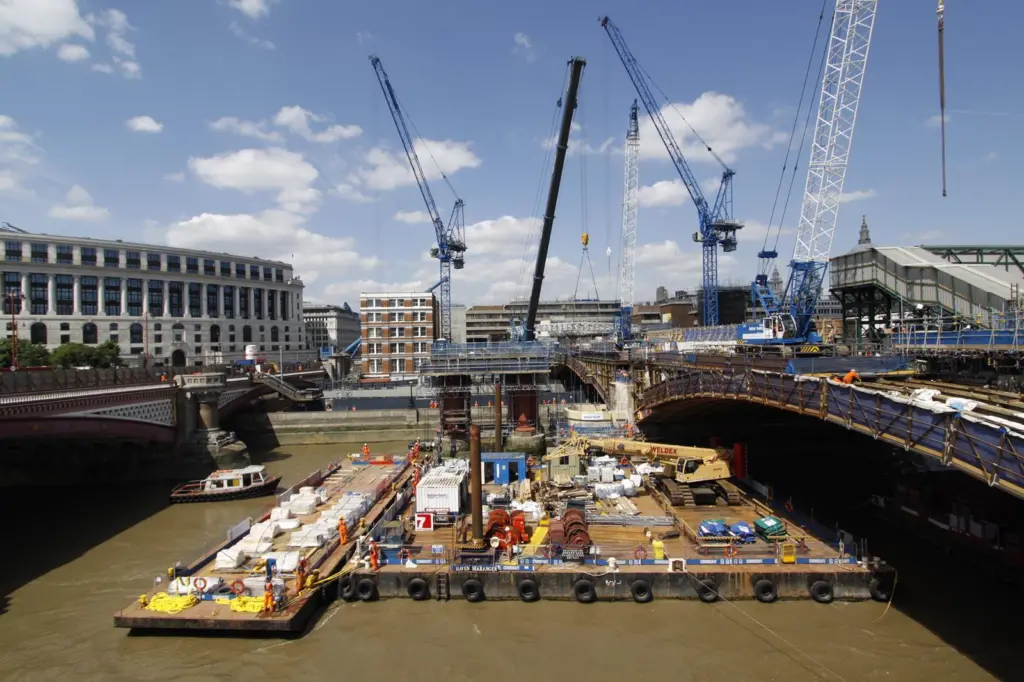
It has been a truly massive project, taking the last three years. Chris Livett of Livett’s Launches said, “In total Livett’s moved about 80,000 tonnes of construction material to and from the site by boat and barge, but using the road would have been nigh on impossible because of the shapes and sizes of these pierces of kit.”
Balfour Beatty was the main contractor tasked with carrying out the design developed by Jacobs and Tony Gee and Partners. It meant widening and strengthening the bridge and building a new Network Rail station across it, with realigned tracks and covered platforms spanning the river Thames. The new station roof, built on top of the bridge, is currently being fitted with 4,400 solar panels to create London’s largest solar array and a new southern entrance is giving passengers access from the south side of the river for the first time.
Chris Evans, Balfour Beatty’s project director pointed out that it was a tricky job, made trickier by the need to keep the station open virtually throughout the programme to minimise disruption. Mr Evans said, “It’s like changing the engines on an aircraft mid-flight. You’d rather not do it that way, but you’ve got to keep the passengers moving.”
So, a lot of the work has been done at night and over weekends. And of course, to stop the incoming fabrication pieces from jamming the roads, the river was the obvious choice.
The project, amongst other things, involved renovating the bridge and letting it out to make it 6m wider as well as lengthening the station until it ran the length of the bridge. Mr Livett explained that the start of the project involved fetching pontoons and crane barges along with scaffolding while the Port of London Authority (PLA) put in a bespoke mooring system designed by Livett’s that included ten mooring buoys and anchors along with a number of mooring points fitted to the bridge.
The company made good use of some of its vessels, four boats in particular, Meridian, Eddie C, Alfie and Artemis along with a tug called Steven B which was used to tow the big flat top pontoons into position next to the bridge. Livett’s also chartered the multi-cat Jessica S along with other support vessels including the Horton and various flat-top pontoons. These were used as a base for the workmen as well as storing equipment. Eddie C, a neat 10m tug, was particularly useful, as it has a low freeboard and central cabin allowing for all round viewing and, outside, an accessible deck area.
However, the next phase meant transporting downriver a number of the main, structural elements, six big 25 tonne rib sections that make up the ‘skeleton’ of the bridge.
These rib sections were moved on flat-top pontoons like Devon and Searider and transported three ribs at a time from a base at Thames Wharf Silvertown. On getting to the bridge these rib sections needed to be tandem lifted by the onsite mobile cranes. There were also pre-cast station platform units and wall sections to move which were handled by the Port of Tilbury.
Andy Rex of the Port of Tillbury explained, “The lorries turned up over a two day period every few weeks and we craned the pieces straight off and loaded them directly onto the pontoon.” The process “was helped enormously” by Balfour Beatty. “Balfour gave every piece a sequential number and a very detailed loading plan. After all, while we have a lot of room here, at the build end there’s no chance of going back and saying, ‘lets do that one first instead’.”
Work started first on the east side, extending it by two rib sections outward, while the west side had to have a lot of the framework and deck plates taken away. “We would get something around 150 tonnes of deck plates moved in one hit”, explaind Mr Livett.
“This wasn’t easy, especially since there are 7m runs on the tide, he aded. “We also barged in two parcels of 3,000 tonnes of precast platform for the bridge roof sections.”
Further, Blackfriars almost abuts the old St Pauls railway bridge, which also needed major work as around half an abutment had to be rebuilt with precast concrete sections, creating a lot of scrap that needed to be barged away.
Mr Livett continued, “We had to cope with a live railway, running above, and high voltage lines. At the back of us on the shoreside we had the Embankment, one of the busiest roads in London.
However, what needed special consideration were the fibre optic cables. These feed half the City of London’s dealing rooms, so there was the possibility of bringing the UK’s financial sector to a grinding halt. On top of this there is a river with members of the public both sailing on it and crowding the foreshore. Captain Terry Laurence of the PLA added that despite all this pressure, the PLA could only shut a single navigable arch during the day and two at night, which meant logistics had to be very tightly choreographed.
“It’s a little like working on a motorway. From the point of view of the contractors it would have been so much simpler if we could have just closed the whole river entirely and they could have worked on it in one piece”, said Capt Laurence. But the river is, after all, a highway that needs to keep flowing, literally and metaphorically.
Taking a step back and looking at the project as a whole, it’s remarkable that it has been done with so little disruption. There have been money issues, with the complete Blackfriars project running well over budget but, says Network Rail, much of this was to do with scope updates. For example, separate Network Rail and London Underground stations were needed on the north bank as well as increasing the number of lifts from two to four to cope with expected growth in passenger numbers. The station’s roof also had to be changed after the project team could not make the original Vierendeel truss work with the solar panels, resulting in a deeper roof truss being introduced.
However, Capt Laurence added that the operation has been “a big success”, as the feat of moving most of the build materials on the river shows what can be done “in an environmentally friendly, and cyclist friendly, fashion.”
Related Articles
 FEATURES & VIDEOS
 MARINE CIVILS
 OTHER NEWS