![MaritimeJournal[Seawork]](https://www.maritimejournal.com/wp-content/uploads/2026/09/MaritimeJournalSeawork.svg)





A brief look at Aiviq
The world’s media focused on Alaska at the beginning of the year when the Royal Dutch Shell ‘Arctic’-class drilling unit Kulluk was driven aground by violent weather on the southeast shoreline of nearby Sitkalidak Island on December 31, 2012.
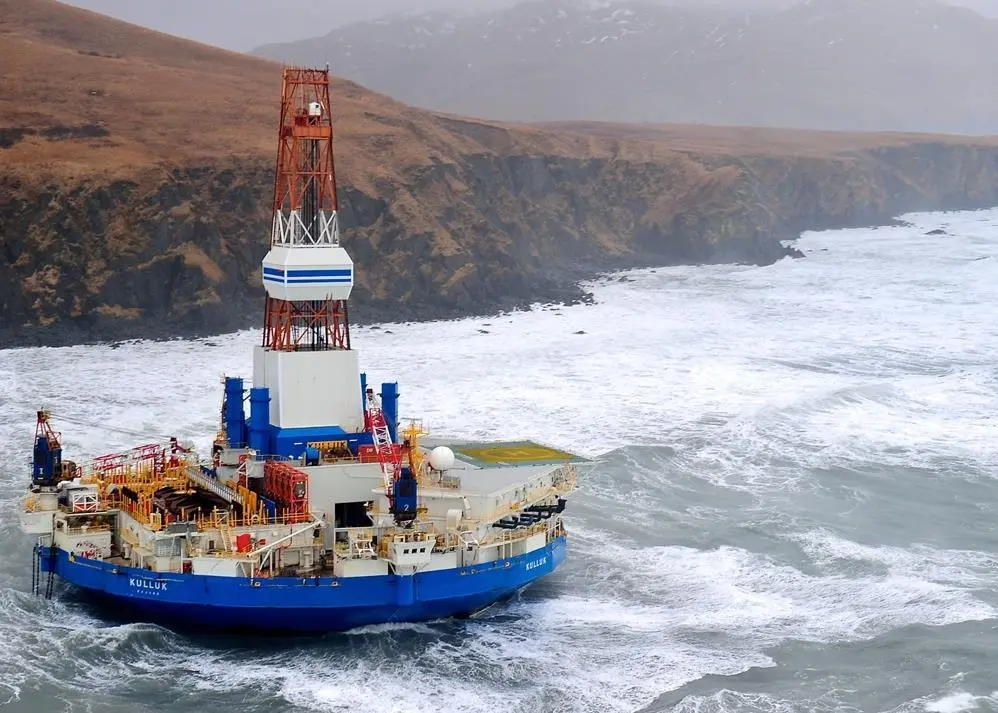
The massive rig was under tow from Alaska to Seattle, Washington state for maintenance and repairs. After several anxious days for the Unified Command in charge of the operation, Kulluk was subsequently refloated and towed to a safe harbour on Kodiak Island in the Gulf of Alaska, where it was to undergo a thorough safety assessment before resuming its journey south.
The lead tug at the time, which suffered machinery problems and towline failures during the unfortunate and drawn out incident, was the Aiviq, a highly sophisticated vessel of which little was known outside North America.
Aiviq is a unique icebreaking, anchorhandling tug supply vessel owned and operated by Edison Chouest Offshore, under contract to Royal Dutch Shell and is certainly the largest and most powerful vessel of its type in the USA. The name Aiviq means walrus in the local Arctic dialects.
The vessel was completed in 2012 by North American Shipbuilding, involving yards at Larose, Louisiana and LaShip in Houma, at a reported cost of $200m. Aviq was built to an in-house design produced by Chouest and is the largest and most advanced vessel ever built by the company. It was intended for exactly for the duties it was engaged in with the Kulluk.
Aiviq is a large vessel of 110m long overall, with a beam of 24.4 m, a depth of 10.4m, a draft fully laden of 8.6m, and weighing in at 4,129 dwt. The hull construction complies with the American Bureau of Shipping Ice class A3 and incorporates double skin tanks. As an anchorhandling tug and supply vessel, large towing/anchorhandling winches are located amidships along with chain lockers and storage tanks for both liquid and dry bulk cargo.
A powerful propulsion system comprises four Caterpillar C289 12 cylinder medium speed diesels, each generating 5,440 bhp at 1,000rpm. The engines are coupled in pairs, through Flender gearboxes, to drive the twin 4.5m diameter Schottle controllable pitch propellers, rotating in fixed nozzles. This arrangement gives the tug a bollard pull of 200 tonnes and a free running speed of 15 knots in open water and 5 knots in ice of up to 1m thick.
Aiviq has three bowthrusters, including one retractable azimuthing unit, and two transverse stern thrusters, which along with main propulsion system and rudders can be controlled by a Dynamic Positioning system.
With a vast amount of electrically powered equipment onboard the vessel has a huge appetite for power, which is supplied by two 2,000kW shaft generators and four Caterpillar 3512 C auxiliary generators of 1,700kw each.
Aiviq is a complex and highly sophisticated vessel whose primary role is towing and anchorhandling for drilling rigs in Arctic conditions but among the other tasks can be added fire fighting, pollution control, rescue and emergency response. Not a vessel to be dismissed lightly.
Related Articles
 SPECIAL REPORTS
 TUGS & SALVAGE
 EQUIPMENT