![MaritimeJournal[Seawork]](https://www.maritimejournal.com/wp-content/uploads/2026/09/MaritimeJournalSeawork.svg)





Hot issues for cold ironing
The Finnish Port of Helsinki’s recently installed ship to shore cold ironing station isn’t new tech that’s being exploited, its old tech that’s already got a good, mature base, and evidence that eco-projects are not all about being ‘first’. ?
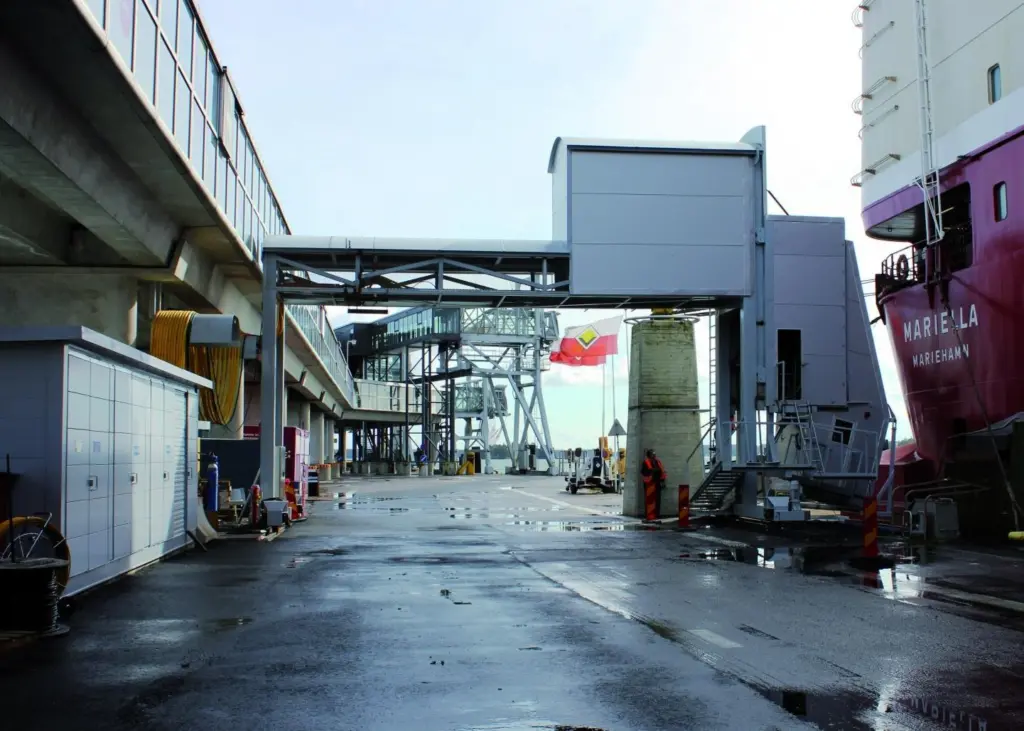
The quay at Katajanokka has been a standard part of the route for Viking Line’s ships Mariella and Gabriella for some time but a recent cold ironing system means auxiliary engines don’t need to run at berth to keep the power on, minimising noise and emissions. This is a point of major concern when a harbour is sitting in the lap of residential areas.
However, the scale of the project and its economic rationale has taken a great deal of weighing up. Aino Rantanen, the port’s environmental manager explains: “There’s still no standard for the industry and whatever you put in most probably won’t fit the next ship, they are all so individual, and any standard is some way off as it would be decided by the ships, not the ports.”
There is also a power issue. “You can’t just drop this kind of thing in anywhere since the power draw is so huge, she says. “I’ll admit that even though we had done the calculations and were certain that the city’s grid could handle it, I had my fingers crossed the first time we turned it on in case we blacked out an entire area.”
The draw comes to something like 10MW in total, before transforming to the required 50Hz frequency for the vessels, roughly the total electricity consumption of a mid-sized town and even the transforming station takes up enough room to fit a small flat.
However, the economic case was won by a number of very specific factors. One is the established nature of the ship calls, secondly the ships are staying overnight, long enough to make sense of powering down the engines. Thirdly, this pair of ferries had exactly the same technology at the other end of the route in Stockholm, so Helsinki could take advantage of a proven, worked out design. Even so, the construction of the whole system has cost approximately €1m plus another €400,000 for incidental items like asphalt.
There are twelve, heavyweight cables altogether, running from two efficient transformers which can provide up to 4MW of electricity. Although people talk about ‘plugging in’, in fact it’s a technology heavy operation, needing an extensive amount of cabling and backup systems and a large, automatic shore power transformer substation, as well as a cable transport device that moves on a rail gantry system that passes over the access road.
The technology is necessary to minimise the possibility of accidents, but it also means that the ship’s electrical officer can use a radio-controlled connection device to guide the transport device to the ship’s service hatch inside 15 minutes without needing the crew onshore to lend a hand.
Related Articles
 FEATURES & VIDEOS
 MARINE CIVILS
 OTHER NEWS