![MaritimeJournal[Seawork]](https://www.maritimejournal.com/wp-content/uploads/2026/09/MaritimeJournalSeawork.svg)






Germans tackle last hurdle on canal to Berlin
Twenty three years after Germany was reunited, work has begun on construction of a second lock at Zerben, the last major civil engineering project on the renovated Elbe-Havel Canal (EHK) linking the east and west German waterway networks.
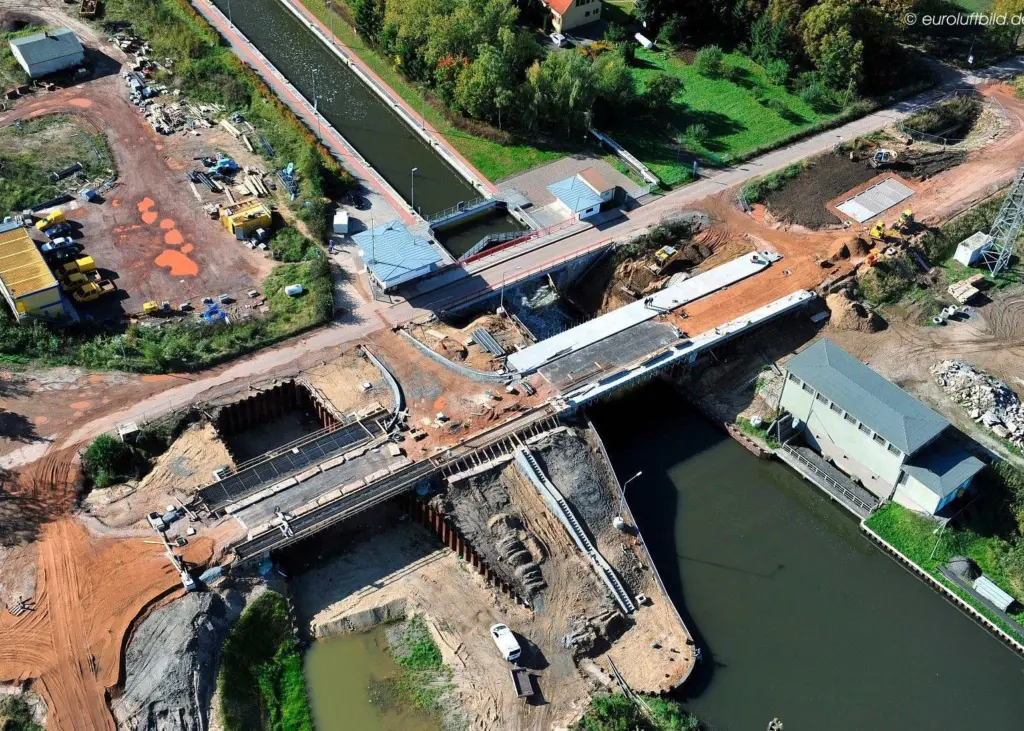
The project is part of the €39.4bn German Unity VDE transport programme which began after the fall of the Berlin Wall in 1989. The aim of 17 individual giant projects in the VDE programme was to link the long disrupted and often much neglected road, rail and waterway networks of the former GDR with those of West Germany.
The second Zerben lock is part of the VDE No. 17 project, for which €2bn was allocated and of which €1.5bn was spent up to the end of 2011. It covers the renovation of the entire 250km east-west waterway from Hanover across the Elbe at Magdeburg to Berlin.
Already finished are major renovation projects on the Mittellandkanal west of Magdeburg and on the Elbe-Havel-Kanal to the east and while the second Zerben lock is being built, smaller jobs along the route are now also being finished.
The spectacular 900m long Magdeburger Wasserkreuz, where the Mittellandkanal crosses the Elbe on a bridge, was completed in 2003. Big inland motorships have been able to reach Magdeburg from the coast since 2007 with two stack container transport to and from Berlin possible since 2009.
In four years time, says the Berlin Transport Ministry, Zerben, about 4m deep, will be open to two-way traffic by modern barges of 110m in length, 11.45m width, drawing 2.8m, as well as to convoys of 185m along the entire stretch between Hanover and Berlin.
The second lock at Zerben is costing €60m. Waterway and shipping authorities say the existing lock, built in 1938, can only provide water depths of 2.95m -3.15m.
The cost of converting the old facility for modern waterway traffic would be as much as building the parallel second lock. More to the point, it would close down the entire route to all canal traffic for several years. Normal traffic can continue relatively undisturbed during the building of the second lock.
The Wasserstraßen-Neubauamt Magdeburg awarded the Zerben contract for the oversight, main construction and infrastructural work to a consortium grouping GP Ingenieurbau, Bauer Spezialtiefbau and GP Baugesellschaft. Further substantial hydraulic steel works are being carried out by SIBAU Genthin while isa Industrieelektronik in Weiden is handling electrical and electrical communications engineering.
The new lock will be just 45m from the old one and will have a usable length of 190m and a width of 12.5m, with a fall of 4.85m -5.5m. Equipped with folding lock gates, it will have a low turbulence Multiport system with 276 nozzles filling the lock at a rate of 1m/min.
By Tom Todd
Related Articles
 FEATURES & VIDEOS
 MARINE CIVILS
 OTHER NEWS