![MaritimeJournal[Seawork]](https://www.maritimejournal.com/wp-content/uploads/2026/09/MaritimeJournalSeawork.svg)






Another RAstar is delivered to Australia
The Pilbara Apollo, the latest addition to the RAstar 3200 series of escort tugs, was one of several new tugs heading for employment in Australia over recent months.
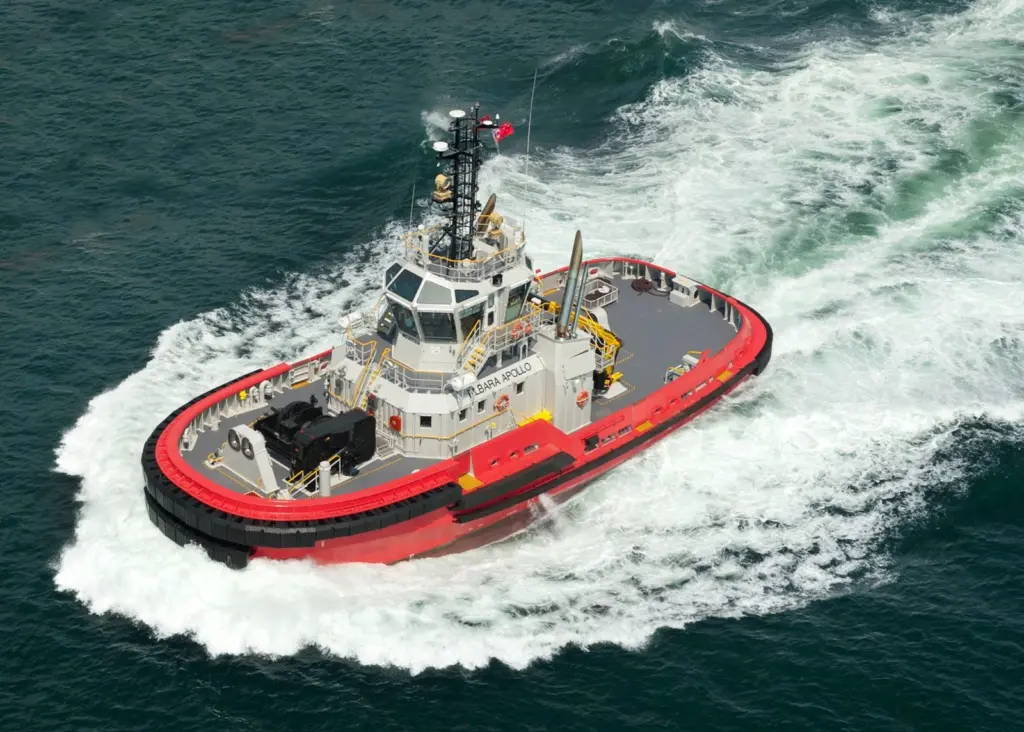
Constructed by the Uzmar Workboat and Tug Factory in Turkey, the tug was built for Rio Tinto Ltd and is operating at the company’s iron ore export facilities at Cape Lambert (Port Walcott) and Dampier.
PilbaraApollo is the first of six new RAstar3200tugs to be delivered as part of this contract with Uzmar. The tugs are designed to assist very large ore carriers in berthing and un-berthing at exposed, open water berths in severe wind and wave conditions.
The unique ‘sponsoned’ hull form of theRAstar Class vessels gives these new tugs a level of safety and comfort that will enable them to operate in conditions that were previously deemed unworkable. This unique RAstar hull form developed by Robert Allan Ltd (RAL) has been proven in both model and full-scale testing to provide significantly enhanced escort towing and seakeeping performance.
The tug was classed by Bureau Veritas during construction, but will be converted to Lloyd’s Register in Australia. Pilbara Apollo and its sister ships measure 32.00m in length (excluding fenders), with a moulded beam of 12.80m, a moulded depth of 5.37m and a navigational draft of 6.03m.
Integral tanks can accommodate 129m3 of fuel oil, 39m3 of fresh water, 1.0m3 of propulsion unit oil, 2.7m3 of sludge, 14.5m3 of oily water, 3.4m3 of main engine lubricating oil and 5.7m3 of sewage.
Two Caterpillar 3516C HD main engines are each rated 2,350kW at 1,800 rpm, a total of approximately 6,300 bhp. Each engine drives a Rolls-Royce US255 propulsion unit incorporating a controllable propeller.
On trials, PilbaraApollo met or exceeded all performance expectations, with bollard pulls of 80.9 tonnes pulling ahead and 77.0 tonnes astern, with a maximum free running speed of 14 knots.
Two Caterpillar C6.6 diesel generator sets, each with an output of 100 ekW, provided onboard electrical power.
The fendering system for this series of tugs was devised by the owner’s representative, Neil Edwards, working in close cooperation with the design team at RAL and the fender suppliers, Maritime International. Ship handling fenders at the bow consist of two rows of 1,000mm deep, 1,400mm wide custom designed ‘W’ section mouldings. Extruded hollow 300mm by 300mm square section rubber fenders provide protection at the main sheer line, and 500mm wide by 450 mm deep ‘W’ block type fendering is used at the stern. The fendering system was subject to extensive Finite Element Analysis (FEA) to verify the responses and loads and early indications from the operators are that this solution will perform very well in the rough sea conditions.
The hydraulic deck machinery, all supplied by Ridderinkhof, includes a ‘split’ single drum escort towing winch on the foredeck, incorporating a windlass for the anchors. A single drum towing winch is fitted aft for towing over the stern.
Pilbara Apollo has been outfitted to the highest standards for a crew of up to six people. The lower deck contains crew quarters and the Master and Chief Engineer staterooms. The wheelhouse is designed for maximum all-round visibility with a forward control station providing maximum visibility to both fore and aft deck working areas.
By Jack Gaston
Related Articles
 SPECIAL REPORTS
 TUGS & SALVAGE
 EQUIPMENT