![MaritimeJournal[Seawork]](https://www.maritimejournal.com/wp-content/uploads/2026/09/MaritimeJournalSeawork.svg)






Complex contaminated spoil removal task
Poole UK based Jenkins Marine recently completed a complex contaminated spoil removal project at Millbay Inner Basin in what was their second involvement in recent years at Plymouth’s Millbay Dock.
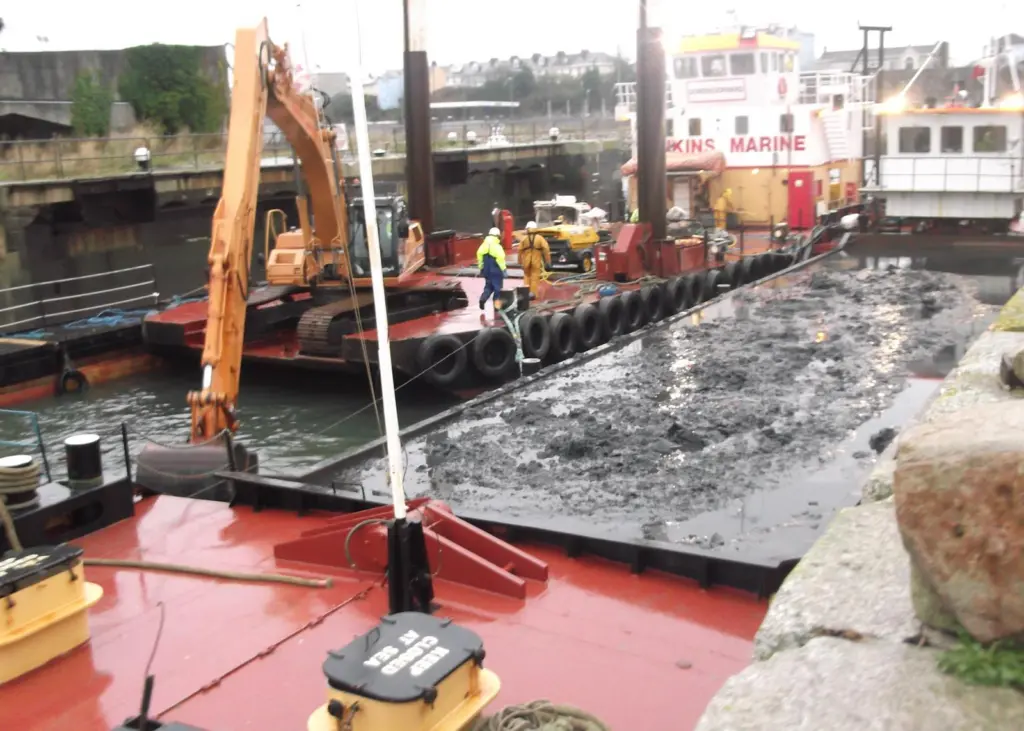
Millbay Inner Basin has a long and illustrious history, having been conceived and built by the renowned civil engineer Isambard Kingdom Brunel for the Great Western Railway Company in the 1850s. A feature of this historic dock is its granite walling, but as with other similar docks with significant historical interest, and despite being a listed structure and famous landmark, it has been abandoned to its fate over recent years.
For many decades silt built up in the main channels, all but blocking the basin to shipping. Several years ago Jenkins Marine was involved in a major project removing 37,000m3 of spoil as part of the project to undertake restoration of the dock.
For that work Jenkins Marine employed state of the art computer controlled equipment, including a Prolec dredge computer system accurate to 10mm. A Case CX350 long reach excavator was employed to dredge the material. Now, following that successful campaign, Jenkins has returned to remove a further 2,000m3 of sediment from the entrance channel to the dock.
A particular problem to be addressed was the contaminated nature of the sediment and special arrangements and conditions were put in place as part of the dredging licence issued by the Marine Management Organisation (MMO). Jenkins Marine mobilised its 300m3 capacity self-propelled split hopper barge Nab for removal of the sediment, custom built protective hardwood timber mats being fitted in the hopper well for the project. The sediment was then transported to nearby Clyde Quay within Millbay Dock where contaminated land remediation contractor Vertase F.L.I.took over responsibility for unloading and processing the contaminated sediment. A 45 tonne excavator was employed to transfer the material from the Nab to 30 tonne dumper trucks and then into a nearby bunded holding lagoon.
The dredge licence issued by the MMO stipulated that all dredging works were to be enclosed by a silt curtain. To surround the entire dredge area would have required 200m of curtain, a measure with significant cost implications. Jenkins Marine came up with the innovative idea of a smaller silt curtain to surround the dredger, and move with it. The curtain was supported by Unifloat modular road transportable pontoons, in turn secured to Jenkins Marine’s self-propelled spud leg pontoon dredger Doreen Dorward, which dredged the spoil. Although dredging operations were restricted by tides, work continued 24 hours a day, seven days a week on the project.
Jenkins Marine director Dan Jenkins said: “This was a complex project, despite the relatively small dredge quantity. There have been a lot of hurdles to jump and lengthy liaison with all involved to get to the point of actually dredging on site. I am very pleased that Jenkins Marine has been able to offer a uniquely adaptive solution to meet the regulatory requirements for the dredging of contaminated sediments for this project”.
Related Articles
 FEATURES & VIDEOS
 MARINE CIVILS
 OTHER NEWS