![MaritimeJournal[Seawork]](https://www.maritimejournal.com/wp-content/uploads/2026/09/MaritimeJournalSeawork.svg)





Heerema’s new Bylgia is delivered
Heerema Marine Contractors (HMC) Nederland BV has taken delivery of the new state of the art anchorhandling tug Bylgia.
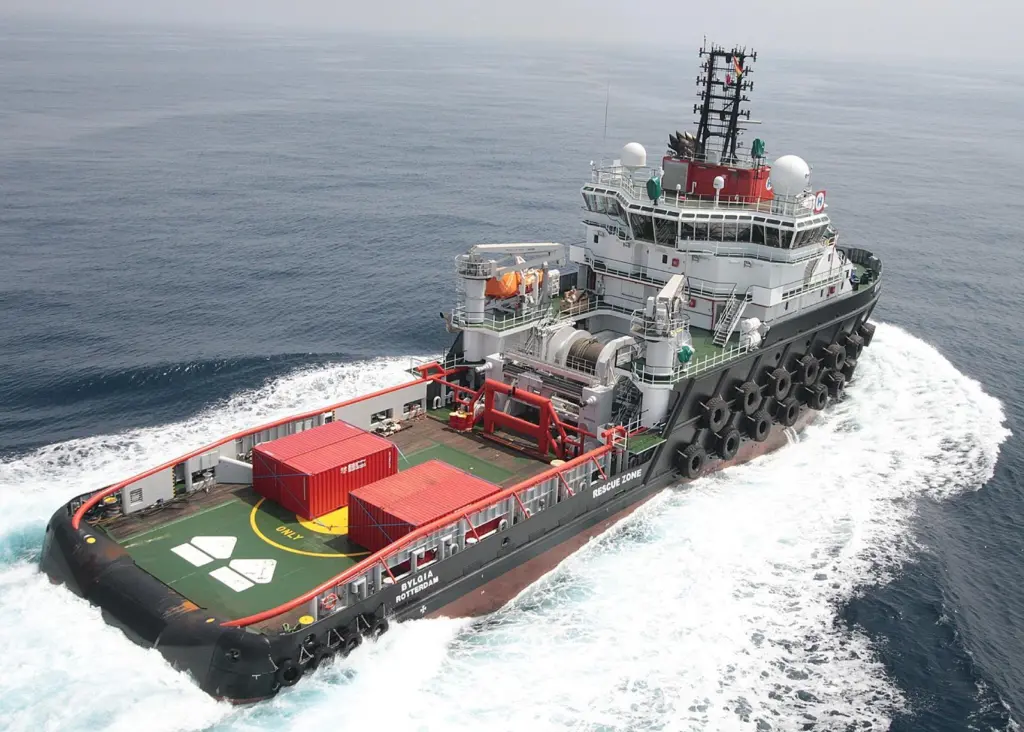
The new tug was formally christened in Vigo, Spain on 28 June and after extensive trials arrived in its home port of Rotterdam on 20 July.
Bylgia took just 19 months to build at the yard of Astilleros Armon Vigo SA. A sister ship, Kolga, is currently being fitted out and will be delivered in five months. The tugs are part of a massive investment being made by HMC in new and more sophisticated offshore construction plant.
In 2010 the HMC Board decided to replace the ageing and well known anchorhandling tugs Husky and Retriever. A nine month international tendering process was initiated and after an intensive technical/commercial review cycle the decision was made to place an order for the design and construction of two new vessels with Astilleros Armon.
Bylgia and Kolga are named after two of the ‘Sea God’ Aegir’s daughters. Aegir is the name of HMC’s new deep water construction vessel, due to be operational late in 2013.
During the design process HMC was faced with some important decisions regarding environmental, commercial and safety issues. On studying the use and fuel consumption of Husky and Retriever it was found that the tugs were on ‘standby’ for about 40% of their annual sailing time. When barges are moored alongside the crane vessels they sail with minimal power, which is inefficient and very polluting for the engines. The power plant, a four engine, twin screw configuration, was chosen to address that issue.
Bylgia and its sister will not only tow over long distances but will also spend a considerable time on standby assisting the HMC crane vessels in the field. For that reason, after a cost-benefit analysis, it was decided that to use Marine Diesel (MDO) fuel for the main engines and auxiliaries would be less polluting.
The entire HMC fleet is now running on MDO due to its availability worldwide, low sulphur content and reduced SOx emissions.
Bylgia and its sister are anchorhandling tugs capable of long distance towing and operating economically while ‘on-site’. They are equipped for worldwide operation (excluding Arctic) under the Dutch flag. The tugs comply with Lloyds Register of Shipping notations; +100A1 TUG, Anchorhandler, +LMC, UMS,IWS, CAC(93), DP(AA), EP, SCM
The tugs are considerably larger that the Husky and Retriever, measuring 72m in length overall with a breadth moulded of 18.00m, a depth of 8.50m and an operating draft of between 5.75m and 7.75m. The configuration chosen is that of a modern conventional offshore anchorhandling tug with a long forecastle, two decks high and heavily fendered with horizontal strakes and tyres. A typical twin screw hull incorporates a bulbous bow and is constructed with a double skin, isolating the fuel tanks from the outside shell plating. An open stern features a 500 tonne Hatlapa stern roller. The large clear after deck of 400m2 has a load strength of 5 tonnes/m2 and 10 tonnes/m2 in the area around the stern roller. The bulwarks are strengthened and a cargo rail installed to protect cargo and personnel working on deck.
As previously mentioned, Byglia has four main engines driving two controllable pitch propellers manufactured by Schottel, via twin input/single output gearboxes. The engines chosen are MAK 6M32C diesels developing a total of 12,000 kW (approximately 16,092 bhp). Already compliant with Tier 2 regulations, the engines are ready for upgrading to Tier 3 when required.
Also installed are two Schottel SST 880kW, electrically powered tunnel thrusters, one forward and one aft. Provision has been made to install a second stern thruster at a later date if required. A Rolls Royce ‘swing-up’ retractable azimuthing thruster of 880 kW is also located beneath the bow. This type of thruster has the advantage of still being able to act as a bow thruster in the retracted position.
On trials Bylgia achieved a bollard pull at 100% MCR of 202 tonnes, without using the retractable thruster. A maximum free running speed of 15.7 knots was recorded and an economic cruising speed of 12 knots is achieved at 75% MCR.
The propulsion system chosen is extremely versatile. Two engines can be shut down for maximum economy when less bollard pull is required, and the electrically powered azimuth thruster provides sufficient power for station keeping when the tug is on standby. When the main engines are off electrical power for the thruster is supplied by the auxiliary generators.
A Kongsberg K-Pos-21 dynamic positioning system to DP-2 standard is installed in both tugs, giving fully integrated control of main engines, propellers, rudders and thrusters.
Demands on the electrical system aboard Bylgia are exceptionally high with electrically operated thrusters, pumps, towing winch and other deck machinery. Power is supplied by two Marelli shaft generators, each rated at 3,125 kVa , coupled to the propulsion gearboxes and two Caterpillar C32 powered auxiliary generators of 975 kVa each. A single Caterpillar C18 generator rated at 500 kVa is provided for emergency use.
Tanks are provided to accommodate 2,500m3 of fuel (MD), sufficient to to sail directly from Rotterdam to Cape Town, South Africa without taking additional bunkers. There is also provision for 125m3 of drinking water and 1,300m3 of water ballast. In order to maintain approximately the same draft there is provision onboard to make the same amount of fresh water each day as the amount of fuel consumed. In this way it is possible to use fresh water ballast, avoiding the detrimental effects of salt water on the tanks.
A most important feature in each of the two sister ships is the electrically powered, twin-drum, waterfall style towing and anchorhandling winch specially designed and fitted by Ibercisa. The winch is located amidships in a sheltered area created at the aft end of the forecastle. Each drum weighs 90 tonnes and this massive winch had to be assembled onboard the tug after it was launched.
Both drums have a brake holding capacity of 500 tonnes at the first layer and a dynamic brake capacity of 350 tonnes at 47.6 m/min at the first layer. One drum is designated for towing and the other for anchorhandling (work drum). Both have an identical line pull of 350 tonnes at 10 m/min or 180 tonnes at 20 m/min. Both drums are divided into two sections and have the capacity to accept 2,500m of 3 ½ inch steel wire rope (SWR) in one section and 800m in the other. An emergency towing drum carries 1,600m of 3 ½ inch SWR.
This powerful winch is capable of installing anchors in water depths of up to 1,500m. Among the advanced features incorporated in this new Ibercisa winch is the Emergency Quick Release, which can release the load on the wire within three seconds from all operational modes.
A powered storage winch is provided to accept spare pendants of up to 100m of 6 inch synthetic rope.
Also included in the impressive outfit of towing and anchorhandling equipment is two sets of Triplex tow pins and line handling gear and two Triplex ‘S’ type wire stoppers, all rated at 550 tonnes safe working load (SWL). The latter was chosen for its ability to handle synthetic anchor cables. A pair of hydraulic guide pins of 200 tonnes SWL is also fitted.
Three deck cranes supplied by Ferri are provided and strategically positioned to assist with handling stores, heavy equipment and towing/anchorhandling gear. Two articulated cranes are mounted on pedestals at boat deck level, one rated at 10 tonnes at 10m radius and one at 4.5 tonnes at 10.5m radius. The third is a folding knuckle boom crane capable of lifting 2.6 tonnes at 13.5m reach.
Accommodation aboard Bylgia and its sister is extensive and designed for up to 40 people. Four single berth cabins have private sanitary facilities and a day room. Twelve two berth cabins are also included along with three four berth cabins for passengers, all with private sanitary facilities.
Hereema Marine Construction is a world leading marine contractor for the oil and gas industry. It transports, installs and removes all types of offshore facilities. These include fixed and floating structures, subsea pipelines and infrastructures in shallow waters, deep and ultra-deep waters. The company operates three of the four largest crane vessels in the world. Bylgia’sfirst task will be an anchor handling job in the North Sea for HMC’s semi-submersible crane vessel Hermod.
The tugs to be replaced by Bylgia and Kolga, Husky and Retriever, will be sold. Built in 1978 and 1982 respectively, they have been popular vessels of 60.6m in length, with MAK main engines of 12,000 bhp giving them a bollard pull of 160 tonnes and top speed of 15 knots.
Related Articles
 SPECIAL REPORTS
 TUGS & SALVAGE
 EQUIPMENT