![MaritimeJournal[Seawork]](https://www.maritimejournal.com/wp-content/uploads/2026/09/MaritimeJournalSeawork.svg)




The Damen ASD tug 2810 Hybrid takes shape
Another project rapidly coming to fruition is the Damen ASD Tug 2810 Hybrid being built for Iskes Towage & Salvage of Ijmuiden.
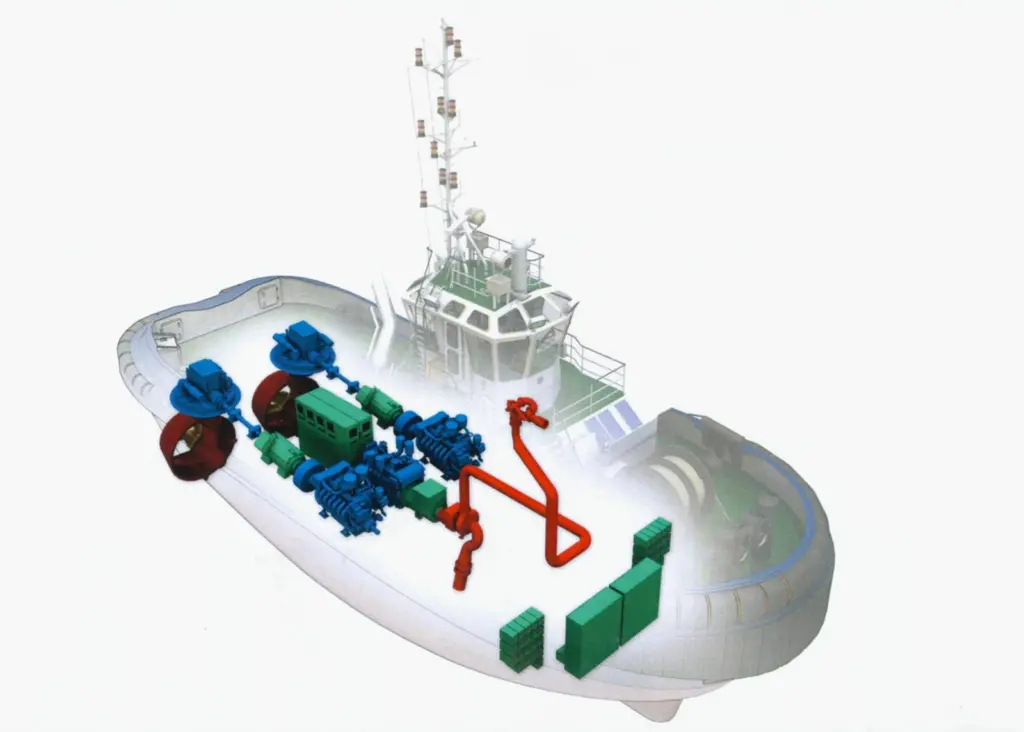
The tug will be a Hybrid version of the popular Damen ASD Tug 2810, with a bollard pull of 60 tonnes. As further details emerge regarding this new propulsion system there is no doubt that it promises to be a very interesting approach to the Diesel – Electric -Battery concept.
Considerable research went into the choice of machinery and its configuration. Based on four years of intensive research with the E3 Tug project, a state of the art propulsion installation has been developed. A method has been developed by the Damen Research Department, in cooperation with the Delft University of Technology, to calculate the fuel consumption and emissions based on the operational profile of a vessel. The study found the an ASD Tug 2810 on harbour duties rarely operates at high power or high speeds, spending 7% of the time below 8 knots and only 2% at maximum bollard pull.
In the hybrid version of the ASD 3910, two MTU 16V4000 main engines will be installed to power the propulsion units. The choice of MTU engines for this project represents a significant departure for Damen. Each of the IMO Tier 2, V16, common rail diesels is rated 1,840 kW at 1,600 rpm for a total of 4,940 bhp. Rolls-Royce US 205 FP fully azimuthing propulsion units are to be installed, incorporating a five blade propeller of 2,400mm diameter and a built-in on/off clutch. An ABB electric propulsion motor/generator will be fitted, installed in the shaftline between the engine and propulsion unit. The motor is water cooled and rated at 440 volts, 60 HZ AC, and has a power output of 230kW at 900 rpm.
Also installed is an MTU 12V2000 diesel engine rated 695 kW at 1,800 rpm to drive a generator and, when required, the fire pump. That engine will be fitted with an exhaust gas after-treatment system incorporating a Selective Catalytic Reduction (SCR) system, a Diesel Oxidation Catalyst (DOC) and a Diesel Particulate Filter (DPF). This combination is fully compliant with the IMO Tier 3 regulations being introduced in 2016.
Two separate Lithium Polymer battery packs will be installed, each rated at 100 kW – 120 kW/hr.Two switchboards will be used, one for propulsion power and the other for ‘hotel’ services. A purpose designed Hybrid Control Unit will control the various operational modes.
In service the ASD Tug 2810 Hybrid will sail at up to 4 knots on batteries alone with no diesels running. For speeds of up to 8 knots the motors will be supplied by the generator, with only the the Tier 3 diesel in operation. For higher speeds of up to 13 knots and during push/pull towage operations only the Tier 2 main engines will be running. Any excess electrical power from the motor/generators will be used for battery charging. In fire fighting mode the main engines will provide power for propulsion and the fire pumps will be driven by the generator engine.
When compared with the current diesel powered ASD 2810 it is expected that the ASD 2810 Hybrid version will offer a fuel saving of up to 30%, with a reduction in emissions of up to 40% in NO, HC, CO and up to 30% reduction in PM, CO and SO. This was calculated with a true operational profile for the hybrid vessel compared with the standard ASD 2810.
The Iskes ASD 2810 is scheduled for trials at the end of 2013. The completed tug will incorporate some customisation, such as double-drum winches fore and aft, wooden deck protection, and an open stern with towing pins and forks.
The Damen standard version for stock is expected in the spring of next year. All standard ASD Tug 2810 Hybrids will incorporate single split drum electric winches from DMT, solar panels fitted to the deckhouse to charge 24V battery packs for starting the engines and emergency power for navigation lighting and radio equipment. Other green initiatives include LED lighting and a special paint coating, making the vessel more environmentally friendly and clean for at least five years.
Related Articles
 SPECIAL REPORTS
 TUGS & SALVAGE
 EQUIPMENT