![MaritimeJournal[Seawork]](https://www.maritimejournal.com/wp-content/uploads/2026/09/MaritimeJournalSeawork.svg)






Venice flood barriers put to the test
An important milestone with the project to protect Venice from flooding from high tides has passed with successful testing of four floodgates.
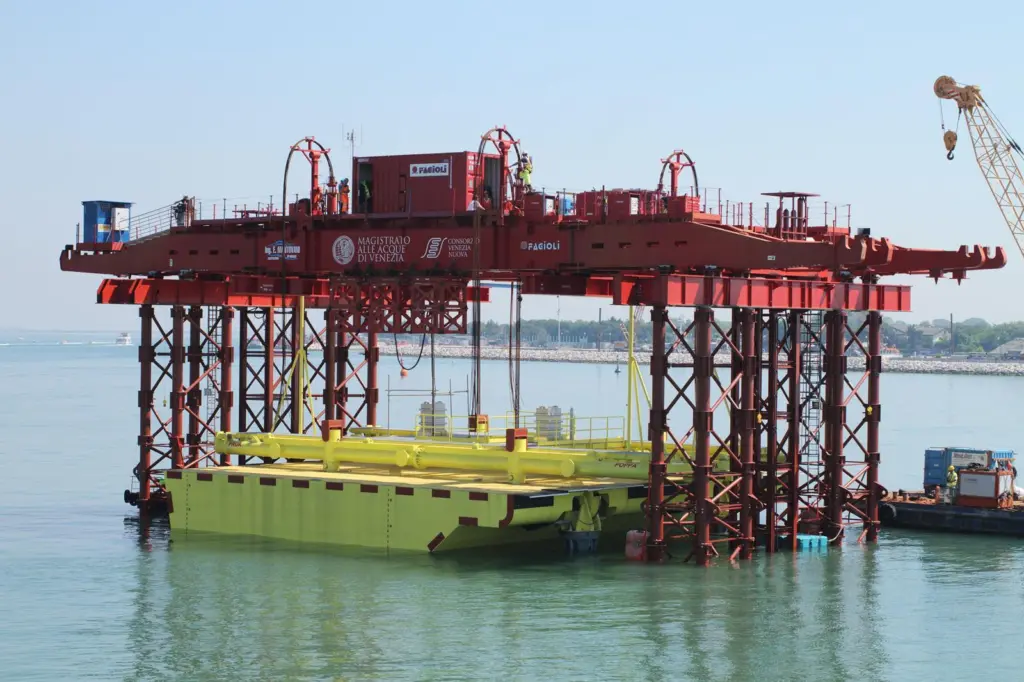
Venice has a long history of vulnerability to flooding with 80% of the city affected in 1966. The city lies within a lagoon with three openings to the Adriatic Sea and is an area full of architecture of historical importance against the backdrop of an economy dependent on tourism. The MOSE project, as the flood defence scheme is called, is aimed at addressing problems from the long term effects of global warming and rising sea levels.
Consorzio Venezia Nuova comprises a group of Italy’s leading construction companies at both international and local scale, along with research institutions, acting on behalf of the Ministry of Infrastructure and Transport (Venice Water Authority) on the mammoth project. Work commenced in 2003 and is currently around 75% complete.
The Authority is taking a multi-faceted approach to the problem of which flood barriers at the three entrances are just part. As well as the threat from the sea the lagoon also acts as outlet for a number of small rivers and canals. Quaysides and paving are being raised, providing a passive defence from high tides (below 110cm), above which the mobile barriers will come into operation. The measures have to allow for the delicate environmental balance, including slowing degradation through land subsidence and erosion. Salt marshes, mud flats and shallows are being reconstructed along with dredging of lagoon canals and channels.
Work includes reinforcing the barrier island to provide protection from tides up to 3m, taking into account projections of future sea level trends made by the Intergovernmental Panel on Climate Change. The main theme of the MOSE project itself, and the element recently tested, centres however on the provision of tidal barriers at the three lagoon inlets at Lido, Malamocco and Chioggia. An element of flexibility is included in the design and operation of the barriers, each able to be raised in different combinations depending on tidal conditions at the time. The barrier gates are independent and can be closed, partially or fully, either individually or all three together thus reacting to different and changing environmental conditions.
The plan involves a total of four rows of barriers, two at the Lido inlet (the widest) and one row at each of the inlets at Malamocco and Chioggia. The barrier rows comprise a total of 78 gate elements, 21 and 20 at the two Lido barriers along with 19 gates at Malamocco and a further 18 at Chioggia. The island connecting the two rows of barriers at the Lido inlet will also contain technical buildings along with the system operating plant.
The gates themselves comprise metal box shaped structures, each 20m wide and varying in length between 18.5m and 29m. A concrete housing structure is located on the seabed to which each of the gates is fixed by a hinge at one end. When not in use the gates are filled with water and sit within the housing structure flush with the seabed. The barriers will be raised, closing the inlets only when tides of 110cm above the established height are forecast. At this point closure of the gates will involve compressed air being pumped into each gate section displacing the water within. As the effects of buoyancy take over from the weight of the water the gates rise on their hinges until they emerge above sea level forming a barrier between the waters of the lagoon and open sea beyond. The balance between buoyancy and water weight is thus controlled, allowing the gate to be maintained at variable heights depending on tidal height and weather conditions. As the tide level drops, water is reintroduced into the gates which then return to their housing. It is anticipated the inlets will be closed for between four and five hours on each occasion, the gates able to be raised and lowered in around 30 and 15 minutes respectively. Work has continued simultaneously at each of the three inlet sites, the worksites themselves on land and sea covering a length of 18km.
Navigation and access into and out of the Port of Venice will be maintained through construction of a main lock at Malamocco inlet for large vessels, and two smaller locks at Chioggia and Lido inlets.
Associated work includes construction of new artificial beaches along with widening of eroded ones through sand nourishment measures. Previously, the coast was protected by the construction of jetties, seawalls, groynes and offshore breakwaters. It is expected that erosion will require the new beaches to receive periodic maintenance estimated at 1% per year. Venice’s new flood defence system will be controlled from what is being called the ‘brain of Mose’, in the historic Venice Arsenal area of the city.
By Peter Barker
Related Articles
 FEATURES & VIDEOS
 MARINE CIVILS
 OTHER NEWS