![MaritimeJournal[Seawork]](https://www.maritimejournal.com/wp-content/uploads/2026/09/MaritimeJournalSeawork.svg)




TOWLINES
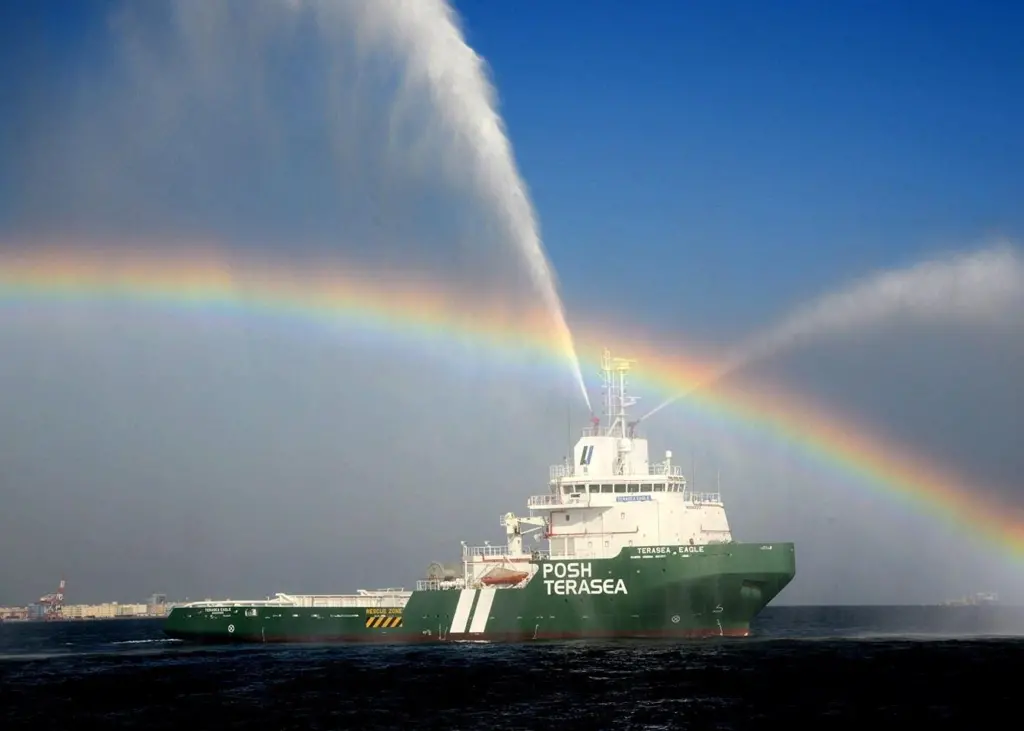
Terasea Pte Ltd of Singapore, part of the POSH Terasea consortium, has taken delivery of the Terasea Eagle, the third anchorhandler in a series of four identical vessels to be built by the Universal Shipbuilding Corp in Japan. The 75.3m vessel has a bollard pull of 200 tonnes thanks to a pair of Wartsila 12V32 main engines generating a total of 16,300 bhp. Large fuel tanks give this new quartet excellent endurance whether engaged in long distance operations or standing by offshore. Terasea Eagle enters service alongside the Terasea Falcon and Terasea Hawk. The fourth tug, Terasea Osprey, is due for completion at the end of February 2014.
Tschudi Offshore & Towage, formerly International Transport Contractors (ITC) has announced a change of address effective from 1 December 2013.
The new address is: Tschudi Offshore & Towage, Sluisplein 45,1975 AG IJMUIDEN, The Netherlands. New telephone: 088 5485200 (24/7)
Email: info@tschudioffshoretowage.com (unchanged)
Website: www.tschudioffshoretowage.com (unchanged)
The anchorhandling tug Gudriis reported to have capsized in bad weather in the Bonny River estuary in Nigeria on 5 November. It is understood that the tug was monitoring an LNG carrier aground in the estuary at the time. The tug crew and some local officials onboard were rescued unhurt and the vessel is lying on its side partially submerged. Gudri is the former Typhoon, well known to many in the deepsea and offshore industries. Built in 1976 for Wijsmuller, the 50m twin screw anchorhandler was powered by Werkspoor diesels developing a total of 9,200 bhp, for a bollard pull of 116 tonnes. The tug became Smitwys Typhoon in 1999, joined the ITC fleet as Typhoon in 2005 and was finally sold to Jampur International Dubai, UAE and renamed Gudri in 2012.
Bureau Veritas (BV) has authorised an ‘Approval in Principle’ basis, a new Computational Fluid Dynamics (CFD) based performance prediction methodology developed by Robert Allan Ltd. as the basis for formally granting the service notation ESCORT TUG. While previously some Societies have approved computer based escort predictions for new tugs on a case by case basis, the majority still require a full scale trial before issuing an escort notation and the associated escort numeral. The process of predicting steering and braking forces and assessing stability to meet Classification Society requirements has been notoriously complex and difficult without model tests or full scale trials. By applying sophisticated CFD techniques within a pre-approved, standardised methodology, Robert Allan Ltd. is able to accurately evaluate escort performance and compliance with Class requirements early in the design process.
Related Articles
 SPECIAL REPORTS
 TUGS & SALVAGE
 EQUIPMENT