![MaritimeJournal[Seawork]](https://www.maritimejournal.com/wp-content/uploads/2026/09/MaritimeJournalSeawork.svg)






Rostock terminal upgrade completed
An upgraded €17m intermodal terminal billed as more efficient is going into full operation in the German Baltic port of Rostock in February and is expected to double handling capacity.
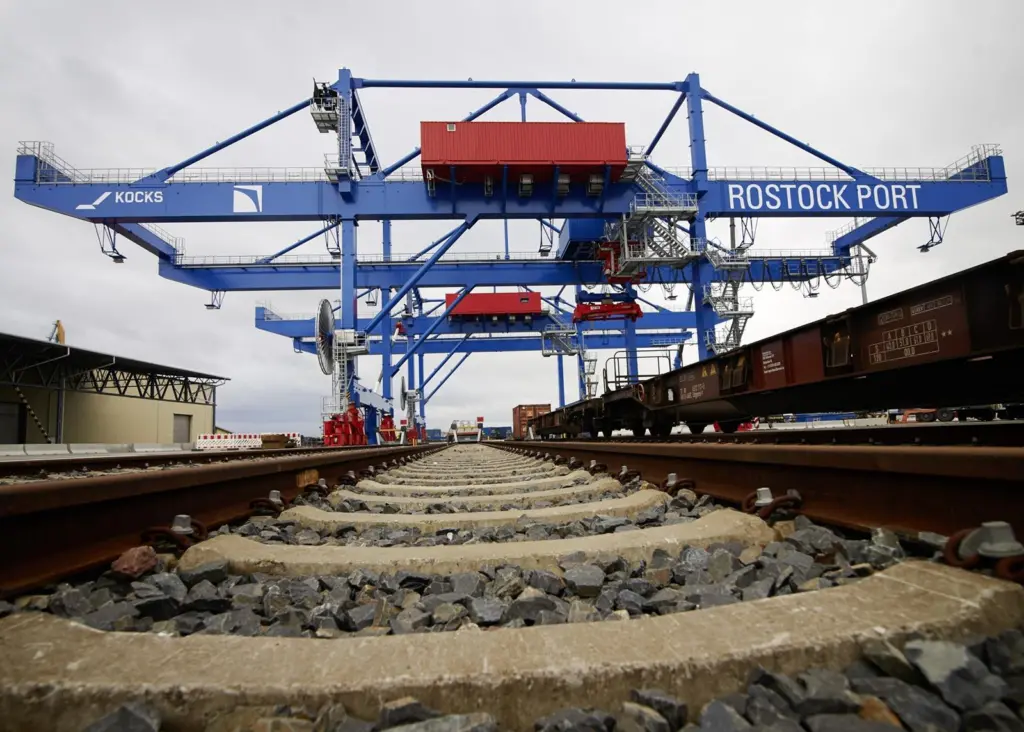
Conversion of the terminal has been under way since May of 2012 and has involved the replacement of older reach-stackers with two giant new gantry cranes, each costing €3.7m, Port of Rostock spokesman Joerg Litschka told Maritime Journal.
The new 500 tonne gantry cranes are each 35m high on a 26.5 track width with a spread of 76.5m and spreader capacity of 48 tonnes. They are also fast, moving at up to 180m a minute – twice walking speed. The first was commissioned last December and the second was joining it this month.
Their manufacture by Kocks, Mr Litschka reported, was a truly international affair with individual crane parts built in Slovenia, Hungary and the Netherlands as well as Germany.
They complete a transformation process at the terminal, south of the port’s Pier 1, which has been carried out gradually by port development company HERO and local construction concern STRABAG AG without disrupting day to day port operations.
A reported 35 intermodal trains operate weekly through the terminal to and from Verona (12), Hamburg (6), Karlsruhe (6), Brno (4), Novara (3), Domodossola (2) and Wels (2). The number of trailer units handled there rose from 64,255 in 2012 to 64,851 last year.
“We are very satisfied with that, said HERO chief Ulrich Bauermeister, “given the ongoing construction work at the Intermodal Terminal and the diverse renovation and maintenance work on important rail track. The port is now well equipped to cope with further increases in rolling cargo volumes”.
The upgraded terminal, for rail, road and seaborne cargo, covers an area of around 30,000m2 while the entire Intermodal Transport Terminal covers about 70,000m2.
The demolition of two old ramps and two rail tracks as well as the extension and relocation of track was completed as early as June 2012. An additional three new tracks for cargo handling have been built making a total of five to be served by the two new cranes. All in all, the changes are expected to double intermodal handling capacity, the Port of Rostock said.
Federal German rail authorities put up 70% of the terminal investment cost while the EU provided an additional €3.3m for the project as part of the European Motorways of the Sea programme. The remaining costs were provided by HERO.
In 2013 the Port of Rostock handled a total of 23.2m tonnes of cargo – half a million tonnes more than in 2012. Most of that – 21.4m tonnes – moved via the port’s main Ueberseehafen.
By Tom Todd
Related Articles
 FEATURES & VIDEOS
 MARINE CIVILS
 OTHER NEWS