![MaritimeJournal[Seawork]](https://www.maritimejournal.com/wp-content/uploads/2026/09/MaritimeJournalSeawork.svg)






A new RAmparts Class finds favour in China
Late in 2013, the first of a new series of RAmparts 3500 class ASD tugs was delivered to its owners Tianjin Port, a major port in the northern part of China.
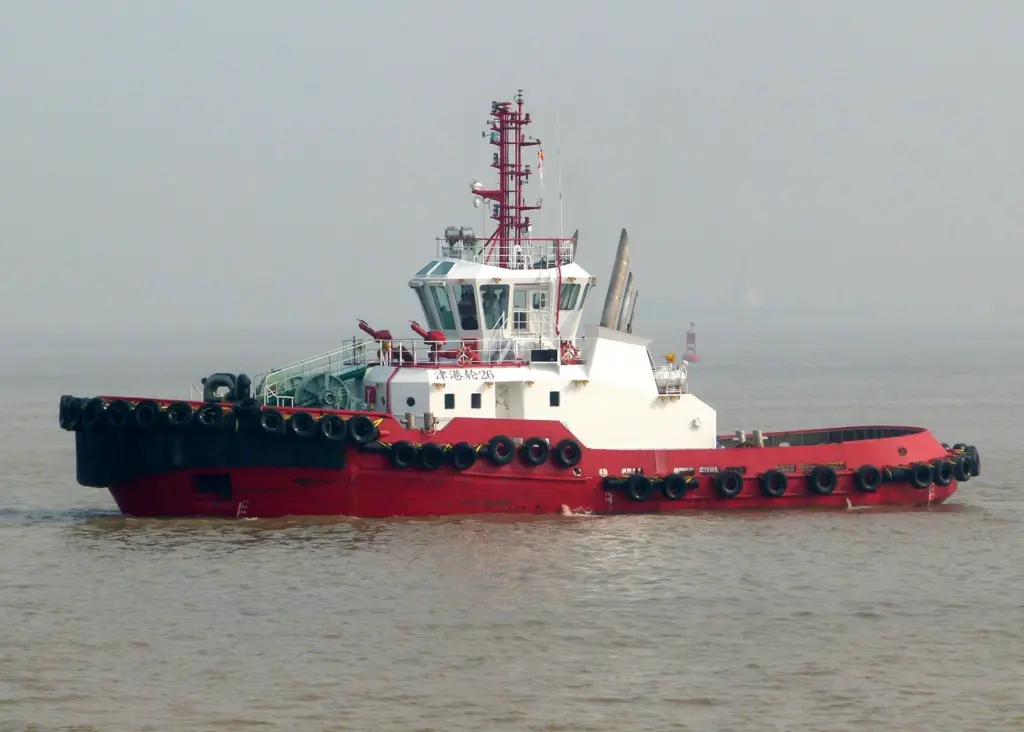
Named JinGangLun26, the vessel was constructed by Shanghai Harbour Fuxing Shipping Service Company. A sister vessel is under construction at the same shipyard.
The RAmparts3500 Class represents the latest evolution of the most prolific class of tugs yet produced by Robert Allan Ltd (RAL). The hull of this new 35m design has been developed from the very successful 32m RAmparts class, of which more than 100 tugs have been built in the past decade. However the design was extensively customised with changes to the fendering system, accommodation layout, wheelhouse arrangement, etc, to suit the particular operational requirements of Chinese ports.
JinGangLun 26 wasbuilt and classed in accordance with Chinese Classification Society (CCS) requirements, with the notation – CCS, Tug, Coastal Service. It also meets the requirements of CCS Ice Class B, and Fire Fighting 1 Vessel, although not formally classed to those notations. The tug is 35.00m in length overall, with a maximum moulded beam of 12.40m, a moulded depth of 5.40m and maximum draft of 4.22m.
Fendering at the bow comprises one row of cylindrical rubber mouldings at main deck level and ‘M’ section moulded blocks between the main deck and the knuckle. There is also substantial fendering to protect the main and forecastle deck sheer lines and a section of ‘outset’ fenders to act as a lifting point for the tug when alongside an attended ship. Cylindrical rubber fendering is used at the stern and, in addition, heavy duty tyres are provided all around the vessel.
The wheelhouse is designed for maximum all-round visibility with a ‘U’-shaped control console selected by the client to provide maximum visibility to both fore and aft deck working areas.
Fully equipped accommodation is provided for a complement of up to 14 persons. The Captain’s cabin and spacious mess/conference room are located on the main deck and the Chief Engineer’s cabin and three four berth cabins for crew below decks.
For ship-handling service at LNG terminals, the vessel is fitted with a safety system which includes gas detection alarms in the wheelhouse with sensors around the deckhouse. The air intake fans on the main deck and deckhouse have explosion proof motors.
Deck machinery includes two towing winches for shiphandling forward and a radial arm tow hook on the aft deck. A capstan is installed on the aft deck to facilitate line handling operations.
The main propulsion system consists of two Daihatsu 8DKM-28eF diesel engines, each rated at 2,390kW at 750 rpm (total 6,410 bhp) to drive a pair of Kawasaki KST-240ZC/B-2.8 fully azimuthing propulsion units.
Electrical power is supplied by three identical diesel generators designed for parallel operation, each with a power output of 100ekW,
On trials JinGang Lun26 exceeded all contractual performance requirements, achieving a bollard pull towing ahead of 80 tonnes and a free running speed of 14.3 knots. The tug also demonstrated excellent directional stability, manoeuvrability and control, to the expressed delight of the owner’s representatives, and the sea trials Masters.
Related Articles
 SPECIAL REPORTS
 TUGS & SALVAGE
 EQUIPMENT