


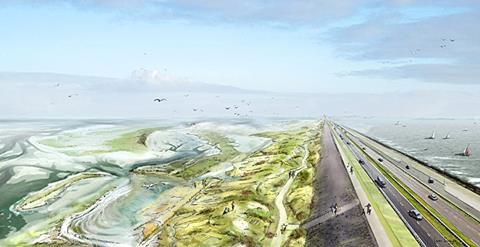
The creation of tidal marshes on the mudflat side of the Dutch Closure Dike (Afsluitdijk) will provide the Netherlands with a sea defense, a new nature area as well as recreation opportunities.
That is the thrust of the advice given to the Dutch Department of Public Works by the consortium consisting of engineering consultancy DHV, knowledge institute Wageningen IMARES, and the design firm Alle Hosper. The department had called on experts to present their plans for the Afsluitdijk market consultation.
According to the consortium's spokesperson, DHV's Marjan den Braber, 'The creation of a wide soft dike has a number of advantages compared to the traditional approach of dike raising, while offering at least the same level of safety.'
The consortium's proposal involves the establishment of 1,500 hectares of new natural area in the form of tidal marshes, overgrown high-sands of which the top parts are only submerged under storm conditions. Thanks to the plant growth and the introduction of sediment, the tidal marshes will grow on their own, accompanying the rise in the sea level.
'Experience tells us that this method works. Tidal marshes have been active on the Dutch coasts of Groningen and Friesland for hundreds of years, and we have a large amount of measurement data on them', explained Kees Dijkema, senior researcher at Wageningen IMARES.
The creation of the tidal marshes will lead to the formation of a 30 km long nature area with a protected bicycle path with a view over the flats. The consortium also suggests setting up a visitors' center, from which one will be able to follow the development of the mudflat works. Motorists, however, will not be able to see much of the tidal marshes, since they will be travelling on the IJsselmeer side of the dike. In response to the transport problem at the intersection of the road and water traffic, the consortium recommends building access bridges over time. These would offer a view over the new nature area.
The concept draws on proven, centuries old technology in a modern format that can be quickly implemented. Furthermore, the proposed solution fits within the available budget. The mud-flats thus constitute a serious alternative to the 'conventional reinforcement that must be completed by 2015.
'Naturally, it would be sensible to optimize the marsh creation by using a test marsh to precisely determine the level to which we will have to introduce the sand and at which point we can let nature take over', said DHV's Jasper Fiselier, the consortium's project manager.
There is a great deal of interest in the cultivation of sustainable sea defenses. DHV is currently working on the construction of the coastal city of Caofeidian on the Bohai Sea in China. The city is being built on a protected island structure on the model of the Dutch mudflats. In addition DHV, Wageningen IMARES and Deltares are collaborating actively in the Mississippi delta in the USA.