![MaritimeJournal[Seawork]](https://www.maritimejournal.com/wp-content/uploads/2026/09/MaritimeJournalSeawork.svg)





EU approves €19.65 million wave energy project
The EU has given the green light to a wave energy project first launched almost two years ago.
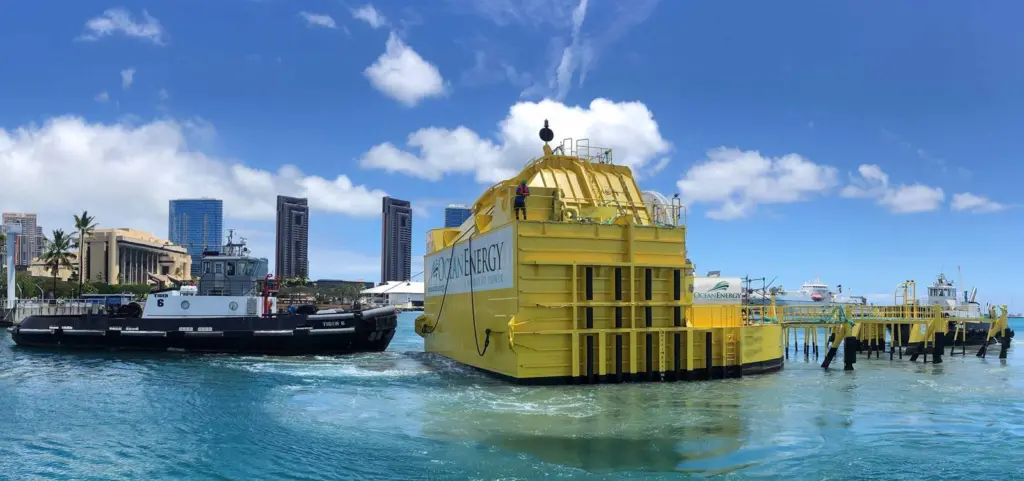
The €19.6 million project aims to form a stepping stone to large-scale commercialisation of wave energy, with a device engineered by the Irish firm OceanEnergy.
The OE35 floats on the ocean surface containing trapped air, with the lower part of the device open to the sea.
Pressure from the waves at the submerged opening cause water to oscillate and drive the air through a turbine, generating electricity. This electricity will then be sent to the grid via subsea cables.
The device will be connected the grid and supply 1MW of electricity if the project is successful.
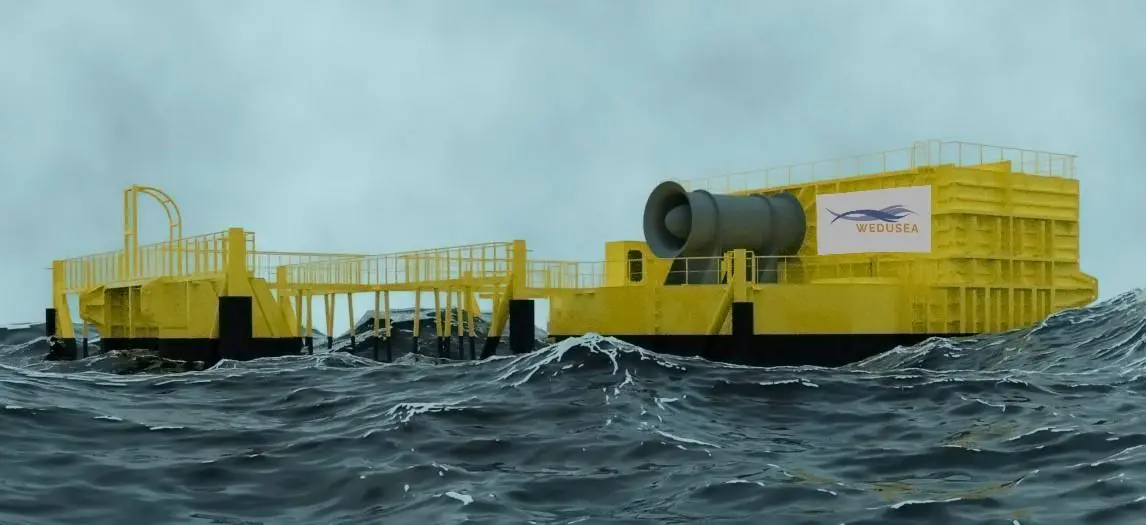
Render of WEDUSEA OceanEnergy OE35 wave energy device, due to launch in UK in summer 2025
As is normal for all EU-approved projects, rigorous testing and verification must be undergone first. This has now been completed and approved, including technical designs and budget.
Co-funded by Innovate UK and the EU’s Horizon Programme, which the UK re-joined as an associate member last year after being kicked out because of Brexit and the Northern Ireland Protocol machinations, the project is being demonstrated at the European Marine Energy Centre (EMEC) in Orkney, Scotland.
So far wave energy has barely scratched the surface of renewable energy but it does appear to be on the cusp, with the UK, for example, granting contracts to six projects totalling 28MW of generation capacity in its recent renewable energy auction round.
“Wave energy is the world’s most valuable renewable resource with around 30TWh of potential annual production waiting to be harnessed,” said Prof Tony Lewis, chief technical officer at OceanEnergy, says. “That’s almost 10 times Europe’s annual electricity consumption. However, this potential has yet to be fully realised. The project will demonstrate that wave technology is on a cost reduction trajectory and will thus be a stepping stone to larger commercial array scale up and further industrialisation.
“We predict that the natural energy of the world’s oceans will one day supply much of the grid.”
Related Articles
 FEATURES & VIDEOS
 ENVIRONMENT
 OTHER NEWS