![MaritimeJournal[Seawork]](https://www.maritimejournal.com/wp-content/uploads/2026/09/MaritimeJournalSeawork.svg)

A ground-breaking spin on simulation: BMT opens ‘world-first’ DISC
BMT has officially opened a 360 degree immersive maritime testing hub, with wall-to-wall LED screens that use live AIS feed to depict real-world port scenarios.
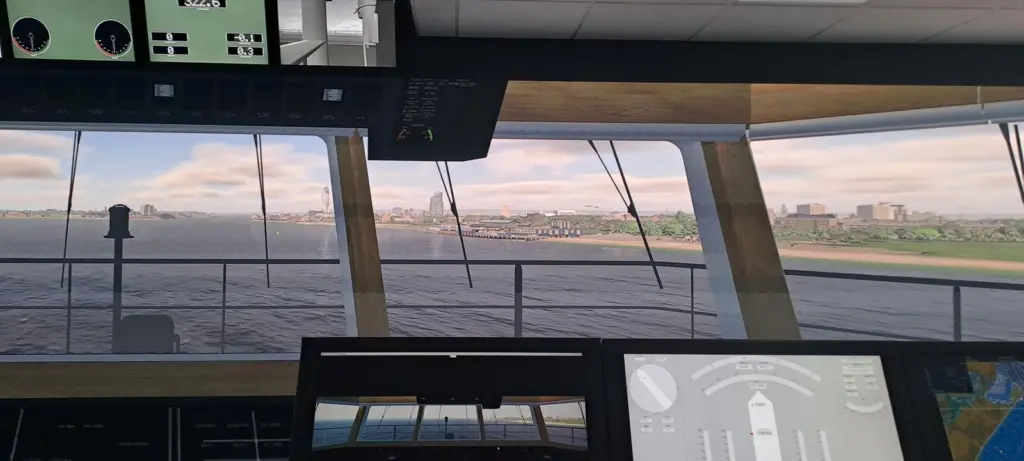
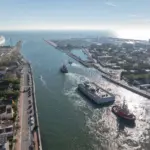
At a selective press event, the ribbon was cut on BMT’s its Digital Innovation and Simulation Centre (DISC), and guests were shown how they could simulate guiding the Brittany ferry Santona into the Port of Portsmouth with tugs, ROVs, navigation lights and static vessels all added to complicate the scene and provide real-world simulation.
Designed to test any kind of vessel manoeuvre, port infrastructure build or complex scenario, the hub takes live AIS feed to simulate what could be happening in a port, with vessels either really there or synthetically added.
Two separate 270o tug simulators – in separate rooms – can also be connected to the DISC’s main bridge so an entire port can be ‘operated’ along with the vessels in it.
The centre is designed to help clients de-risk critical decisions by enabling them to test concepts, validate designs and explore operational challenges before real-world implementation.
Phil Thompson – head of Commercial Product Development, BMT – says the technology has also been used to analyse past real-world incidents, providing insights that help inform safer practices and reduce the likelihood of similar events in the future.
“We have looked at past events – and now understand why they happened and what could have been done to avoid them,” he said. “For example ship speed and entry to the port could have made a difference, and another thing is having escort tugs available.
“One of the primary elements is ship speed on entry into port and transiting very narrow channels.”
Supporting autonomous and remotely operated systems
A key focus of DISC is the development and assurance of autonomous and remotely operated maritime systems.
The ROC-Sim, a deployable Remote Operations Centre Simulator, was officially unveiled on the National Centre for Marine Autonomy (NCMA) stand at Oceanology International in London recently, and sits within the DISC. Like all of BMT’s technology it is in-house designed, and built on BMT’s REMBRANDT software, which forms the base.
BMT says the facility can simulate autonomous and hybrid fleet operations, enabling users to assess how crewed and uncrewed vessels interact in shared environments. This includes the ability to model mission scenarios, navigation and operational behaviours under a range of conditions.
For organisations working with ROVs and USVs, this provides a platform to evaluate system performance and operational concepts within a safe and repeatable environment.
The centre also supports the testing of remote operations through its integrated ROC capability, reflecting the growing shift towards distributed and shore-based control models in offshore and defence applications.
Port and harbour development
DISC is also designed to support port and harbour planning, offering tools to simulate vessel movements, traffic flows and infrastructure layouts.
“We can make digital twins before any investment is made,” said Adam Northover, Business Development manager and senior account lead – Ports, Infrastructure and Environment- UK and Europe. “We have one customer, for example, developing a new harbour, an extension to a port. We can put in the new jetty and the customer can test to see if it will be a problem.”
The ability to simulate mixed fleets – including autonomous vessels – is expected to be particularly relevant as ports adapt to emerging technologies and new vessel types.
“There are so many challenges with conventional ports,” said Phil Thompson. “We are being driven by larger and larger ships going into ports that are designed for much smaller vessels. The ports themselves have got to catch up, with risk management and future proofing.
“For example capital and maintenance dredging: Where do we need to spend the money? Where to dredge for maximum efficiency? It can model depth, silt movements, everything.”
Enabling digital engineering and collaboration
At the core of DISC is a focus on digital engineering and collaborative working. The facility allows multiple stakeholders to engage with simulations in real time, supporting more integrated decision-making across projects.
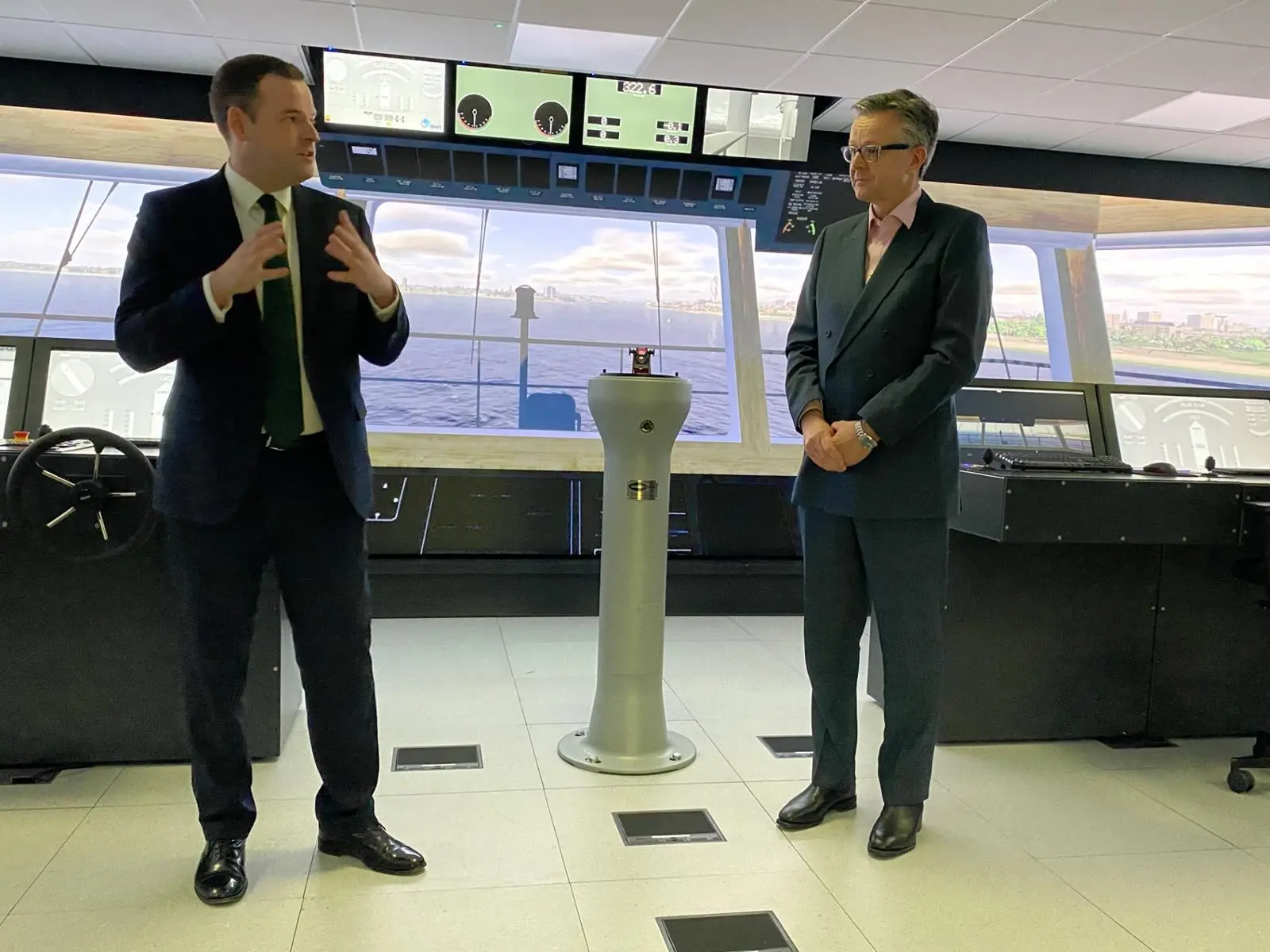
BMT also emphasises the role of digital twins and immersive environments in improving understanding of complex systems. By visualising operations and testing scenarios in detail, users can identify risks and optimise designs earlier in the project lifecycle.
The company describes DISC as part of its broader effort to combine domain expertise with advanced digital tools, helping clients accelerate project delivery while improving safety and performance.
As maritime operations become increasingly complex, particularly with the integration of autonomous systems, facilities such as DISC are expected to play an important role in supporting innovation across vessel operations and port infrastructure.
“There is nothing like this in the UK or even in the world,” said Member of Parliament for Hamble Valley Paul Holmes. “It’s half defence, half engineering – the international situation being what it is, facilities like this can also directly help the Ministry of Defence.”
“The possibilities are endless,” said Adam Northover. “We don’t even know what the different future is for DISC.”
Related Articles
 ACCESSORIES & EQUIPMENT
 ACCESSORIES & EQUIPMENT
 ACCESSORIES & EQUIPMENT