


Methanol safety: Overlooked in today’s fuels race
As the race to find the ideal future fuel heats up, so does the need to make sure fire safety systems are suitable for the new chemistries.
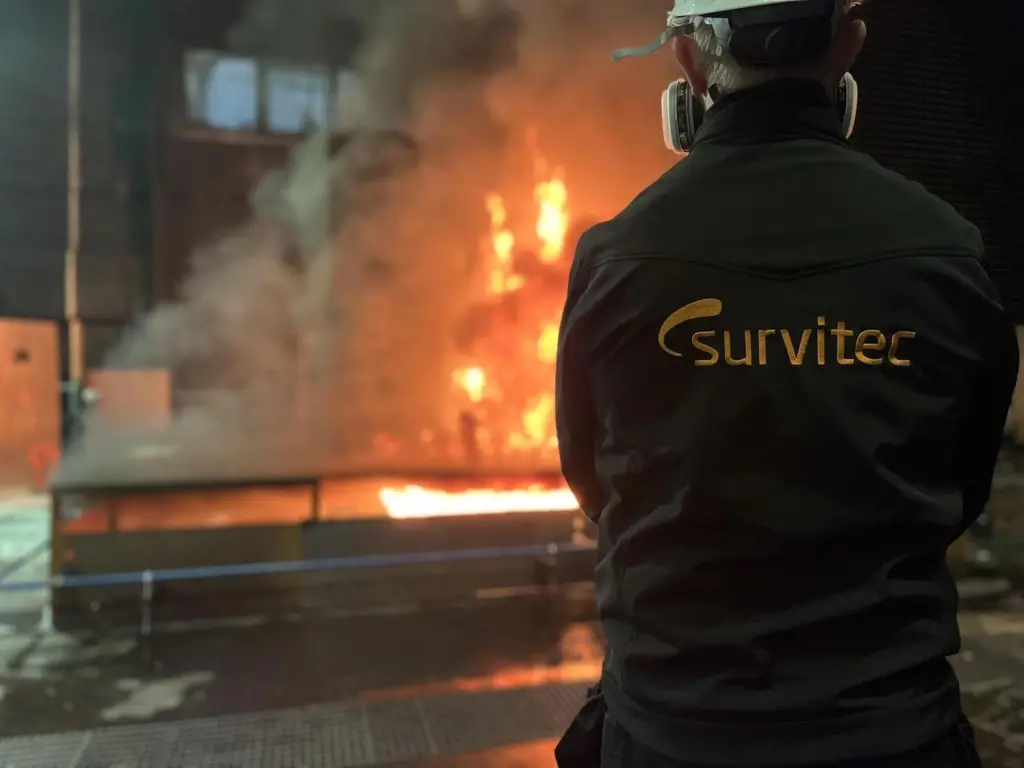
Everyone knows the race for alternative fuels is well under way, with one of the leading contenders on many operators’ lips being methanol – it’s far more energy dense than, say, hydrogen, so it doesn’t need as much storage space; it has reduced emissions; can be made from a number of different sources; has a lower flammability than diesel; and so on.
But operators do not realise, says safety equipment company Survitec, that traditional fire-fighting methods will not be suitable in the event of a methanol fire.
A lot of work has been going in to methanol, with the Port of Antwerp-Bruges announcing the launch of the first methanol tug, Methatug, last week, and Van Oord unveiling its methanol offshore installation vessel recently.
Vessels being built with methanol capacity are out-numbering forecasts, says Survitec, but there hasn’t been a matching interest in fire-safety testing.
Survitec tests
And this is where the survival technology company has stepped in, with a new fire safety study carried out to assess just that: and it has found that existing fire-fighting methods, such as water mist suppression, do not perform as expected on methanol-fuelled vessels.
“A completely different approach is required if these ships are to remain safe,” said Michal Sadzynski, product manager, Water Mist Systems.
But while there are established fire safety regulations and testing standards for diesel fuels, clear test protocols for alcohol-based fuels such as methanol and ethanol have yet to be developed – although Survitec says for bilge areas, statutory rules have been formulated in IMO MSC.1/Circ. 1621, where an approved alcohol-resistant foam system is required for ships running on methanol.
For the first time, it says, a fixed, low expansion foam system is mandatory under the rules when it comes to protecting machinery space bilges.
“Our tests demonstrate that standard discharge devices do not properly extinguish methanol pool fires in the confined bilge space. It is crucial to deliver properly expanded foam on the methanol pool fire and this is not an easy task within such a narrow space where throw length is limited,” said Maciej Niescioruk, product manager, Foam Systems, Survitec.
“We believe this is a high-risk situation that needs immediate action,” said Sadzynski. “We had to completely rethink nozzle placement, spacing and other factors to make water mist suppression effective on methanol. For instance, the range for nozzle installation height is much lower than that needed to put out a diesel fire.
“This finding indicates that if existing vessels are retrofitted to run on methanol, they would need to overhaul and redesign their fixed fire-fighting arrangement completely.”
Fire with a difference
Methanol is a methyl alcohol (CH3OH) that burns in a completely different way than hydrocarbon fuels and has a much lower flashpoint of 12°C.
For a diesel fire, water mist suppression works in two ways: first, the water droplets take the energy out of the flame when they land on it, evaporating; second, they create a barrier to any new oxygen coming towards the flame, thus suffocating the flame.
As methanol can mix with water, it doesn’t have the same effect – you would need much more to put it out. And the second factor with diesel, where the water forms a barrier to the oxygen, also doesn’t apply because there is oxygen already in the methanol fuel – so it will continue to burn.
Another difference between the two types of fire is the visibility: with diesel, the flame and smoke are usually fairly obvious.
But methanol flames are more or less invisible in daylight, and the smoke is also much harder to detect.
Survitec solution
Survitec says it has developed a full system to deal with methanol fires – of which there have not been any recorded yet, thankfully.
It has two sensors to detect the barely visible flame and smoke, an automatic watering process, a foam solution and a flooding capability if needed.
With orders for methanol-fuelled newbuilds increasing by 9% in the last 12 months, 2% more than those for LNG-fuelled ships, and analysts suggesting the methanol-fuelled fleet will account for 20mgt by 2028, it doesn’t take a genius to work out that fire safety needs to be understand and installed, and fast.
And when it comes to retrofits, it is highly likely that fire-fighting arrangements will need to be overhauled and redesigned right away.
Related Articles
 ACCESSORIES & EQUIPMENT
 ACCESSORIES & EQUIPMENT
 ACCESSORIES & EQUIPMENT