



Gravitational pull towards concrete foundations
With 20 to 25% of an offshore wind farm’s capital expenditure sunk into its foundations, offshore wind foundation costs threaten to explode as offshore wind farms move into deeper waters, further from shore.
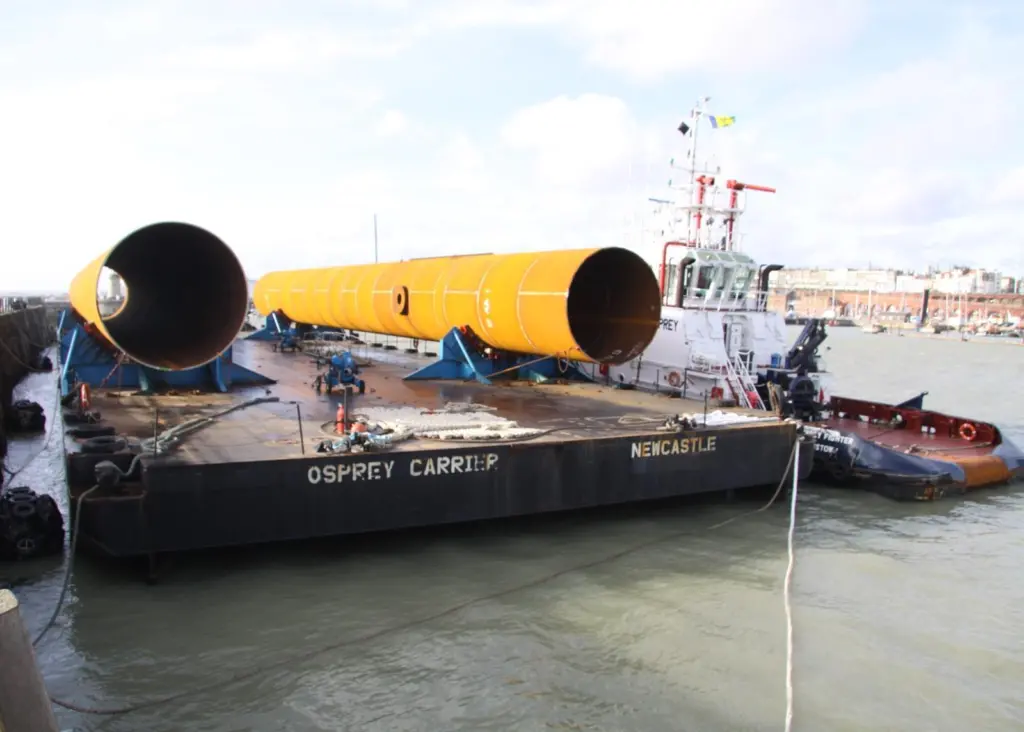
The logistical challenge and its anticipated cost have galvanized designers, developers, and government backed agencies to reset the thinking on subsea foundation design. But the task has by no means been easy.
“With wind turbine sizes now scaling up to 5MW and beyond, the top-head mass is virtually double that of the current mainstream sizes”, said Alan Tricklebank, author of the latest Wind Energy Update Offshore Wind Construction and Installation Report.
“A corresponding increase in the major static and dynamic loadings imposed on the underlying support structure necessitates a new type of thinking on turbine foundation design.”
It has been a considerable ask. But according to the report, a new generation of easy to install subsea turbine foundations designed for mass production is primed to hit the market in the next 24 months.
According to the report, the hiatus in the development of novel offshore wind foundations, following the introduction of monopile foundations, has ended. Among the host of new designs about to break out of pilot mode and into full scale commercial development, gravity base foundations show particular promise.
The UK Concrete Centre and others have advocated concrete gravity bases for several years. However, if these are to be competitive, “innovative approaches need to be applied to their design, production and installation”, says Tricklebank.
The report singles out several promising options due to hit the market by or before 2014. Among them is the Gifford/BMT /Freyssinet consortium’s pre-stressed and reinforced gravity bases, designed for mass production and deployment in water depths up 45m. The system involves onshore pre-assembly of the tower and turbine onto the gravity base unit and installation offshore as a complete structure.
The Hochtief/Costain/Arup consortium is also working on a gravity base designed for quayside manufacturing. Following a two step assembly line, the completed unit can either be stored in the dock or towed to site by DP2 tugs (in waves heights of up to 2m, according to the simulations), positioned, and water ballasted to sink it in to position.
Norwegian start-up, Seatower has developed a set of ‘Cranefree’ foundation designs for offshore wind farms in deep water. These cover gravity base designs that are self-floating tripods and jackets. The gravity base system in particular is designed for mass production onshore from a quayside facility.
A winning feature of gravity base foundations is that delivery and installation of an individual foundation can be undertaken in a 1 or 2 day round trip. “This allows best use to be made of the forecast weather windows, permitting high rates of installation without multiple unit cargoes”, explained Tricklebank.
This ‘single shot’ installation of the foundation and pre-installed turbine unit contrasts sharply with the strategy for steel foundations, where installation vessels are kept offshore and on station for several days, with their own cargo of multiple sets of components, or a supply delivered by additional vessels.
Gravity base foundations also eliminate the negative marine impacts associated with pile driving noise. The robust structures are less sensitive to vessel impact and they are highly durable. There is the possibility of re-powering with new turbines for two 20 year life cycles or more.
Furthermore, with an existing, large, supply chain and as a relatively abundant resource, concrete is less sensitive to price fluctuations than structural steel. According to the report, these factors could be a key determinant in persuading risk averse developers to adopt concrete solutions.
Related Articles
 ACCESSORIES & EQUIPMENT
 MARINE CONSTRUCTION
 POWER & PROPULSION