



China breaks another turbine record but Europe stands firm
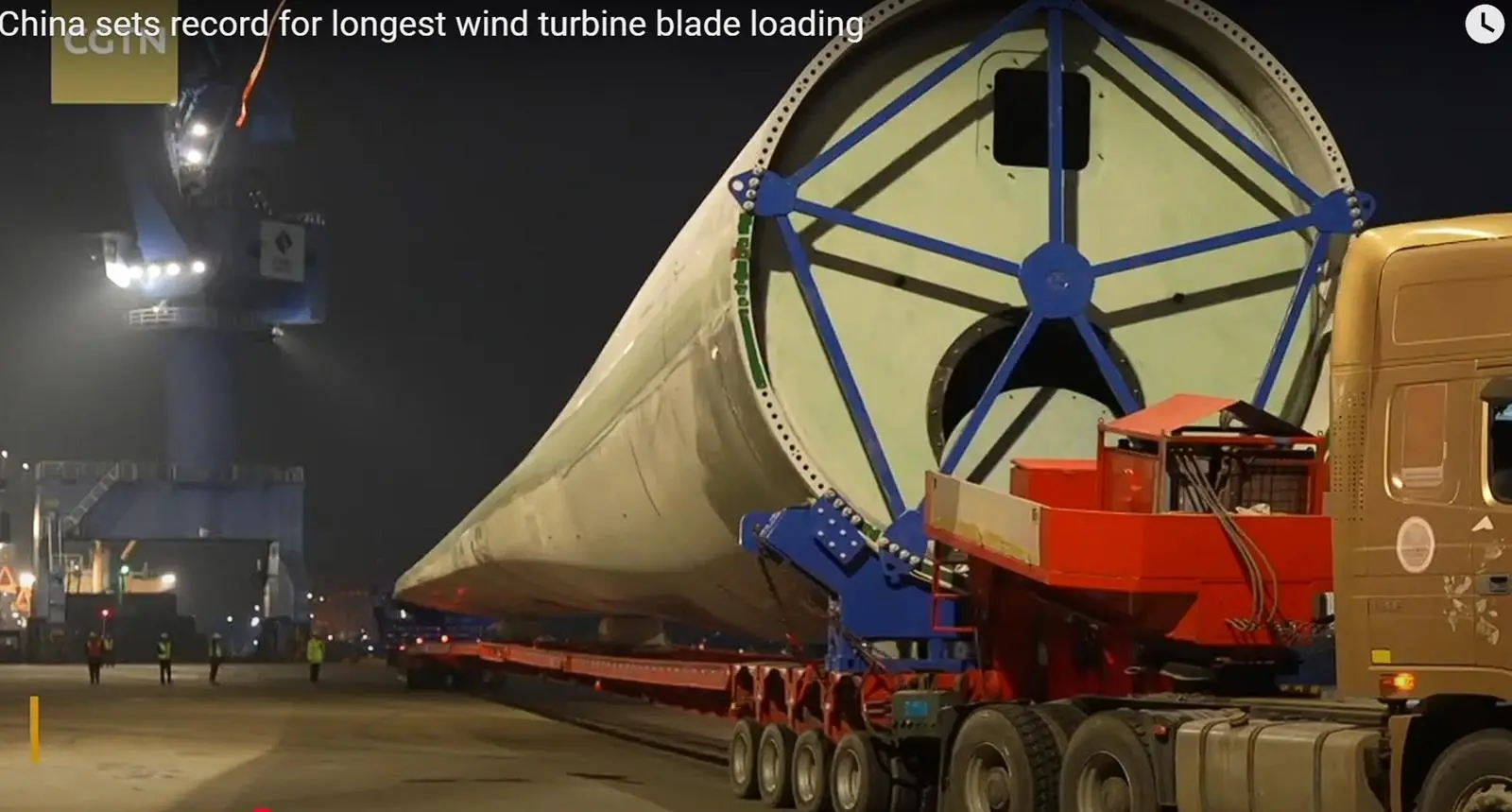
A Chinese government-owned TV channel has released a YouTube video of what it says is the biggest offshore wind turbine blade that has ever been handled by a port.

The China Global Television Network (CGTN) video says the blade is 133 metres long and weighs 67 tonnes, and required the use of a gantry crane cooperative operation system for the first time to get it onto the ship.
It does not name the manufacturer of the giant blade.
The loading was done at the Yangzhou shipyard which, the video says, has become an important loading and unloading port for the collection and transport of wind power equipment in the middle and lower reaches of the Yangtze River.
As if this wasn’t enough, there are already rumours that some Chinese manufacturers are building 25MW wind turbines, which would rotate even bigger blades.
So where does this leave Europe?
Europe is sticking to its guns and looking after its wind industry domestically, says WindEurope Press & Communications manager Christoph Zipf.
While it is true that Chinese turbines are cheaper, there are a host of reasons why orders for Chinese turbines for the whole of 2024 made up just 2%.
Why Europe is steering clear of China
“This is one of a series of announcements from China about different technology breakthroughs and new models,” says Zipf. “But it’s not changing the situation the European wind industry is in vis-à-vis international competition.
“We know that the Chinese OEMs are working on very big turbine models, but we don’t see the market share of Chinese OEMs in Europe increasing. If we look at our orders monitoring 2024 for the full year, Chinese orders made up less than 2% of the European market.
“There are good reasons for that. The turbines are far away to be transported, there are maintenance and operations issues and the market is driven by European manufacturers. The European Commission over the last two or three years on various panels have said they want their clean technology to be made in Europe.
“They have come forward with a big wind action plan to improve industry and ramp up the manufacturing capacity in Europe. The Clean Industrial Deal is putting the wind market in Europe at the heart of European competitiveness.”
Politics and security
There are also political reasons why China is losing popularity with Europe.
“One of the reasons we are not buying Chinese turbines is that the European Commission has launched an investigation into EU foreign subsidies regulation, and they suspect China is unfairly subsidising their turbine manufacturing,” says Zipf. ”This has far-reaching powers – if supplier contracts between European manufacturers and Chinese OEMs are not legal, the EU has the power to fine them as well.
“There’s a different understanding now, with China being very aggressive and the US having changed their approach to trade, and Russia not sticking to the rules.
“We also have to get our act together as Europe and perhaps be a bit less globalist, have a bit more consideration for security and supply – this is where our European policy making is going.”
In the wake of several incidents of Russian and Chinese vessels being suspected of cable sabotage in the Baltics recently, security is a higher concern.
“There’s an understanding in Europe that we need to secure our assets both physically and digitally,” says Zipf. “The EU doesn’t want the data collected by wind farms to go to China.”
Speed of scale-up
It seems that no sooner does the next iteration of giant turbine hit the market, a bigger one hits the factory – and this, Zipf says, is because of competition between Chinese manufacturers themselves. Europe does not need to join in this race.
”The Chinese manufacturers have stiff competition between themselves,” he says. “They compete among each other. They have to keep on innovating and pushing the boundaries – they have very short innovation cycles, they bring a turbine onto the market and already they are running the next cycle.
“It is true that bigger blades increase generation, they’re more efficient, you don’t need as many, but European companies are not state funded, and we like to run things for a few years to see how they work.
”We shall see when the European OEMs have announcements to make.”
Related Articles
 OTHER NEWS
 OTHER NEWS
 SPONSOREDSTORY