





Lightweight cutter restores German lock
As part of Germany’ s WSV and the Bundersministerium’ s River Neckar, the twin Guttenbach Locks were first built in 1939 with a second lock being added in 1955.
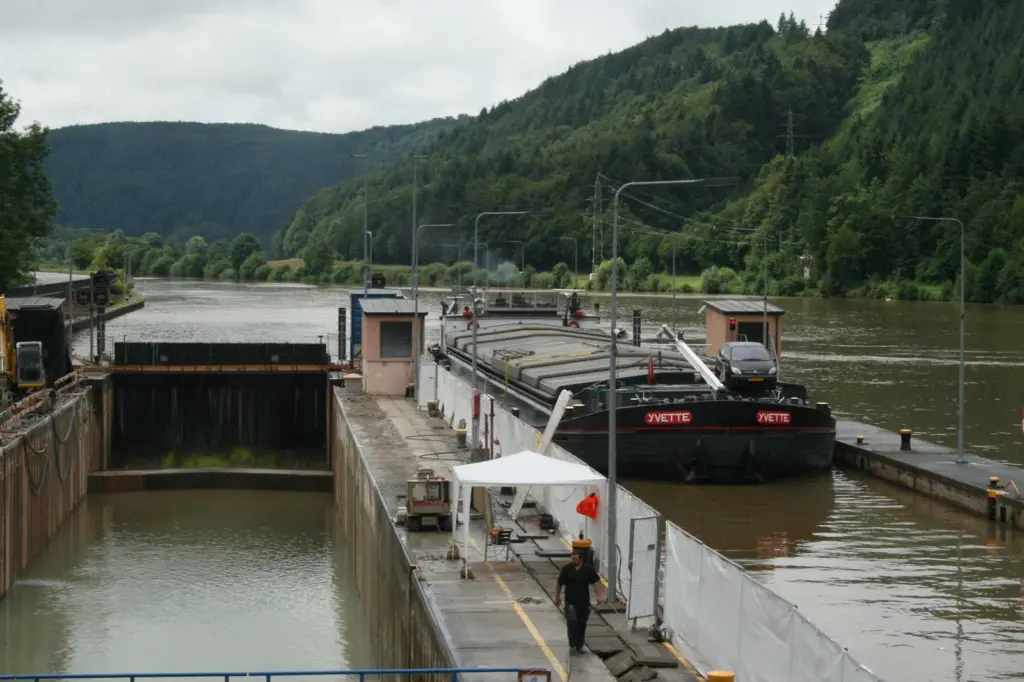
Hydrodemolition techniques using an Aqua cutter HD RA system with a robot arm from Sweden’s
were chosen to remove poor quality and cracked concrete on the Guttenbach Lock.
The middle wall separating both locks and also built in 1939 is just 1.2m wide. With excessive cracking on both sides of the lock walls, weight loadings were a critical factor in determining the method of removing the concrete slab across the full 1.2m width.
Hydrodemolition specialist Luckei Betonfrästechnik, based at Bendorf in Germany, was awarded the contract for the concrete removal and opted to use its Aqua cutter HD RA robot, which weighs only 1700kg.
Luckei is using the Hydrodemolition robot to remove 400mm of concrete along the full 100m long lock wall; totalling 280 cu/m.
The compact and versatile HD Robot Arm is proving ideal for working on the 1.2m wide strip. It features Aquajet’s improved EDS cutting head which keeps the set distance from the nozzle to the surface independent of the selected lance angle, optimizing the removal rate and saving energy. The system also has no electric cables or sensors at the front, eliminating the risk of malfunction due to moisture.
All movements are hydraulically manoeuvred by remote control, a safe distance from the unit. No manual adjustments or use of tools is required to position the robot arm.
Use of hydrodemolition techniques ensure no rebar damage, minimise the risk of good concrete removal, eliminate dust and crystalline silica pollution and leaves a superior bonding surface. It is also substantially faster than mechanical removing methods and is also considerably less labour intensive.
Together with the robot, Luckei is operating a high pressure Power Pack with the capacity of 250 litres/minute of water at 1000 bar pressure. Water is taken from the river and filtered to ensure performance is not affected by dirty water. After use, the water is again filtered and returned to the river.
A tempory gate barrage has been placed across the upstream end of the lock closest to the river bank and water pumped out to provide a dry lock for Luckei to prepare the 9.5m wall. Luckei will then use hydrodemolition techniques for the severely cracked walls and is considering the use of Aquajet’s recently introduced hybrid robot, offering an extended vertical cutting reach of 9m.
Once re-concreted and additional strengthening is completed with the installation of 20m deep pre-stressed anchors along both sides of the lock, new gates will be installed for the lock to resume normal duties.
The River Neckar is 367km long and forms a major tributary to the River Rhine which it joins at Mannheim, discharging an average 145m³/s of water into the Rhine. This makes it the fourth largest tributary and Germany’s tenth largest river.
It is navigable for cargo ships up to the river port of Plochingen, some 200km upstream from Mannheim and features 27 locks dropping the river from 247.32m to 86.50m.
With barge traffic using the Guttenbach Lock every 10 to 15 minutes between 7:00 and 22:00, plans are underway to increase the length of the lock from 100m to 130m in readiness for the new generation of longer barges.
The main contractor for the Guttenbach Lock project is Echterhoff GmbH & Co Kg and consulting engineer is Glass Bauuternehmung GmbH.
Related Articles
 MARINE CONSTRUCTION
 EQUIPMENT
 MARINE CONSTRUCTION