

British architect Lord Foster used a recent lecture at the University of Oxford to reveal more details of the recently proposed ‘Thames Hub’ (see MJ NOV 2011).
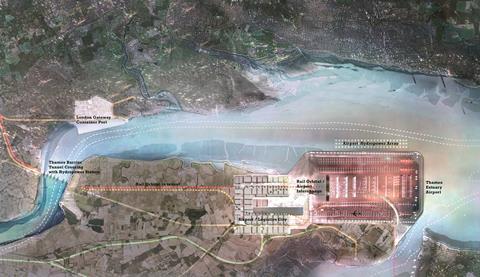
It is an integrated infrastructure plan for the UK that includes construction of a new airport on reclaimed land in the Thames estuary. Since the launch of the plan earlier in 2011, further studies have been undertaken into the proposed Thames Hub, which includes a £20bn high-speed Orbital Rail line around London, a new £6bn Thames Barrier and crossing, and the £20bn international ‘Estuary Airport,’ with annual capacity for 150m passengers. The total estimated cost of the project is £50bn.
“All of this takes place in the context of a comprehensive environmental management strategy that minimises the impact of development and provides opportunities to create significant new wildlife habitats to more than offset losses elsewhere”, said Lord Foster.
The proposal includes a detailed study of wildlife habitats in the Thames Estuary; investigating the potential for a new nature reserve; analysis of the wreck of the SS Richard Montgomery, a World War II munitions ship which lies close to the proposed airport site; a survey of the settlements and listed buildings on the Isle of Grain; further detail on rail alignment and integration of utilities and gas insulated cables; and possible locations of intermodal stations on the Orbital Rail link. Studies have also been carried out into the possible increased risk of bird strikes on airplanes in the Thames Estuary. Findings indicate that this problem is not unique to the site and many precedents exist for dealing with it.
Lord Foster said that in recent weeks, the Thames Hub team has also met a large number of public and private sector stakeholders across a range of infrastructure sectors and has received strong support for the Thames Hub proposals. Initial discussions with investors have shown that there is interest in supporting the project through its planning, design, construction, and operation and maintenance phases. With an appropriate political and planning framework, this is a project that can be delivered.
The main components of the Thames Hub are:
• A new barrier crossing that extends the flood protection to London and the Thames Gateway into the 22nd century. The barrier harnesses tidal power to generate carbon free energy.
• A four track, high speed passenger and freight Orbital Rail route around London, which links London’s radial lines, a future high speed rail line to the Midlands and the North, the Thames Estuary ports, High Speed 1 (Channel Tunnel to London), and European networks.
• An international Estuary Airport, capable of handling 150m passengers per annum, thus enabling the UK to retain its global aviation hub status. The airport is integrated within a logistics matrix that connects by rail the Thames Estuary Ports and the ports of Liverpool, Southampton and Felixstowe. Associated with the Hub is a major renewable energy source in the Estuary.
• A new utilities and data spine in the Thames Barrier, Orbital Rail line and high speed networks, with applicability across the UK.
• A comprehensive environmental management strategy that minimises the impact of development and provides opportunities to create significant new wildlife habitats to more than offset losses elsewhere. The project can also be the catalyst to reduce pressure on foreshore habitats from rising sea levels and storm activity.
Lord Foster said the impact of the hub on foreshore habitats within the Thames Estuary has been of major concern and the wider impact of changing sea levels has been considered. Work is now underway to find a site for a new nature reserve island for displaced migratory birds and wetlands wildlife to create secure new habitats.
Such a facility would build on the experience being developed at Wallasea Island in Essex, where a 600 hectare site has been returned to its original state as a salt marsh. The aim is to create a new habitat that will allow not only new breeding and feeding areas but the opportunity for Britain to lead in addressing the impacts of rising sea levels.
Concerns have been raised about the safety of the wrecked World War II munitions ship, the SS Richard Montgomery, lying in shallow waters approximately four miles from the proposed terminal buildings. The design team has met the Ministry of Defence, which advises that as long as the wreck is not disturbed during the construction of the airport there would be no danger. A strategy for modelling the sea bed in this area is being developed to ensure that this will be the case.
Lord Foster noted that while the Isle of Grain, the proposed site for the airport and extending onto reclaimed land, is one of the most sparsely populated areas in the southeast, extreme sensitivity is needed to compensate and rehouse those people and businesses that would be directly affected. Studies have identified a number of listed buildings that could be affected by a new airport development on the island and a strategy has been developed which could either allow for their inclusion in any new development or their careful removal and relocation as necessary. The team has also studied several precedents for building relocation.
In recent weeks, plans for the new airport in the Thames estuary have won political backing from senior figures close to David Cameron. They are said to include Steve Hilton, the Prime Minister’s strategy chief, and Chancellor George Osborne.