![MaritimeJournal[Seawork]](https://www.maritimejournal.com/wp-content/uploads/2026/09/MaritimeJournalSeawork.svg)





Pilot project launched to use AI to save lives
A joint project to use artificial intelligence to save lives at sea has been set up with a focus on for floating wind farms.
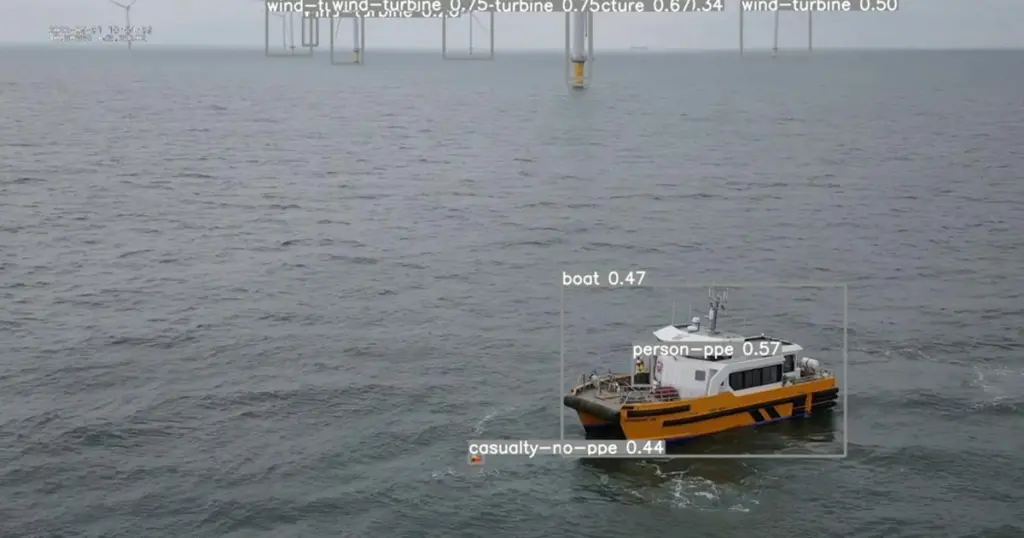
Joint venture Ocean Winds, a 50-50 deal between energy firms EDP and Energie, has signed up UK start-up Zelim, which makes person overboard recovery devices, to test Zelim’s AI enabled person detection software.
During the pilot project, cameras on two turbine foundations at the WindFloat Atlantic project will send live feed to Zelim to monitor.
The software, named ZOE, detects people and objects in waters around turbines and sends alerts to the O&M centre should a safety incident arise, such as a person falling into the water, or an unknown vessel entering the site.
“Finding someone in distress at sea is often a game of chance, especially when you factor in waves, sea spray, darkness and how quickly people can drift in the current,” said Zelim chief technology officer Doug Lothian.
“Couple that with the limitations of a human searcher’s eyesight and concentration. We have been developing ZOE over the last three years to increase certainty in search, even in challenging conditions. We see ZOE providing a safety net around offshore assets, where if somebody ends up in the water, they will be detected and an immediate alert sent, thereby enabling a fast and efficient rescue.”
“As a pure offshore wind developer and operator of more than 1.5GW in the world, a key focus at Ocean Winds is the increase of the safety and health of our workers and communities, which always come first, said Elena Caja, on behalf of the energy firms. “Levering our innovation mindset, we work hand in hand with partners in search and pursuit of groundbreaking technologies that can actually make a difference and help us in this endeavour.”
This is not the first project using Zelim AI. In September, the US Coast Guard signed an agreement to trial the technology.