![MaritimeJournal[Seawork]](https://www.maritimejournal.com/wp-content/uploads/2026/09/MaritimeJournalSeawork.svg)






Angelo Bovo: Veritas SPA
The ubiquitous waste collection boats seen around Venice, 130 of them in all, are getting a makeover: one of the original designers, Angelo Bovo of Veritas SPA, admitted it’s “satisfying” to get another shot at it.

In fact, Bovo’s first job for Veritas back in ‘93 was to “evolve” the design of the waste collection boats that clean up around the historic centre. The development utilised innovative plant engineering – and, he explained “of the technologies then available, the hydraulic system was best for the flexibility it allowed”.
Bovo went on to get even more deeply involved in ecological solutions: for 11 years he collaborated with Veritas’ spring-off, Ecoprogetto Venezia, which transforms the refuse to energy: “We only send 4% of Venice’s waste to landfill,” he told MJ. Alongside this is a plethora of ‘eco-engineering’ projects that include photovoltaic plants, co-generation systems and even biomethanol trucks.
But issues in connection with the original waste collection boats had slowly become apparent over time, especially “noise, maintenance and the possibility of leaks”, admitted Bovo. So it’s been quite satisfying to get a chance to update these vessels with a more environmentally-friendly design.
The remit, he explained, was to electrify the three onboard systems, propulsion, compactor and crane and to reduce to near-zero the leakage of hydraulic oil.
This wasn’t to be straightforward. The first issue was the size and weight of the electrical systems compared to the original hydraulic versions; the crane’s actuator, in particular, just didn’t fit. Despite a fleet replacement programme which will eventually change the metal hulls to composite builds, the scale had to remain the same to fit into Venice’s existing infrastructure.
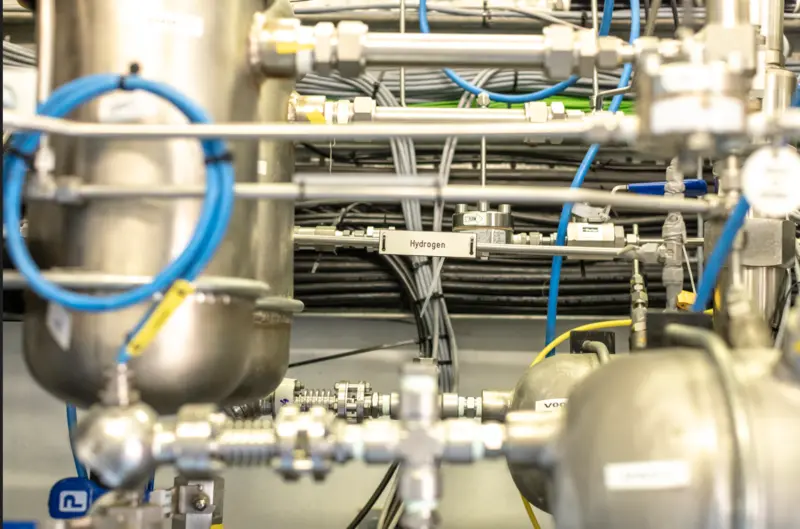
So, while the main configuration is to be electric, a pressure system had to be retained for the crane. Here, Bovo had a novel idea: “Switch the fluid from hydraulic oil to seawater,” keeping the boats free of the main, polluting culprit. However, as he quickly found out “it isn’t easy to find components”. Luckily a fellow Italian manufacturer, Tech Euroengineering from Turin came to the rescue, with an offer to design and build these new, seawater-driven valves.
The final challenge was regulation, as the maritime law is designed primarily for large vessels – not small boats. “So many redundant components are required needing extra space… and this means weight also increases significantly.” However, long meetings with the authorities finally paid off and the boats were declared fit for purpose.
He’s proud of the results, as the benefits include the virtual elimination of oil leaks and reduced emissions – a range-extender genset is only used outside the city centre. However, he added that its hushed operation is extremely welcome: “The city is very quiet – you make a noise and everyone complains.”
Finally, Venice should see the first of these vessels fairly soon. As Bovo explained: “If the prototype test result is positive, we will gradually replace the original fleet with new electric boats.”
By Stevie Knight