![MaritimeJournal[Seawork]](https://www.maritimejournal.com/wp-content/uploads/2026/09/MaritimeJournalSeawork.svg)






Gerhard Kutt: Daredevil turned innovator
Gerhard Kutt, of internationally based (Hydrofoil Assisted Water Craft) HAWC Technologies absorbed lessons in hydrodynamics from an interesting perspective, the wake of a speedboat.
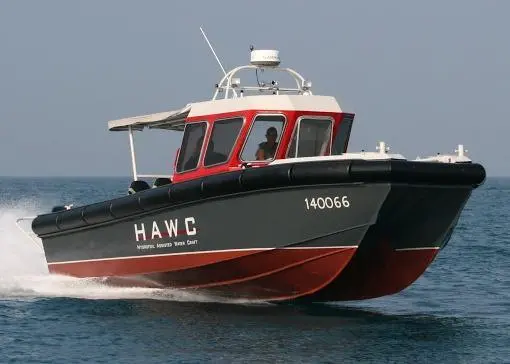
For many years Mr Kutt was one of Asia’s top waterskiing champions, “so fast boats were a technology I was very familiar with”. More recently his experience has been key in bringing innovative hydrofoil elements to speedier craft, giving established European workboat designers the option of integrating new technology in a way that doesn’t have to wipe out years of careful development.
Mr Kutt’s explains it all started back in 2002, following a chance meeting with “the grandfather of the hydrofoil”, Professor Gunter Hoppe on a trip to Cape Town.
“A number of us piled into a one of Professor Hoppe’s hydrocats. It was a 22ft boat with just a pair of 50 hp outboards, and considering the weight onboard I nearly laughed my socks off as I’d been more used to a couple of hundred horsepower to get any pace up.” Not for long. “My first surprise was reaching planing speed in seconds. Next, I’d braced for slamming as we hit rough water but the boat simply didn’t behave the way I’d come to expect.”
Fascinated, he started to find out more. “These weren’t straight hydrofoils but hybrid designs that didn’t need a complete, bottom-up rethink of the entire vessel form. They reduce drag but keep a significant amount of hull in contact with the water.”
The technology’s ability to be incorporate into existing designs without demanding huge modifications made him aware there could be a different, more collaborative kind of build project, an idea which eventually set Mr Kutt on the path of forming Hawc Technologies.
Having negotiated the build on a demo vessel, Mr Kutt explains that he started inviting marine police, customs and anyone who’d be especially interested in heavy-going performance. He says: “To show what the boat could do, we’d go into a full lock turn in waves a couple of metres high”, and while admitting this manoeuvre was almost guaranteed to alarm, “luckily these people are used to it” he says, perhaps just a touch too blithely.
A breakthrough came in 2012 with the interest of Hong Kong’s Agriculture and Fisheries Department, which needed to patrol a UNESCO site; “They thought they needed a much bigger craft, but we took them out in rough weather and gave them a 37 knot run which convinced them to go with our system,” says Mr Kutt. Other projects have followed, but his central idea is to work with, not against, existing designs.
“I know many people try to keep innovation to themselves, but this industry is rife with copycats. So, we really think it is more effective to help people out, even if our cut is smaller. At least it gets the costs down, the quality up, and more of these boats getting into the water,” he concludes.
By Stevie Knight