![MaritimeJournal[Seawork]](https://www.maritimejournal.com/wp-content/uploads/2026/09/MaritimeJournalSeawork.svg)



Michiel Wijsmuller of OSD, the resilient entrepreneur
After studying naval architecture and shipping management, Michiel Wijsmuller didn’t simply settle into the family business even though it was the great Dutch towing and salvage firm developed by his grandfather, Jan Wijsmuller.
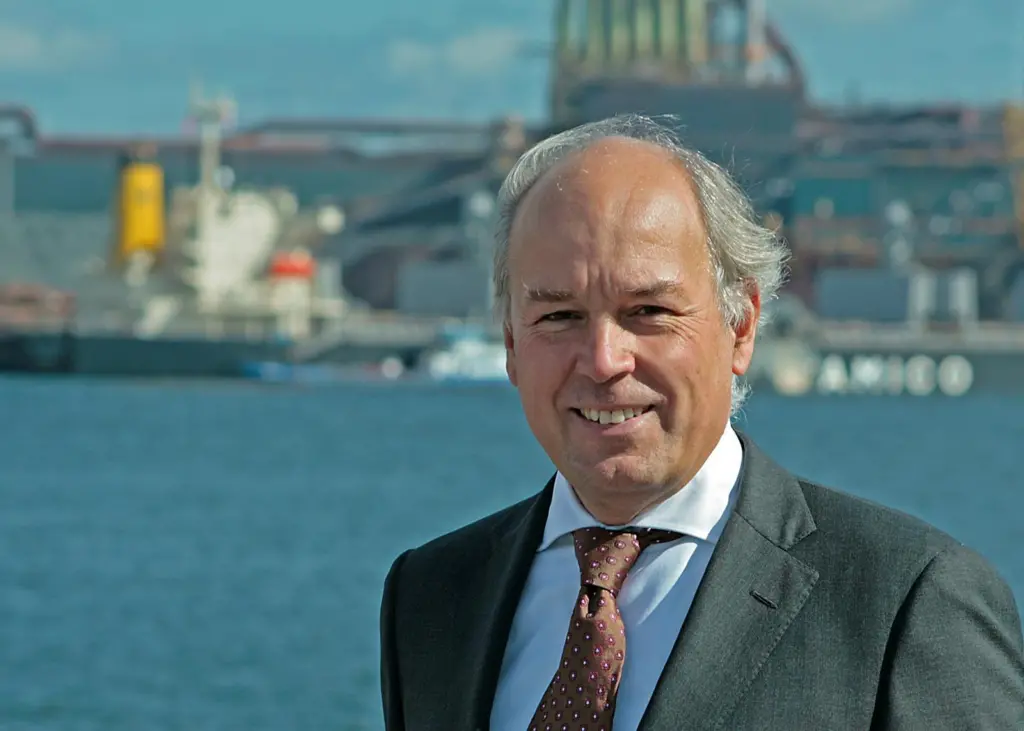
Instead he cut his teeth on a ‘strategy’ role in the Royal Dutch Steamship Co, only joining the family firm in 1980 at the age of thirty, growing the terminal towage side three years later from a base in the Dutch Antilles. “It wasn’t limited to South America. We gained terminal contracts all round the world including Asia,” he said.
However, by 1988 the main business was struggling with its heavy lift division. Mr Wijsmuller returned to take the helm and engineered a sale, freeing both companies to develop. There is still a link in the name: “The ‘wise’ in Dockwise tells you it started with Wijsmuller,” he pointed out.
Then, out of the blue, it seems Wijsmuller became a victim of its own success. After a 90 year history and the development of the largest towing service in the world, 2001 saw shareholders forcing a sale of the company and its 150 vessels to Svitzer, part of AP Moller-Maersk. Despite some sadness, Mr Wijsmuller argues against sentimentality. “On the whole it’s much better to sell up while a company is making money,” he said.
Then again, these events proved to be the springboard for his own entrepreneurial challenges. Mr Wijsmuller is at present chairman of Amsterdam Ports Association, owner of tug broker Worldwise Marine BV and the international Offshore Ship Designers (OSD), both formed by the buyout of a section of the earlier Svitzer deal.
OSD in particular has been given wings with its independence, explained Mr Wijsmuller. “Because we are not tied to a manufacturer, unlike many of our competitors, we can be fully free and this means we can adapt designs more easily.”
For example, a recent, unusual ice-breaking anchor handling design had to be able to pull together very divergent specifications for the Caspian Sea. “We had to reconcile the need for a structure which is light enough for shallow draft environments but strong enough to work in heavy, 70cm ice,” explained Mr Wijsmuller.
Not everything develops according to plan, as a zero-emission Green Tug with Iskes hasn’t really taken off. “It was innovative, but the market just isn’t ready for hydrogen fuel cell harbour tugs,” he said, adding that developing legislation and ‘green consciousness’ might push things forward. Despite this, other aspects of the Green Tug, such as its extremely efficient hull, have gone on to benefit recent vessels.
Other future-predicting moves have been a strategic success. The company has design offices in Europe, the UK and especially Shanghai, with a Singapore office providing a local hub for a growing market.
In short it is fair to say Mr Wijsmuller’s career has been in part about the sometimes difficult balance between flexibility and resilience – both in ship design and in life. Not easy, but a nice trick if you can master it.