![MaritimeJournal[Seawork]](https://www.maritimejournal.com/wp-content/uploads/2026/09/MaritimeJournalSeawork.svg)






Perry van Oossanen: Looking over the overlooked
“I don’t think innovation is the result of a clever idea in a single moment; it’s more about putting together all the pieces of a puzzle,” Perry van Oossanen told MJ. “Slowly the lightbulb begins to glow.”
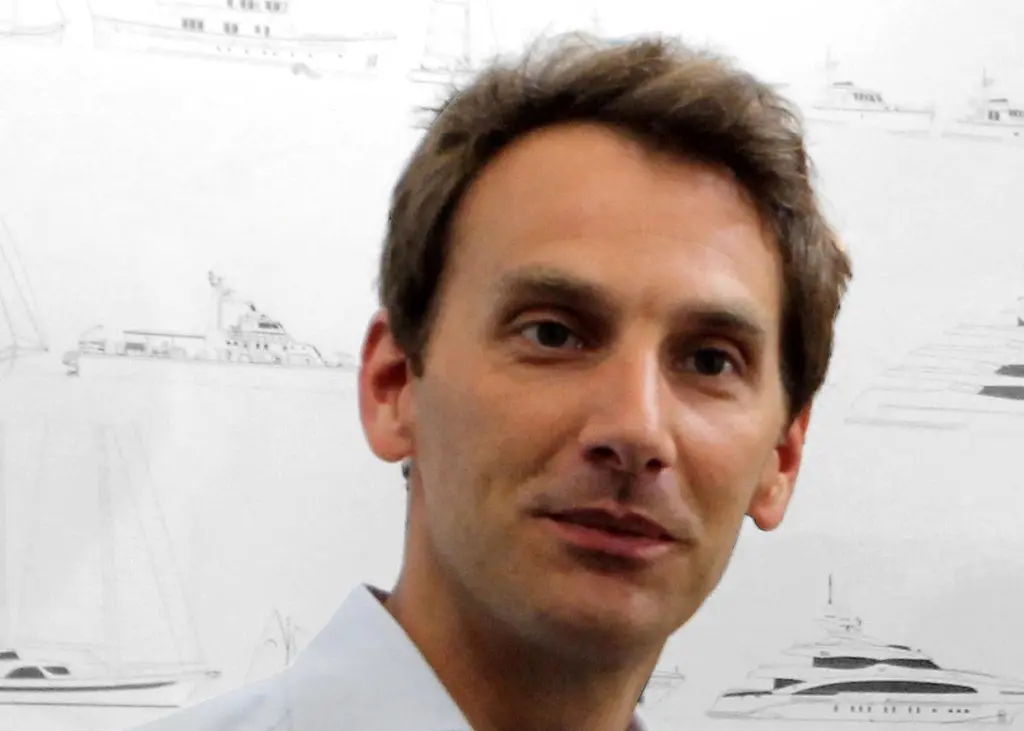
After college he slipped “naturally” into a place at Oossanen, his father’s Dutch naval architectural firm and later helped drive the Hull Vane, a novel hydrofoil that adds thrust rather than lift, onto offshore support craft and navy patrol vessels. But events proved that van Oossanen Sr is not the only one with groundbreaking ideas.
Further, the right time for a new concept may not be the obviously auspicious one.
“At the beginning of the financial crisis my father Pieter, then director, knew there might be a lull in the commercial work so he asked us all to think of an R&D project we would like to follow.”
It was a wise move as these became the kernel of some extremely innovative designs which helped the company grow even during the recession: Perry chose to focus on what some might have dismissed as a simple anomaly.
“The tank test results from an earlier project had showed up something I really hadn’t expected – a bulbous bow that seemed to raise efficiency even at semi-displacement speeds. So one Friday afternoon I sat down with all the various bits of information spread out around me to work out why, and what use could be made of it.”
“While a hard chine hull gives you good results if you get it up and planing, many of these boats spend most of their time down in the water; so I was looking for something that would be effective at both high and low speeds.” This became the start of the company’s fast displacement hull which has a bulb and still retains a rounded form – but gives the necessary efficiency. It’s become one of the company’s success stories with around 25 builds to date.
Despite this, Mr van Oossanen admitted “difficult projects still show me how much I have yet to learn” and since he and his partner have been running the company since 2012, he still has the sales and marketing to support throughout.
So it’s a bit of a stretch, but one he believes is useful. “The good thing about taking on both the technical and the commercial side is that you get a feeling for what’s going on; it’s a matter of finding the right balance between the technology push – where your expertise can make improvements – and market pull – what your clients are asking about: this puts you in a better position to tune your research… the fact is you can think up some very clever ideas but if no-one is interested, they just won’t find a home”.
He added that more is in the pipeline: “The next hull form will be significantly better at seakeeping giving windfarm and patrol operations much greater operability without compromising the hydrodynamics. After all, that’s our number one boundary condition.”
By Stevie Knight