![MaritimeJournal[Seawork]](https://www.maritimejournal.com/wp-content/uploads/2026/09/MaritimeJournalSeawork.svg)




Breaking into the plastics and marine debris market
A V-shaped, zero-emission floating debris collector is due to hit the market later this year.
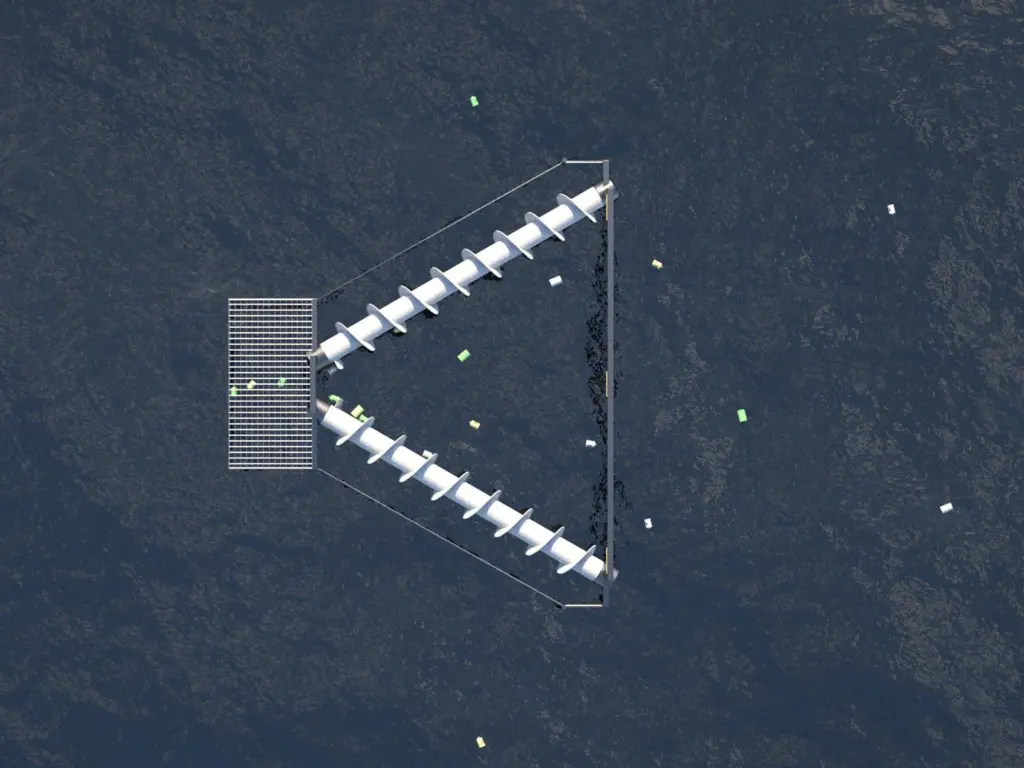
Importantly, it has neatly avoided the price-increasing traps of energy consumption, crew and complexity “all of which result in high capital and operational cost” says Radé Svorcan, of Canadian developer, Technika Engineering.
It’s managed this feat by incorporating the buoyancy, debris collection and even propulsion into helicoidal arms which turn like screws. The action moves the floating waste down to a collection basket which gives the DeltaSea unit the ability to process concentrated debris “even in areas where you can’t really see the water for the plastic”, said Svorcan. He added: “Other technologies tend to be quite limited in these locations, both needing high power and getting clogged.”
These ‘arms’ also provide it with a stately, 1m per second transit pace. “The first commercial units will be battery driven, being recharged in port,” says Svorcan, “but later ones will be able to pick up solar power and wave energy, making them useful for more isolated locations”.
It’s fully kitted out with remote monitoring and control systems to allow a safe interface with other vessels and marine life: there’s also a camera option for navigation support in densely trafficked areas.
The prototype trials in Canada have shown it’s effective. “Our ‘nominally sized’ unit has 6.5m arms and can cover up to 0.5 km2 of water surface area during a 24-hour operation period,” said Svorcan.
This model promises to provide a valuable tool to ports, terminals, hydroelectric plants and other areas where floating litter is a problem – especially as the twin arms can be closed up for easy storage and transport. However, a remote, offshore version can be scaled up to deal with four times that.
While the basket at the back will be sized for harbours, when it comes to very polluted rivers, it will be customised with conveyors on the rear that will engage with a barge to accept larger quantities of debris prior to transfer to shore.
As a useful extra, it’s not limited to plastics: it can also clean up oil and chemical spills from the water surface in case of a pollution incident. The first Deltasea units should be available later this year, with the ballpark pricetag on the first commercial units expected to start around US$150,000 including delivery to the customer.
By Stevie Knight
Related Articles
 ACCESSORIES & EQUIPMENT
 ENVIRONMENT
 MARINE CONSTRUCTION