![MaritimeJournal[Seawork]](https://www.maritimejournal.com/wp-content/uploads/2026/09/MaritimeJournalSeawork.svg)






Discovery of offshore carbon capture site
Drilling in the North Sea has discovered a site that is considered suitable as a permanent home for the storage of carbon dioxide.
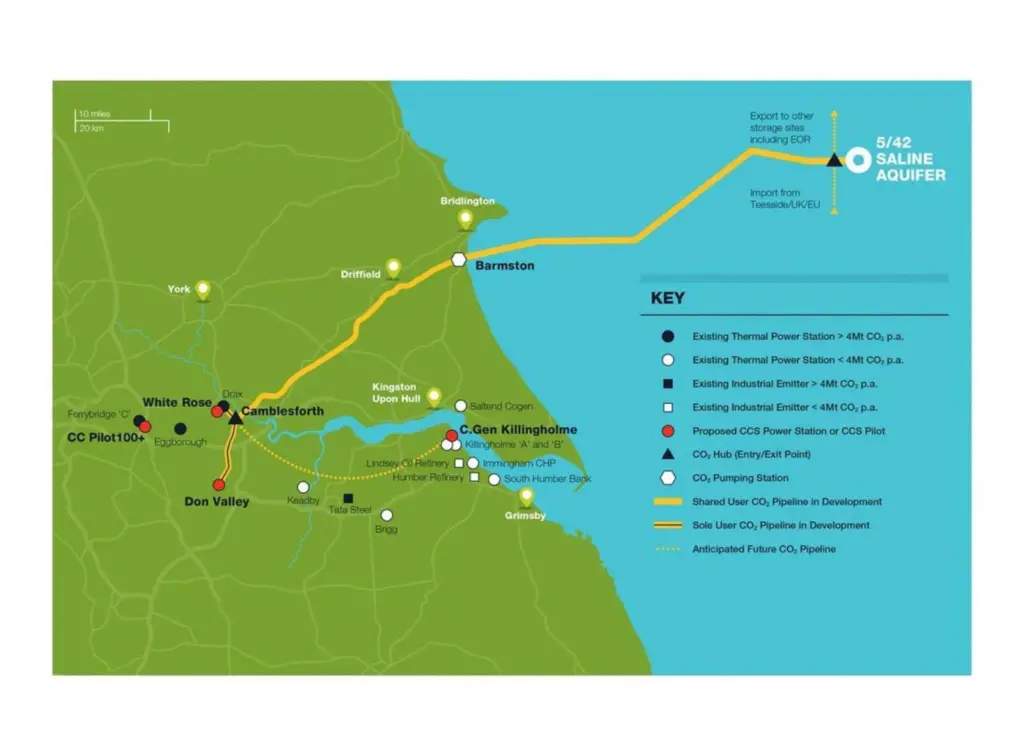
Early indications from drilling operations 65km off the Yorkshire coast have discovered a site that is estimated to be able to hold up to 200m tonnes of CO2 from a carbon capture scheme. The drilling operation was funded by an EU grant established to advance carbon capture techniques in Europe.
The storage site is located off Flamborough Head, which makes it convenient to be connected by pipeline to the heavy industry and power stations around the Humber Estuary and inland in Yorkshire. There are a number of proposed and existing coal fired power stations in this region and the plan is to link these power stations by pipeline to a central CO2 hub at Camblesforth. From there a pipeline would take the CO2 to the coast at Barmston, just south of Bridlington, where it would connect into existing redundant gas pipelines for part of the route to the storage site.
It is planned that the pipeline would connect to a well that was formerly used for gas extraction. The rocks below have become porous because of the extraction of the gas and it is planned that the CO2 would replace this gas in the porous rock formation and be trapped there by the solid rock above. The exploratory drilling has established that up to 200m tonnes to CO2 could be stored in the area.
This test drilling is just one part of the programme to establish a viable CO2 storage system. It is been undertaken by National Grid, which is part of a consortium established under the White Rose CCS project. Other partners are Alstom, which will be responsible for the construction of the CO2 hub, and Drax, which owns the major power station involved in the project. This test drilling paves the way for further investment in this technology but at present this is heavily dependent on government and EU grants for further progress, but at least the drilling has established the technical viability of the project.
Further information: www.nationalgrid.com
By Dag Pike
Related Articles
 ACCESSORIES & EQUIPMENT
 ENVIRONMENT
 MARINE CONSTRUCTION