![MaritimeJournal[Seawork]](https://www.maritimejournal.com/wp-content/uploads/2026/09/MaritimeJournalSeawork.svg)




Flood forecast buoys
Marine and coastal communities in the South West of England and Wales will benefit from improved flood forecasting, with the introduction of two new wave monitoring buoys, located off the Isles of Scilly and West Pembrokeshire.
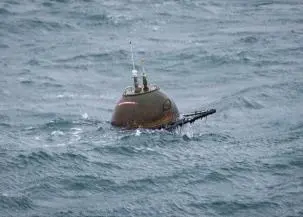
Following a review of last winter’s floods the need for two new wave observation buoys was identified by flood forecasters from the Environment Agency (EA) and Natural Resources Wales (NRW). This increases the strategic wave monitoring network specifically deployed for flood forecasting from 13 to 15 monitoring buoys.
Cefas have taken the lead in helping both organisations assess locations and prepare for the operational deployment of the new buoys. Funding for the new buoys was made available from UK government’s flood recovery fund.
Discussions with the Environment Agency and Natural Resources Wales identified optimum locations for two new buoys The West Pembrokeshire buoy was laid and activated on 11 September and the Isles of Scilly buoy went live on 11th October.
Cefas’ WaveNet programme collects and processes data from its network of monitoring buoys, tethered at strategic locations around the UK coastline. A combination of government and private industry-funded sites covering UK coastal waters provide near-real time measurements of wave heights. WaveNet is operated and maintained by Cefas who work in partnership with the UK flood forecasting authorities; Environment Agency, Natural Resources Wales, Scottish Environment Protection Agency and Rivers Agency Northern Ireland.
Cefas and the national flood forecasting authorities work together with Met Office, National Oceanography Centre and British Oceanographic Data Centre through a UK Coastal Monitoring and Forecasting (UKCMF) partnership to develop and maintain the UK wide coastal flood forecasting capabilities.
Dr. David Pearce, Cefas Project Manager for WaveNet said: “Expansion of Cefas’ WaveNet network will help improve the UK’s flood forecasting and early warning infrastructure for the benefit of coastal communities in England and Wales. The 15 monitoring sites, when combined with near-real time data made available by other publically-funded programmes and industry partners, provide comprehensive coverage of the wave climate around the UK.”
Neil Ryan, senior flood forecaster at the Environment Agency said: “These new wave buoys provide flood forecasters in the Environment Agency with an improved real time understanding of sea conditions around the south coast of Cornwall. This will help us provide better advice, guidance and warnings to communities and emergency responders about imminent coastal flood risk.”
Near-real time wave data and wave forecasts for the next 24 hours are freely available to the general public on the WaveNet website (www.cefas.defra.gov.uk/wavenet). During last winter’s storms, the WaveNet website was a key source of up-to-date information on wave conditions to marine and coastal communities, and received up to 5,000 hits per day.
By Jake Frith
Related Articles
 ACCESSORIES & EQUIPMENT
 ENVIRONMENT
 MARINE CONSTRUCTION