![MaritimeJournal[Seawork]](https://www.maritimejournal.com/wp-content/uploads/2026/09/MaritimeJournalSeawork.svg)






Oil slick detecting radar successfully verified
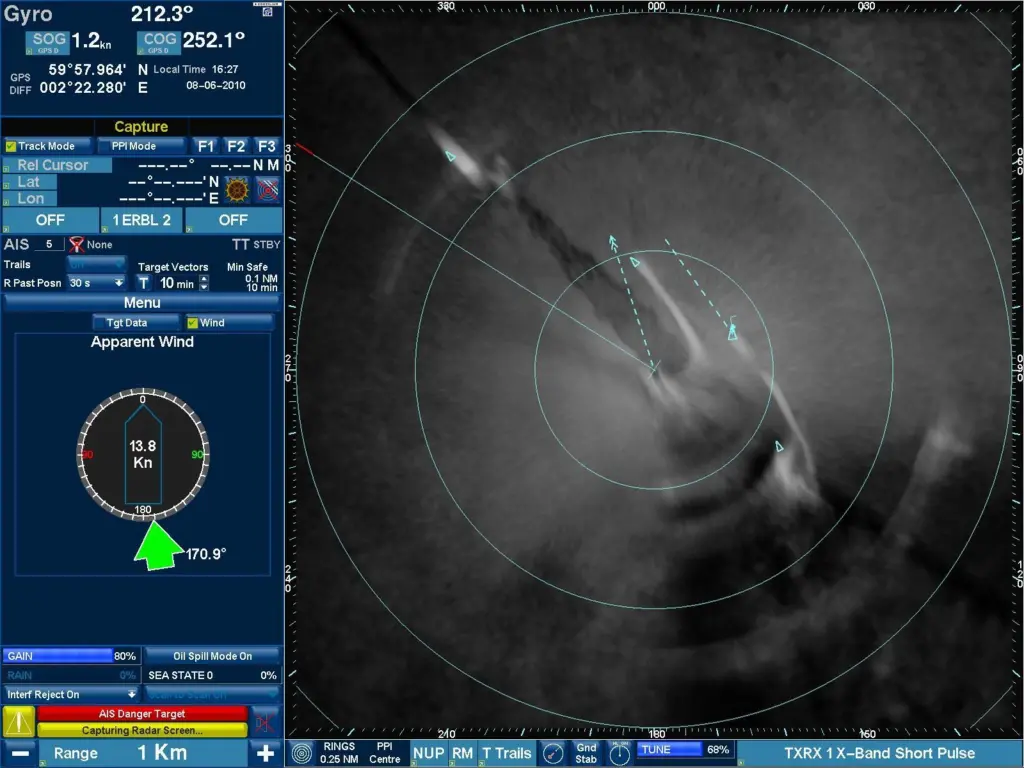
During three days of extensive testing, the advanced capability of Sweden’s Consilium’s oil spill radar to detect oil slicks has been successfully verified. The sea trials were part of an exercise to certify satisfactory safety and efficiency in oil spill response operations.
The operation was conducted by the Norwegian Clean Seas Association for Operating Companies (NOFO). The recent exercise, Oil at Sea, was the largest and most comprehensive annual oil spill response exercise in Europe. In addition to the boats’ crews, some 50 people were involved as observers. Ten boats, helicopters and planes participating in the exercise were coordinated and supervised by the Norwegian Coastal Administration.
With the permission of the Norwegian Coast Guard, the Consilium Selesmar Selux ST 340 radar display and a 12kW 9ft antenna radar sensor were temporally installed on the vessel KV Bergen. The Selux ST radar display was equipped with an add-on special edition software package, providing the advanced hardware video processing function to enable the detection and tracking of oil slicks.
During the testing, under various sea state conditions, oil slicks were detected and clearly recognised up to the maximum limit of the sea clutter map. Further to the tests, data recorded during the trials has led to the development of a special interface to present the oil slicks directly onto the Consilium ECDIS.
Consilium claims to be the first company in this market segment able to provide an oil detection feature built into in an IMO/SOLAS ARPA navigational radar plant. The radar plant is using the same hardware already approved by the Federal Maritime and Hydrographic Agency in Germany and is compliant with the European Maritime Directive (MED).
The navigation officer can use the radar display as a normal ARPA radar and then easily switch over to the oil spill function whenever necessary. A master/slave interswitch board is provided as an integral part of the Consilium radar plant, which means that the oil spill radar display can easily be interfaced to all radar sensors of the navigational radar plant.
The oil spill detection is also achieved by the technical performance of the Consilium radar sensor and by its capability to increase the speed of the antenna rotation to up to 44 rpm. The advanced video processing allows for operation under all visibility conditions. The trials were carried out during daylight and at night, with sea states ranging from 2 to 4.
Related Articles
 ACCESSORIES & EQUIPMENT
 ENVIRONMENT
 MARINE CONSTRUCTION