![MaritimeJournal[Seawork]](https://www.maritimejournal.com/wp-content/uploads/2026/09/MaritimeJournalSeawork.svg)




Creeping up on the inside, wave and tidal
Offshore wind will most likely spring to mind when considering marine renewable energy, understandable given the scale of activity throughout Europe.
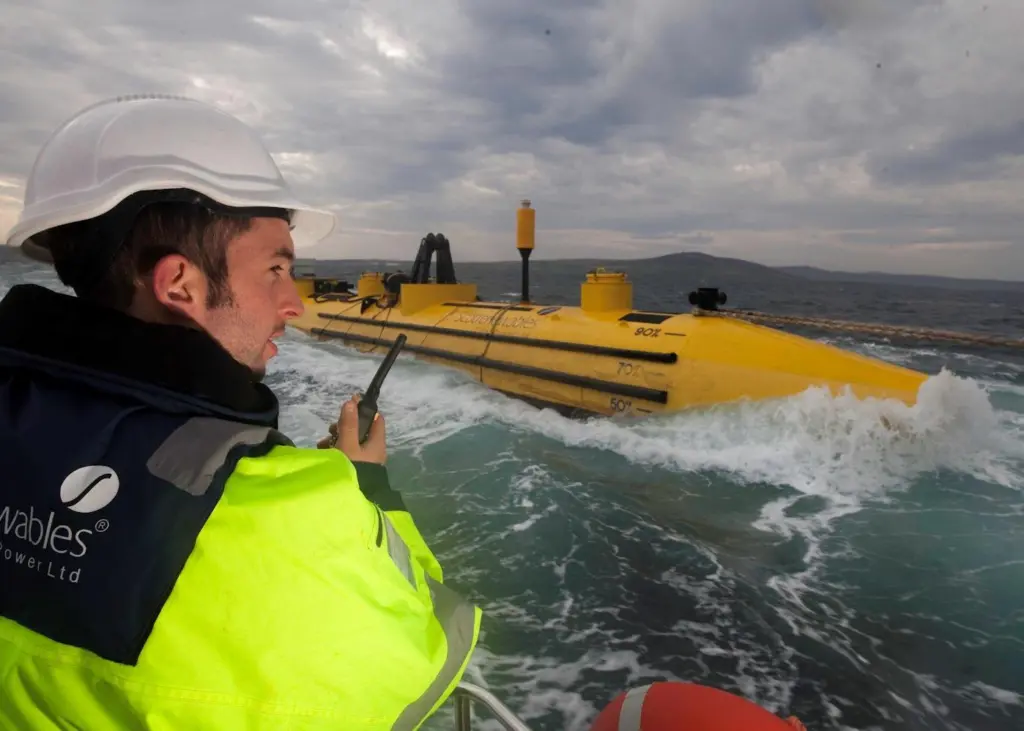
But offshore wind energy could be viewed as a sea-based development of the onshore version. The expression ‘marine renewable energy’ more accurately applies to wave and tidal (W&T), an industry that while still some years behind, is developing steadily in the shadow of its larger cousin. Currently leases have been agreed for 37 projects including test/demonstration facilities in UK waters with potentially huge opportunities for associated industries.
RenewableUK remind us that with 36GW of practically extractable W&T resources available in the UK, (offshore wind is working to deliver 25GW of capacity by 2020), marine renewable energy could provide 20% of the UK’s electricity consumption. From what is currently a small start, The Crown Estate (TCE) is planning for a peak annual W&T installed capacity in the Pentland Firth and Orkney Waters projects alone of 450MW in 2019, involving in excess of £6bn total capital expenditure.
The implications for marine based industries are significant and MJ recently spoke exclusively to John Callaghan, Programme Manager (Wave & Tidal) at TCE in London to shed light on this somewhat Cinderella industry. We found interesting and ambitious developments currently under way, clearly an industry working on the basis of providing a significant percentage of renewable energy to the UK’s energy supply mix.
It is difficult not to make comparisons with offshore wind when considering W&T energy, but natural symmetries do exist. Indeed one advantage of being somewhat behind the leader is that lessons learned can be applied in a similar way that offshore wind has learned from the UK’s long association with the offshore oil and gas industry.
STEWARDING THE RESOURCES
TCE’s role with W&T is similar to offshore wind, as Mr Callaghan explained, “Our ownership of various areas of seabed motivates our interest so we are obliged to hold the estate to account to make money from it. We look to wave and tidal project development as a commercial opportunity, particularly for the future. A reason for our entry is we are not just interested in projects being built, but built in a sensible way with a view towards sustainability and socio-economic impacts”.
Developers are expected to manage certain aspects including local issues, but TCE is able to lend support in more strategic areas such as government, regulatory and standard planning methodologies that potentially affect a number, or sometimes all W&T projects.
At this stage of the industry’s development, there are differences in the make-up of those involved compared to offshore wind. The smaller scale means that in the last decade or so a lot of momentum has come from companies developing W&T devices as they try in turn to develop markets to sell the technologies to. The level of involvement of utilities and independent project developers varies between full involvement and joint ventures with technology companies. With 37 projects now in the marine estate, including funded ones such as the European Marine Energy Centre, it is an evolving situation. But TCE points out that as with offshore wind, utilities are thinking long term and large scale, while technology companies have more pressing needs to actually sell a few machines to get projects up and running as they have been funded by a mix of government grants and private capital. Venture capital investors expects a return. It is encouraging that large equipment manufacturers are increasing their involvement through investing in, or actually buying small technology start-ups.
Asked about financing, Mr Callaghan does not see the head start that offshore wind has in the queue as a problem. “No, I don’t think it is a problem because there are sufficient investors, particularly companies interested in long term ownership, playing out to at least the end of the decade. Wave and tidal is seen as opportunities to grow their renewable energy asset base involving initial investments rather than immediate short term financial returns, with the value of learning how these projects can work. We are kind of at the stage where people are coming in to see what they can learn.”
Progress is not yet at a stage where defined ‘rounds’ are emerging as with offshore wind (at the time of writing TCE was due to announce the North Ireland and Strategic Areas). This is partly due to some developers prospecting sites without clear development plans time-scale wise, in turn partly due to lack of visible markets to sell to.
The significant development is the establishment of Pentland Firth and Orkney Waters Round 1 development sites, the thinking behind which is explained by Mr Callaghan. “We set out to stimulate the market by saying that in the Pentland Firth we have an area that has a concentration of really good tidal and wave resources. We set a target of 700MW to test the market and we received about 40 expressions of interest that led to agreements for leases totalling 1,600MW – double the original target.”
The intention seems to be working with a number of companies committed to projects and suppliers gearing up to provide the technology. Greater financial visibility has resulted, aided by grant schemes set up by DECC and the Scottish government not to mention the DECC offer of up to 5 ROC’s for W&T.
SUPPLY CHAIN PRIORITIES
Comment is often made about the level of UK supply chain content with offshore wind. With W&T however, the industry is mainly at prototype testing stage currently without the large volume demands that will naturally follow as scale increases. Developers will however be aware of the political ‘what’s in it for the community’ questions as projects progress. Again the potential is significant, TCE forecasting around £800m expenditure on device manufacturing (Pentland Firth and Orkney) by 2018.
The financial aspects however will be important considerations for developers as Mr Callaghan explained. “What we are going to see are companies trying to make projects work in the first instance, not ignoring the local interest but focussing quite heavily on the commercials. If they don’t do that they will struggle to obtain sanction to invest from their own boards, in other words normal commercial behaviour will mean going to the market to look for best value for money in supplying products.”
As another indicator of the potential, for Pentland Firth and Orkney projects TCE forecasts a peak steel requirement for device manufacturing of over 300,000 tonnes in 2018. Installation and commissioning will bring significant work for marine support industries, with forecasts that 2019 will see a peak of around £1.6bn in expenditure involving 250 vessel months with installation and commissioning.
For offshore wind the basics of converting one form of energy to another is simple, via a windmill. Turbine size and foundation type are perhaps the major decisions to be addressed, recognising of course there are many others.
With W&T however there are currently around 20 various sized companies developing and testing a wide range of innovative and diverse technologies for both wave and tidal. Mr Callaghan was asked if eventually there will be winners and losers with some dropping out. “Yes, I think that is likely, in fact it is already happening to a certain extent, sometimes due to the merits of the technology, sometimes that for various reasons companies aren’t backed to pursue the technologies. There is a great diversity in wave energy convertor technology at the moment, partly due to the need to cater for different physical situations, different sized waves and some intended for nearshore deployment and some in deeper waters. Perhaps we may see two different markets emerge. With tidal we are seeing a little more convergence, certainly in recent years horizontal axial flow is being pursued more than any other type.”
CHALLENGES FOR PORTS AND THE GRID
At a recent workshop examining opportunities from W&T for small ports (held in a south east of England port heavily involved with offshore wind) the question of integration, whereby W&T is co-located with offshore wind was raised. The benefits are obvious, including sharing of structural infrastructure and cabling but Mr Callaghan, while not dismissing it for the future, feels the challenges for all three forms or renewables are sufficient at this stage in their development to preclude its realistic consideration.
“I think it is worth looking at as a possibility, so from a commercial perspective you obtain better value from your cables and substation either because you are generating more of the time or you can install a larger cable but at marginal cost increase. However, I think the technical complexity question is more important and what we hear wind developers say is that it would add risk to the projects where the commercial objectives have to be met rather than an R&D facility.”
The nature of the technology indicates that with some devices, less in-situ routine maintenance will be possible compared with offshore wind. A five year rolling maintenance programme is one option envisaged, but it will be real-time experience that determines the final O&M picture. The possibility that devices will require shore based facilities for planned and unplanned maintenance/repair will provide opportunities for port facilities, including requirements for lifting capabilities, workshops, and a local mechanical and electrical skills base.
Offshore wind has produced significant challenges, and in turn opportunities, for UK ports of all size and Mr Callaghan is asked about the implications of W&T for ports. “It is of course not of such a large scale but if all these projects get built out that will be a major offshore construction industry, lots of vessels and certainly a requirement for local ports to be adapted and extended. Orkney Islands Council and The Highland Council are already planning ahead and investing relatively modest amounts of money in additional facilities. There will be questions about whether people will want the potential level of industrialisation but the local impact in small communities, even modest expansion of ports, could be significant”.
Debating renewable energy, it isn’t long before the question of grid connectivity arises. Historically, the concentration of heavy industry in the north required power generation to be concentrated there rather than the (then) lower energy consuming south of the country.
The situation is now somewhat reversed, requiring transmission systems to adapt accordingly. In a similar supply and demand context, concentrations of wind, wave and tidal resources are not necessarily geographically convenient to the areas of demand. W&T resources in the north west of Scotland are rich and Mr Callaghan highlights the importance of both an adequate onshore and offshore grid.
“Good places for wind and wave and tidal exist near coastal communities, quite small villages rather than large towns and cities, so we are already seeing new thinking about development of the onshore grid, a more coordinated approach, connecting multiple offshore windfarms rather than the radial system. In wave and tidal it is similar, with some projects in places where the grid isn’t.
“Developments are already happening on this front around the Pentland Firth, with Scottish Hydro planning new transmission capacity in two or more phases connecting the north of Scotland to the largest of the Orkney islands and also thinking how to connect the rest, even a possible HVDC link connecting projects down the east coast in the Moray Firth and maybe going into the Shetlands as well.”
Finally, Mr Callaghan is asked what is the biggest hurdle in the way of W&T? “I don’t think there is a single thing. At the moment it is preparing to take the next step in building the track record, seeing the first array projects happen, learning the lessons that will be encountered with construction and installation with a clear demonstration of commercial viability and setting the scene for larger scale projects. The biggest hurdle then is keeping up with the massive progress and the various coalition and devolved government’s line to encourage marine energy and serving government policy for more renewables and less carbon emissions.”
By Peter Barker
Related Articles
 FEATURES & VIDEOS
 MARINE CIVILS
 OTHER NEWS