


Electric outboards: Matching power to real-world demands
When specifying an electric replacement for an existing petrol outboard, it’s easy to assume that if you currently have a 6hp or a 20hp or bigger, you simply need the electric equivalent.
But it’s not that simple, writes Algie Bennett, owner of Lymington-based Electric Outboard, which since 2023 has been supporting water-based businesses, private individuals and watersports clubs to make the shift from petrol and diesel engines to electric alternatives.
The right motor is the one that matches how you actually use the boat. And that means understanding your use case before choosing your replacement electric motor.
Before going into this further, it’s worth briefly mentioning the difference between the power delivery of a petrol engine and an electric motor.
A petrol outboard typically develops its power at higher engine speeds, whereas an electric motor delivers immediate full torque from very low revs. That means an electric motor can provide high thrust without needing to be revved hard.
Therefore the relationship between motor power and real-world performance isn’t a straightforward horsepower for horsepower comparison and the simple conversion of 1kW = 1.34hp isn’t always entirely helpful.
Displacement vs planing boats
The simple truth is that displacement boats are more efficient at lower speeds.
We’ve found over the years that moving them at 60% of hull speed requires relatively little power and gives hours of run time on a modest battery. Increase the speed and all you’re doing is exponentially pushing more water out of the way, using more power and reducing your run time. It’s important to note that this is true for both electric and petrol outboards – but it’s more evident with electric due to the lower energy density of the battery compared to a petrol can.
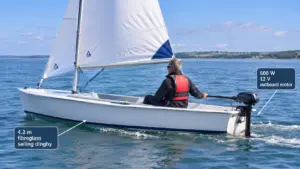
If we use a 4.2m fibreglass sailing dinghy with a 600w 12v motor as an example, at half power it is pulling 25 amps doing 3.5 to 4 knots. At this level, a small 100Ah battery will last four hours and give you a range of 15 to 16 miles.
Push this to full power, you’re only going to achieve 4 to 4.5 knots and the same battery will only last a couple of hours and reduce your range by around 50%.
Planing hulls are obviously different. Designed to lift out of the water and stay there, the instant torque of an electric motor can get them on the plane immediately versus the traditional power curve of a petrol outboard.
Remember that once on the plane – again whether using an electric or petrol outboard – you can back off the power and maintain the plane.
For example, on a Seastrike Semiflat 12 using a Momentum M10 10kW electric outboard with its MB-6 6.8kWh battery, over 7kW is required to achieve planing speeds but planing at around 11 knots can be maintained with around 4kW – extending run time and cruising range.
The key question is whether you need to maintain top speed continuously: If so, you’re going to drain the battery pretty quickly.
Understanding how far and how fast you really go on the plane versus what you think you do is crucial to determining whether an electric outboard is a viable replacement for your petrol engine or not.
Using the same example as above, this will get you on the plane when you really need to get somewhere fast and around 8 hours run time if you’re mainly cruising around at 4 to 5 knots. However, if you need to burn around at full speed for the entire time out on the water, then you’ll drain the battery in about 40 minutes.
Calculating much power you need
As well as thinking about the boat that you’re going to use an electric motor on, you also need to think about:
- Where do you typically operate – are you on inland waters such as a reservoir, in a harbour or marina, or are you mainly out in coastal waters?
- The general current, wind and other conditions the motor will need to contend with.
- If you’re generally operating in sheltered waters, is having more than enough power and duration ‘just in case’ important or not?
- The typical crew and equipment load weight is an important factor.
- How long and often you generally run the motor for – are you constantly on the move or are you motoring to a site and then weighing anchor or holding station while you test water quality for example?
- Do you use your motor for manoeuvring, training, safety or as an auxiliary?
- What is your charging infrastructure and requirement? If you don’t have easy access to shore-based power, portability of battery(ies) could be a key factor.
Knowing these details can make a huge difference between finding the right solution and buying the wrong one.
Use-case
An environmental engineering consultancy was engaged to do some surveying and monitoring work on sites that provided drinking water supply. This required them to use an electric outboard motor to deliver the work.
They carefully went through what they really needed in terms of the boat, load, speed, run time and conditions.
They only needed a 3m RIB for their team and equipment and while the work meant long days out on the various sites, they were only going to motor for relatively short distances and then hold station while undertaking the various tasks required. There was no need to get on the plane.
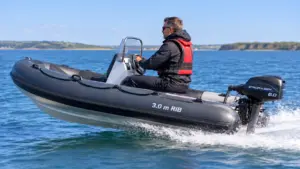
While on inland waters, working over the winter months, they realised that they could face inclement weather – particularly wind.
They settled on a 2.5kW electric outboard with a 1.4 kWh battery with a spare battery to cover the ‘just-in-case’ scenario. Project completed, they reported that the upfront due diligence meant that they had the right motor for the job – including the budget.
Making the final decision
The move to electric propulsion is becoming a viable option for an increasing range of work boats, but there is no single solution that suits every application.
Your starting point should always be the same: understand what the boat needs to do, gather evidence of how it is actually used, and match the propulsion and battery system to those demands.
Sometimes that could well mean that you will actually need a smaller motor than expected; sometimes it could mean a more powerful solution or a different approach to charging. And sometimes, electric propulsion may not yet be the right fit.
The aim is not simply to replace a petrol outboard with an electric equivalent. It is to find a solution that works reliably for the boat, its operator and the job it needs to do.
Related Articles
 VESSELS
 ELECTRICAL SYSTEMS
 SPECIAL REPORTS