

TTS Port Equipment has secured a raft of contracts for port gangways in recent weeks, and delivered and installed a number of linkspans.
Among the contracts for gangways is one to build elevated passenger gangways at two Stena Line terminals at the ports of Belfast, Northern Ireland and Stranraer in Scotland which will serve Stena’s Irish Sea route.
In Stranraer, a short elevated walkway will be installed to enable passengers to access the ships via an existing upper deck linkspan. In Belfast, some 100m of walkway will be built. This marks the first step in a terminal development programme for passenger embarkation that will enable access to the ship’s stern. TTS will also help construct concrete foundations and make alterations to the terminal building. The equipment will be ready for use by spring 2010 at both ports.
TTS has also been involved in the repair of a linkspan at Karlskrona in Sweden after a Swedish ferry, Stena Baltica, demolished a passenger gangway while berthing in stormy weather at the ferry terminal last October. The repair work undertaken by TTS Port Equipment saw the gangway being brought back into service on 20 December, one day before the estimated completion day. Coincidently, in May this year, TTS Port Equipment AB received a conversion order from Stena Line Scandinavia AB to rebuild the port’s upper deck linkspan and install a new passenger gangway. When completed, the new gangway will connect with the recently repaired gangway.
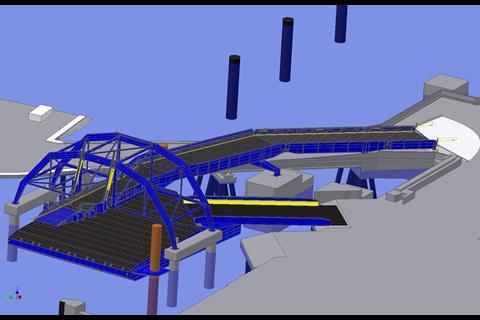
TTS has also recently been awarded a contract to deliver an upper deck linkspan to be used in conjunction with two new Stena Line vessels at Harwich International Port in the UK. The new linkspan, serving Berth 2, will facilitate double deck operations, providing upper level access to the ropax ferries, each with the newly specified capacity to load and discharge vehicles from an upper deck over the bow.
‘The TTS proposal comprises a new structure supported by dolphins which have been specified to maximise safety and stability, being completely separate from the existing pontoon’, said Håkan Jönsson vice president aales at TTS Port Equipment.
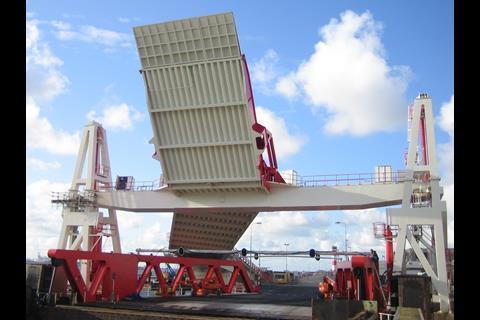
The entire ramp will operate as two parts; one adjustable, the other lifting. The adjustable portion will be elevated by means of hydraulic cylinders built into an arched support structure, while the free floating lifting ramp will be hinged to the adjustable ramp and will rest on the vessel deck when deployed. There will also be modifications to the seaward nose of the existing pontoon to improve vehicle transitions. The linkspan installation is to be performed in the first half of 2010 and forms part of Harwich International Port’s multi-million pound investment in delivering upgraded facilities for ro-ro vessels.
In December, the company also announced that it had successfully installed both upper and lower deck linkspans for Stena Line BV at the port of Hoek van Holland. The linkspans will facilitate the smooth running of the two new ferries coming into service on the Hoek van Holland to Harwich route next year. The lower deck linkspan, an existing installation, has been converted so that it now operates via hydraulic cylinders. The old counterweights and wire systems have been replaced with towers equipped with hydraulic cylinders for lifting and lowering the linkspan and locking the ramp in the various required positions.
The upper deck linkspan is a new structure designed to align with the centreline of the new vessel. It has access ramps placed beside the lower deck linkspan at quay level. This adjustable ramp is raised using the hydraulic cylinders built into the towers of the lower deck linkspan.
The end of 2009 also saw TTS Port Equipment deliver a new linkspan to serve the port of Ystad in southern Sweden. At 25m wide by 14m long, the linkspan has been designed to accommodate traffic growth at the port. Hydraulically operated, it can be locked at levels ranging from seven degrees below horizontal to seven degrees above, which is crucial for offering flexibility to port customers.