


The UK’s Harwich International Port has completed preparations to receive the new generation of superferries to be introduced by Stena Line. The first vessel, the new ‘Stena Hollandica’, came into service on 16 May, with the ‘Stena Britannica’ to follow later in the season.
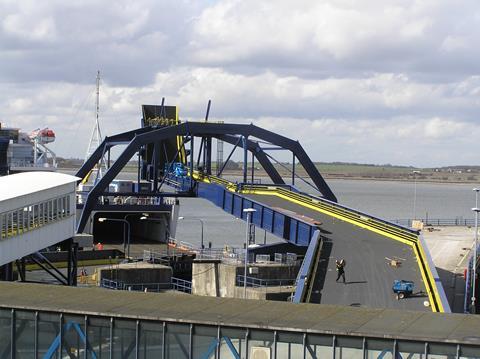
A new linkspan to serve these vessels was designed and fabricated by TTS of Sweden and towed from its build site in China to Harwich in sections by barge. These pieces were stored on the former HSS berth until their recent installation.
The new double-deck linkspan is 114m long from concrete approach ramp to end of its finger flaps. The main section is of a steel bridge construction supported by a steel arch, with a hydraulic cylinder system for both manoeuvring and rotating the end turntable.
Simultaneous loading and unloading is required due to a larger freight capacity on the new vessels. The ferries will be berthing at Harwich with their bow to the linkspan, but since the bow ramp is only capable of single file traffic, the upper linkspan is needed in order to turn around the increased level of cargo within the same berthing slot.
Able to operate as two independent sections, one part is adjustable while the other is a lifting section. The adjustable portion will be elevated by means of the hydraulic cylinders which are built into an arched support structure. The second, free floating lift ramp will be hinged to the adjustable ramp and is designed to simply rest on the vessel deck when deployed.
The linkspan is fully automated and is ‘tide following’, which means that once it is connected to the ship it will follow the ship automatically through the tidal range. It has been designed so that a minimum height of 5m is kept between the underside of the upper linkspan and the lower pontoon. In order to comply with safety regulations, systems such as hydraulics are duplicated so that in the event of failure of one system, the second system has the capacity to operate the linkspan in its entirety.
There will also be modifications to the seaward nose of the existing pontoon to improve vehicle transitions, which have been designed by Mott MacDonald and carried out by Groupbridge Limited.
The new ‘superferries’ were built in Wismar, Germany, and have a gross tonnage of 62,000. At 240m in length and with accommodation for 1,200 passengers, their facilities include restaurants, bars, cinemas, gaming areas and internet facilities.