

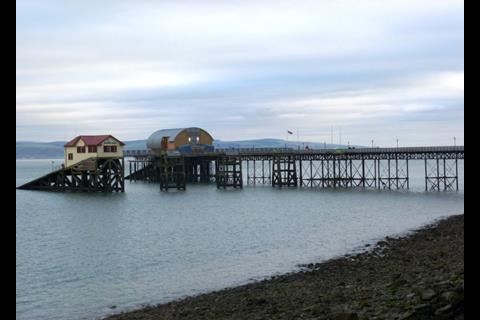
Seawork exhibitor Opus International Consultants of Fareham UK served as lead designer for a complex project to build a new lifeboat station integrated with the cast iron lattice structure of the existing listed pier.
The UK’s Royal National Lifeboat Institution (RNLI) has had a new lifeboat station and slipway constructed on Mumbles Pier in Wales to accommodate the new 25 knot Tamar class slipway lifeboat.
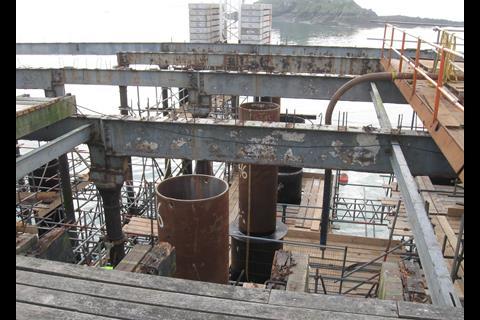
The building consists of a glulam framed superstructure supported off a concrete undercroft constructed on tubular piles. The central area of the existing pier head deck had to be cut away to accommodate the footprint of the new facility and the remaining dilapidated pier head deck was refurbished.
Consultation for the Swansea Bay Regeneration plan favoured a visitor’s ‘point of arrival’ and weather shelter building on the listed cast iron pier head. Though this was a more expensive option than constructing a slipway lifeboat station alongside the existing pier built in 1898, the client chose to accommodate the visitor’s facility within the new RNLI station, as preferred by the Planning Authority and pier owner. The location of the boathouse within the pier head was also due to the ground conditions for the slipway piles and the proximity of deep water for launching.
Constraints were:
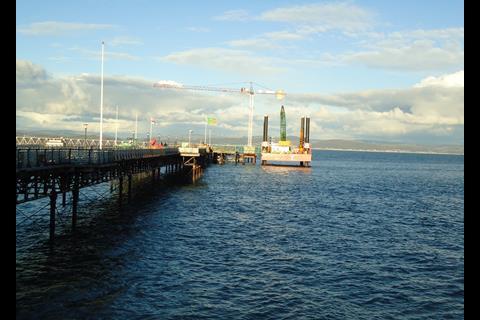
• Location is remote and land access is restricted. All plant and materials need to be delivered by sea
· Piling installation into 8m of mud on top of 7m of stiff clay over bed rock
· No disturbance to be incurred to the cast iron lattice structure of the existing listed pier by vibration or displacement of clay around pier foundations
· No negative effects incurred by the adjacent oyster and piddock beds.
Work commenced on site in June 2012, with the entire scheme completed in late 2013. Boathouse piling operations were completed between mid-August and September 2012.
Companies involved in the scheme and their remit:
Client: RNLI Trading Ltd, Poole
Pier Owner: AMECO, Swansea
Lead Designer: Opus International Consultants, Fareham
Civil Engineering Framework Contractor: BAM Nuttall Ltd, Norfolk
Site Stage NEC Project Manager: Haskoning DHV
Quantity Surveyor – McNaughts, Poole
Geotechnical elements
Geotechnical works included the piled foundation for the boathouse suspended over the
pierhead and the piled foundation for the slipway seaward of the pierhead itself. Below the large tidal range the ground conditions consisted of 8m of mud over 7m of stiff clay, lying on a layer of mudstone bed rock. The substantial depths of unstable material required the 1,200mm diameter boathouse piles to be no less than 30m long, far longer than used on similar lifeboat facilities built previously.
The original design of large diameter drilling using a pile top rig had been chosen to safeguard the structure and environmental constraints. Close collaboration between the designer and contractor concluded that the screw piles of the existing pier, founded in the upper clays, would not be significantly affected by standard pile driving operations when expertly carried out and did offer considerable savings to the client.
Stability
To achieve sufficient pile penetration through the stiff clay into the rock bed detailed surveys and calculations were carried out. These confirmed the required pile load capacities of 1,500 KN for the anticipated length of pile and also determined corresponding dynamic driving resistance.
Pile sets were determined so that design loads could be verified and hammer suitability calculated in terms of pile penetration rates. All piles were expected to found in mudstone, the compressive strength of which was calculated as 5,000 kN/sqm for the end bearing. The driving resistance of the alluvium and associated adhesion factors were also taken into account.
The decision to employ a pile driven rather than the planned large pile top diameter drilling method meant that the piling operations were significantly speeded up, reducing the programme by a number of weeks as each pile took only one day to install as opposed to the allotted minimum of three days. Having considered the use of heavy pile installation equipment working off the listed cast iron as being structurally inadvisable, the piles needed to be lifted over the width of the pier head using a crane mounted on a jack up barge.
Strong team work, open and honest communication, careful planning and skilled civil engineering expertise enabled the compilation of a comprehensive risk register which enabled measures to be put in place to mitigate the effects of the operation.
The level of potentially damaging vibration affecting the existing pier structure was constantly monitored by a temporary ‘real time’ traffic light monitoring system. This operationally visible system was connected to movement detectors on the pier. It provided the piling team with blue, yellow or red warning lights as each of the 15 piles were driven into place. If a red light giving an instant warning of any distress to the pier occurred this would have provided the opportunity for proactive intervention by the operation team. Also the results generated for each installation were recorded for ongoing analysis. If results of the analysis demonstrated it was necessary, the designer and contractor could revisit the method and rework the plans.
Throughout the entire piling operation the sensors never triggered a red light warning. As a result of working within the system’s tolerances, the integrity of the seabed, the oyster and piddock beds and the historic pier structure were all preserved.
Understanding that the risk to the existing pier was minimal from a standard pile driven approach, employing this method saved six weeks on the programme and despite the client acknowledging the potential risk of damage to the pier, budgeted at £500,000, this proved not to be required.
Risk mitigation
The traffic light monitoring system gave confidence to the contractor that operations were proceeding as expected and certainty to the client and pier owner peace of mind that the structure would not be adversely affected.
The success of the piled foundations was delivered as a result of a proactive, integrated, cross company, team approach which facilitated full, direct and open discussion. The development of a comprehensive risk register ensured each contributor mutually understood the relative advantages and risks arising from each of the different solutions and was able to contribute to the final decision and selected methodology of a standard driven piling method. Once the design had been finalised all parties continued to share information ensuring that the identified risks were controlled and not realised. As a result the concise, fully deliberated, geotechnical solution employed, along with proactive mitigation strategies, was a proven success. The original listed pier structure remained unaltered and with little disturbance to the sea bed clays and the oyster and piddock beds were preserved.
“The collaborative approach to the scheme positioned us well to assist the contractor to proactively manage the perceived risks to achieve the scheme objectives”, said Brian Hillman of Opus.
BAM Nuttall added: “Our ability to work collaboratively, together with our proposal to use driven piles and willingness to be responsible for the risk, saved the project six weeks of programmed time.”
“As a Charity, it is important for the RNLI to know the risks and likely costs attached to a project in advance. The collaborative approach by the project team in exploring alternatives, coupled with a higher degree of cost certainty based on the priced risk register, allowed effective risk management and a successful outcome”, concludedBen Sautter of the RNLI.