![MaritimeJournal[Seawork]](https://www.maritimejournal.com/wp-content/uploads/2026/09/MaritimeJournalSeawork.svg)

UK’s tallest quay cranes at Port of Southampton
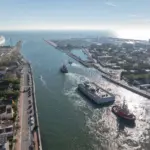
Marine operations specialists at the Port of Southampton have completed a complex shiphandling operation to bring the first two of four new ship-to-shore container cranes safely alongside DP World’s Southampton terminal.
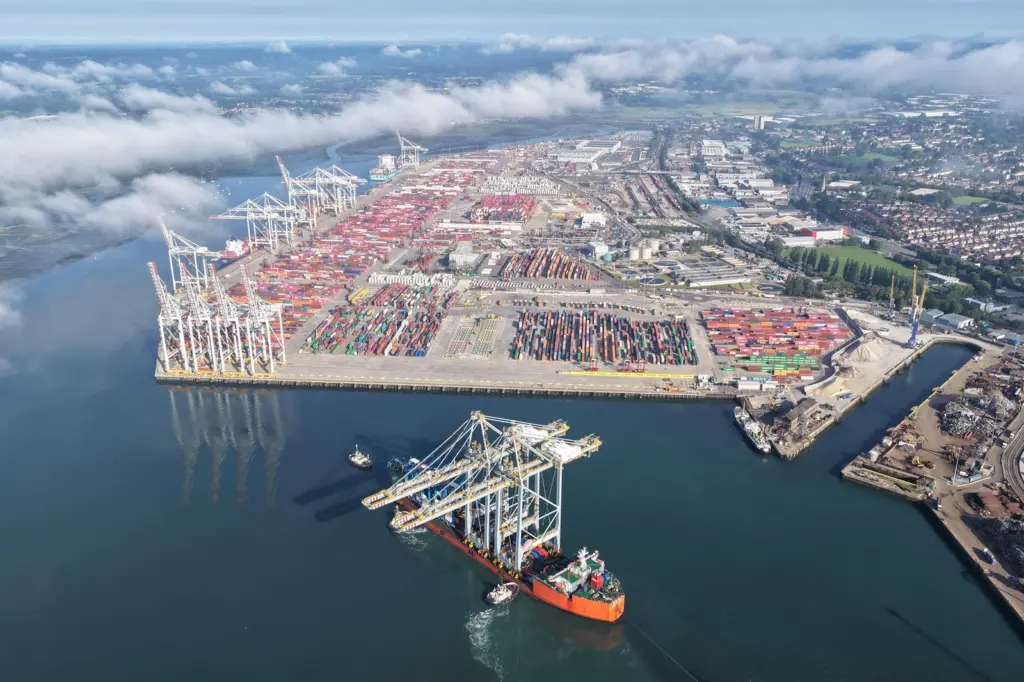
The pair of cranes, which were manufactured in China and bought outright by DP World for £60 million (€69 million), are the tallest quay cranes in the UK at 150 metres and are intended to increase container handling capacity and reduce vessel turnaround times at the terminal. They weigh more than 2,000 tonnes each.
Their arrival required a carefully managed transit through one of the UK’s busiest deep-sea ports. Due to the dimensions of the cranes, which extended significantly beyond the beam of the transport vessel, the overall width of the cargo exceeded 160 metres, presenting challenges for navigation within the port’s confined waters.
ABP coordinated the marine operation, involving dedicated pilotage, tug assistance – four Svitzer tugs were deployed – and vessel escort. Temporary restrictions were placed on other ship movements, while the transit was scheduled during an early-morning window to minimise disruption to normal port activity and provide favourable operating conditions.
“The width of the cranes and barge at 168m was the main challenge,” said Tim Morris, head of Corporate Communications with Associated British Ports (ABP), which owns and operates Southampton.
“This meant that the vessel could not pass other ships in the navigation channel through the Solent and the Western Docks berths in the port needed to be clear of other vessels between 102-106 berth.
“This meant we had to make sure other vessels were moved or held out of the port whilst the movement was undertaken.”
Four Svitzer tugs were deployed,
Steve Masters, harbour master for ABP Southampton, said the operation had required extensive planning and coordination between the marine team and other stakeholders.
“The scale of this delivery required meticulous planning, precise coordination and the expertise of our marine teams to safely navigate a highly complex operation through a busy working port,” he said.
Southampton is the UK’s third largest container port, with the DP World terminal handling around 2 million teu annually and regularly accommodating the largest deep-sea container vessels trading to the UK.
“Trade powers the UK’s growth and prosperity, and today’s arrival of two fantastic new quay cranes is a landmark moment for Southampton and for our long-standing operation in this vital port,” said Kris Adams, DP World CEO UK Ports & Terminals. “DP World’s investment is equipping our terminal here in this major trading city for the future, ensuring we can handle the next generation of large container vessels, boosting our capacity and efficiency. Upgraded infrastructure at Southampton will allow us to better serve customers across the UK and strengthen our terminal’s contribution to the national economy.”
For marine operators, the movement illustrates the increasing complexity involved in handling oversized project cargoes and port infrastructure components. As terminals invest in larger cranes to serve ever-bigger container ships, harbour authorities are increasingly required to develop bespoke marine plans involving towage, pilotage, traffic management and carefully selected tidal and weather windows to ensure such deliveries can be undertaken safely without significant impact on commercial operations.
The remaining cranes, another pair, are expected to be delivered to Southampton in the coming months, and Morris said that because of the seamless execution of the plans, which had taken three months to lay down, the same process will be used when they arrive.
The width of the cranes and barge at 168m was the main challenge. This meant that the vessel could not pass other ships in the navigation channel through the Solent and the Western Docks berths in the Port needed to be clear of other vessels between 102 – 106 berth. This meant we had to make sure other vessels were moved or held out of the port whilst this movement was undertaken.