

It seems it’s not the physical burden so much as the administrative one that has pushed heavy lift and project cargo off European trucks and onto the waterways.
Although the size of project cargo in Germany has been highlighted by the sheer scale of windfarm pieces being moved out of places like Bremerhaven to deep water installations, the real issue has been the weight.
Boris Kluge of Bundesverband öffentlicher Binnenhäfen (Association of Inland Ports) explains that the heavy lift permits needed to get across Germany by truck “have, for several years, become harder and harder to acquire” and these restrictions have added to the expense.
“For example, going from Munich to Hamburg with a 150 tonne transformer now requires a trip via Berlin and these permits are for night passages only. When you combine this fact with the longer journeys, it’s no longer possible to do it in one trip. If you are faced with the extra cost of two or even three night's travel it simply becomes unfeasible.”
The other, obvious answer is for manufacturers to move production close to the seaports, but while some have taken the opportunity, many like Siemens have stated, very clearly, they don’t want to abandon their Berlin base. That might have been fine if Siemens was not also developing a new generation of huge wind turbines at the production site in Berlin’s Mitte district. The SCT5-8000H has a capacity of 375MW and a weight of 520 tonnes, too heavy for the city’s lovely old bridges.
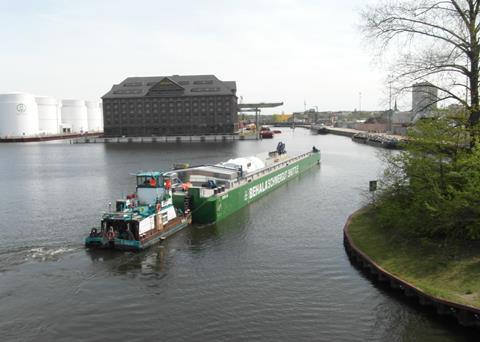
So, using Siemens’ requirement as a catalyst, Behala GmbH began to develop wide bodied and heavy transport for Berlin. Klaus-Günter Lichtfuss of Behala explains the solution uses the nearby Charlottenburger Verbindungskanal and the construction of a reinforced loading dock near Siemens’ facility as well as building a heavy cargo capacity ro-ro barge.
A joint venture between the Technical University of Berlin and Behala, the GSL Ursus was designed with a capacity of 1,200 tonnes, or enough to take two multiaxle trailers holding 800 tonnes of cargo. Its 64.5m length, 9.50m beam, 2.5m draught and integrated loading ramp was a careful compromise between flexibility, capacity and the maximum dimensions that could get through Berlin’s waterways. It also has a novel underfloor heating system to keep the load areas ice-free plus 820 tonnes of ballast capacity which both helps with the tricky stability elements of heavy cargo lifts and gets the barge under the city’s low bridges.
However, just as important is the Ursus ‘Zone 2’ approval, which means the barge can get all the way down to the open sea and make it into the major coastal ports in one hop.
French connection
Equally, road issues have given French waterway developments a distinct edge.
“While it takes six to eight weeks to get road transport authorised between Burgundy and the main European harbours, you only have to allow a maximum of 10 days to ship oversize or overweight parcels from Burgundy out of the port of Le Havre or Rouen,” says Patrick Maletras of Tramar.
The combination of deepwater at Le Havre with a string of smaller facilities has given Normandy manufacturing an interesting mix of quays to load out from; no less than 13 in Le Havre, five in Rouen, and nine in Paris, with partner ports adding another four.
The complex boasts a number of strengthened quays at Gron and Sens (on the Yonne tributary), Bonneuil (on the Marne), Evry and Bray. It is navigable by ocean-going vessels as far as Rouen, which has a 11.17m depth despite being 120km from the sea and further, the network reaches over 300km inland. Gron and its neighbour Sens are close to halfway across France. This combination of capability and location has captured heavy cargo from companies as diverse as Alstom, EDF and Technip Total.
Tramar’s mixed containers and out-of-gauge barge service runs regularly between the LogiYonne facility at Gron and Le Havre, grabbing a number of agreements from manufacturers which for decades had been simply bearing the increasing administrative overland burden, says Mr Maletras. Gron itself has both a heavy lift area and ro-ro ramp, and despite a couple of days of restricted navigation a year it can accept loads of 650 tonnes with an air draught of 5.0m. Nearby tank manufacturer Charlatte Reservoirs has been making full use of the facilities, with nine out of ten orders reaching the sea via this route including a recent order of 11, 42 tonne, 20m long pressure tanks for a water desalination project in Perth, Australia.
“We’ve seen the number of out of gauge parcels going through Le Havre increase from around 100 per year in 2010 to 600 in 2013,” points out Mr Maletras.
Benefits
Interestingly, inland ports have added some unexpected benefits to the mix. One of them is that although a hitch in production on the manufacturing side would usually throw all the road transport plans and permits out of the window, the waterway link is inherently more flexible and usually makes renegotiation for carriage of a large parcel much easier, both on the barge shuttle and at the seaport for the final leg of the journey.
The other is that this same flexibility gives manufacturers some leeway to make the most efficient plans.
“There are a number of manufacturers with limited warehousing capability for these big pieces, and once they have constructed an item they don’t want it in the way,” says Mr Kluge. Another point he makes is that logistics specialists are very, very expensive, something that’s only matched by the cost of hiring the cranes. “Anything with a heavy lift capability can have a price tag of €10,000 per day,” he says, adding the inland ports can often help address all these issues.
Mr Kluge explains: “Manufacturers can often park an item at the port while waiting for another set of pieces to be ready before loading, or let it sit on a pontoon barge while the most cost effective onward transportation opportunity is negotiated, rather than relying on the project cargo experts to do everything. This can lower the price of the crane hire, the specialists and the total journey.”