



ASV for autonomous navigation helps UK Navy
A brand-new class of Autonomous Surface Vehicle (ASV) has been designed to enable the UK’s Royal Navy to understand how to maintain a technical advantage over potential adversaries.
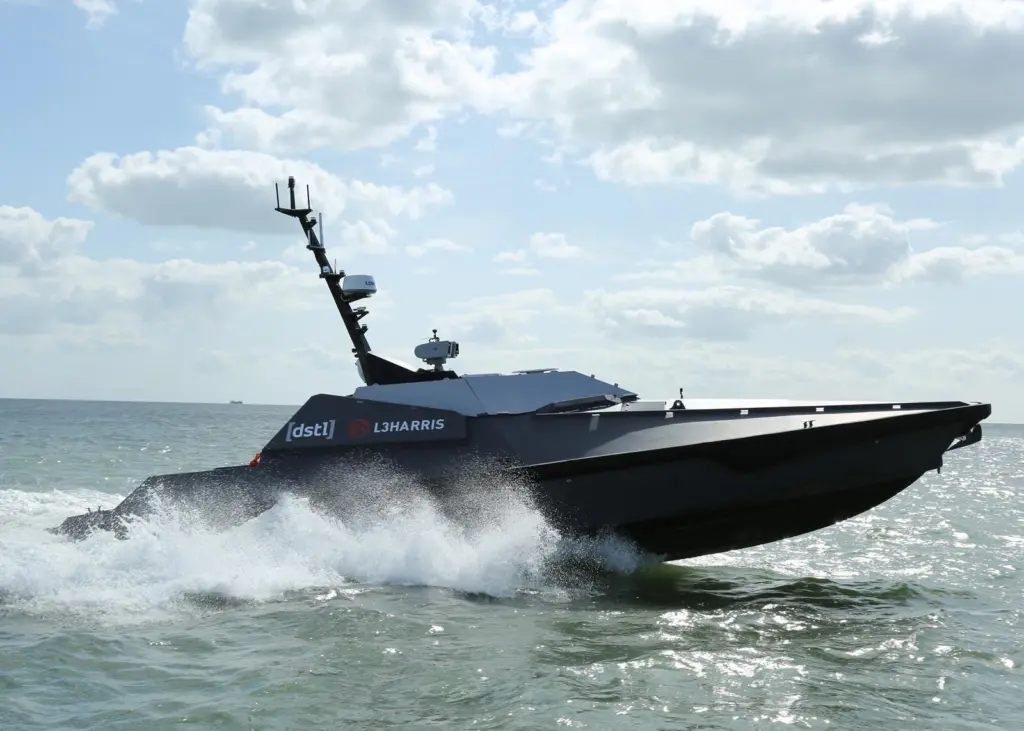
Designed, built and commissioned by L3Harris’ Unmanned Maritime Systems team, the Maritime Autonomy Surface Testbed (MAST) 13 is a 13m long high-speed system capable of fully autonomous navigation. The ASV uses L3Harris’ ASView proprietary autonomous control system and advanced algorithms developed for the UK’s Defence Science and Technology Laboratory (Dstl).
“MAST 13 reflects the increased use of unmanned systems in the military domain. This vehicle serves as a test platform to support new concepts for the Royal Navy, allowing them to exploit unmanned systems and maintain a technical advantage,” said Alasdair Gilchrist, above water systems programme manager for Dstl.
Launched this month, the system has carried out unmanned surveillance and force protection in the Victoria Dock at DSEI.
Long-term collaboration
Since 2014, L3Harris and Dstl have collaborated to develop ASVs that support new concepts for the Royal Navy and act as a testbed for innovative technologies.
“As the programme continues, we welcome collaboration with other organisations to test new algorithms, sensors, payloads and novel concepts,” added Mr Gilchrist.
Predecessor MAST systems developed by L3Harris and Dstl have carried out numerous high-profile operations, including the Royal Navy’s Unmanned Warrior in 2016 and the Australian Defence Showcase, Autonomous Warrior in 2018. MAST 9 is currently in Portugal for the NATO exercise ‘REPMUS’.
The high-speed vessel is operating autonomously, beyond line-of-sight, to carry out reconnaissance, interdiction and patrol tasks.
By Rebecca Jeffrey