


The wave energy sector has made significant progress across Europe in recent years – and strong currents continue to buoy its surge towards technological and commercial maturity, reports Abigail Williams.
Against a background of rising levels of commercial interest and technical sophistication, efforts to expand the European ocean energy sector are continuing at a rapid pace – and a growing array of innovative devices are undergoing advanced deployment and testing.
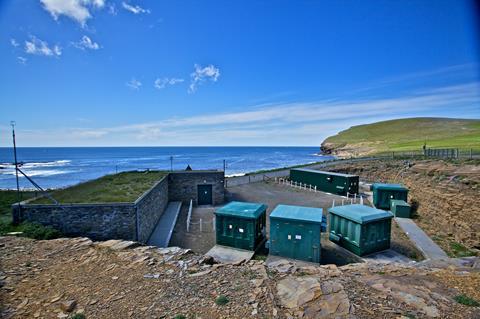
One of the main centres of activity in the sector is the European Marine Energy Centre (EMEC) in Orkney, Scotland, the world’s leading test site for wave energy technologies, and a key hub for the development and testing of wave power systems across the continent.
As Caron Oag, communications lead at EMEC, says, efforts at the centre are currently focused on supporting the next phase of device deployments, ongoing testing of individual devices, continuing development and expansion of test infrastructure to ‘support both next-generation device demonstrations and larger-scale array projects’.
The centre is already working with developers moving in that direction, including OceanEnergy, which is preparing to test its OE35 device at the EMEC site in Billia Croo, and CorPower Ocean, which is also progressing plans for a wave energy array at the Orkney facility.
“Alongside this, we continue to support subsystem innovation, focusing on the underlying systems that make those technologies viable offshore,” she says. “For example, Whitford Ltd worked with us on long-term testing of subsea coatings, which are critical for protecting equipment in harsh marine environments, and the University of Edinburgh demonstrated a convergent beam acoustic doppler profiler for improved flow measurement.
“Through projects like FOREST, we are also helping to test subsea technologies, connections and digital systems that will be critical to making wave energy reliable and commercially viable.”
Launched late last year, the €4 million EU-backed FOREST (Future Ocean Renewable Energy System Technologies) project aims to drive advances in subsea components and digital technologies to introduce new global standards for durability, reliability and efficiency in ocean energy systems.
The three-year initiative - coordinated by EMEC, and including partners in Portugal, Spain and Sweden – also seeks to enhance the performance of ocean energy arrays, reduce the levelised cost of energy, foster sustainability of ocean energy systems, and accelerate market readiness.
“Across Europe, the sector is becoming more focused and coordinated, with greater emphasis on validated performance, standards and system integration,” she says. “As technologies become more proven, the priority is shifting towards building confidence and attracting the investment needed to move into commercial deployment.”
Growing pipeline
Elsewhere, Rémi Gruet, CEO at Ocean Energy Europe (OEE), says the wave energy project pipeline in Europe ‘continues to grow’ and, according to OEE data, has increased from around 13MW in April last year to 24MW today, reflecting growing confidence in the sector and the transition towards pre-commercial projects.
One initiative that illustrates the sector’s move towards pilot farms and larger-scale deployments is the POWER-Farm EU project, which aims to deploy the world’s largest wave energy farm to date: a 2.5MW installation comprising seven wave energy converters (WECs) operating in the highly energetic North Atlantic Ocean.
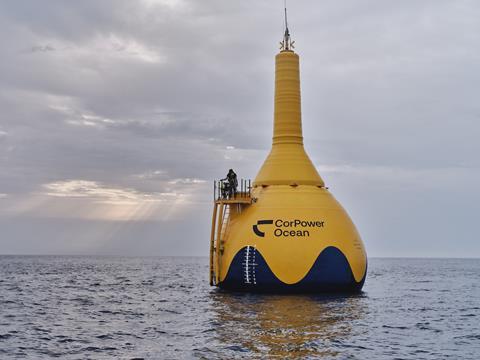
Launched at the beginning of the year, the six-year initiative, led by wave technology company CorPower Ocean alongside a consortium of partners including OEE, is designed to pave the way for commercial-scale expansion beyond the project, with plans to scale capacity to 30MW by 2030 and 300MW by 2032. Testing and deployment will take place at EMEC.
Gruet says the long-term ambition is to establish wave energy as a mainstream renewable energy sector in Europe, capable of delivering up to 17% of electricity demand in target EU countries by 2050 through large-scale manufacturing and deployment within the continent. In doing so, Gruet says the project will generate and share comprehensive techno-economic, environmental and performance data and implement a best-in-class environmental monitoring programme, providing valuable new insights into the impacts of wave energy farms.
“In parallel, POWER-Farm EU will demonstrate major advances in volume manufacturing and operations, showcasing the capability to support the deployment and servicing of hundreds of megawatts of wave energy capacity by the end of the project,” he says.
Port infrastructure
In tandem with this upward trend, Gruet says a growing number of full-scale wave energy devices are being tested and validated in real sea conditions across Europe, including recent deployments by Seaturns in France, as well as Ocean Energy and Wave-Op, which are all preparing larger-scale deployments over the coming year.
Earlier this summer, French wave energy outfit Seaturns announced the successful deployment of its S1 full-scale wave energy demonstrator off the Gironde estuary on the French Atlantic coast, kickstarting an offshore trial campaign set to run for a minimum of 12 months.
“These projects build on successful demonstrations and help generate the operational data needed to attract investors, insurers and future customers,” he says.
Following the successful deployment of a prototype of the DIKWE (Dike Wave Energy) system near Brest in the Iroise Sea, Wave-Op – a joint venture between Groupe Legendre and Geps Techno – also conducted a full year of testing under real sea conditions using a single module connected to the test site and generating electricity.
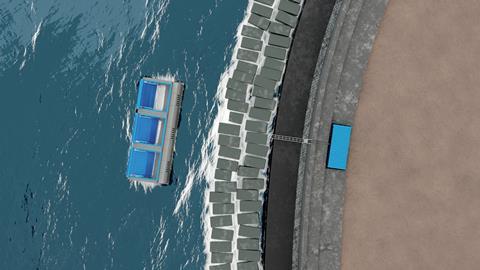
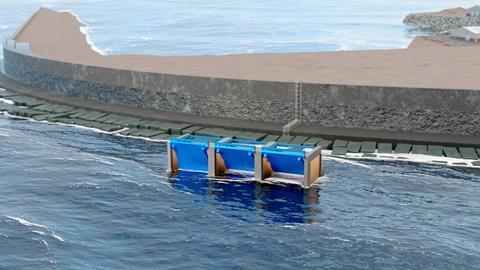
The system consists of an oscillating wave-energy converter, known as a flap, which is installed in front of, on, or within breakwaters and captures the mechanical energy of incoming waves through its oscillating motion. Each flap is integrated into a modular structure adapted to the specific characteristics of the breakwater or coastal structure, enabling energy generation to be combined directly with coastal protection infrastructure.
“The results were very encouraging. On average, the system converted approximately 25% of the wave energy captured into electricity. This represents an excellent efficiency level for wave energy technology,” says Quentin Henry, Wave-Op managing partner at Legendre Construction.
“We are currently installing a larger demonstrator consisting of three modules in Boulogne-Sur-Mer, France, which is a major step towards industrial-scale deployment. Installation is expected to be completed by the end of 2026, and the first electricity generated by the system will be fed directly into the port’s electrical network shortly thereafter.”
Compact design
Netherlands-based wave energy company Wave Energy Collective has recently carried out testing of its compact Kaizen 2.0 system in controlled and real-sea conditions, including large-scale testing at the Deltares Delta Flume and offshore testing at the Scheveningen Offshore Test Site in the North Sea.
Kaizen 2.0 is a compact WEC based on a floating structure that moves with waves and transfers motion energy to a rotary shaft and generator, converting the mechanical energy of wave movement into electrical energy.
“The system is designed to be lightweight, robust and relatively easy to deploy compared to many conventional wave energy systems,” says Julia Baas, project coordinator & communications manager at Wave Energy Collective. “Its compact design allows it to follow the motion of the sea while limiting extreme loads during rough conditions, which is important for survivability offshore.
“This has the potential to reduce installation and maintenance costs while enabling deployment from smaller vessels, making wave energy more accessible and scalable.”
A key recent milestone was a successful 24-hour offshore test, which revealed that measured loads were significantly lower than expected, demonstrating the system’s ability to reduce peak forces and align with earlier simulation and flume test results.
Key challenges
Gruet says one of the main challenges facing wave energy developers is access to capital – and he stresses that continued support at both national and European level is essential to help the sector progress towards commercial deployment and reduce costs over time, as has been the case for wind and solar energy.
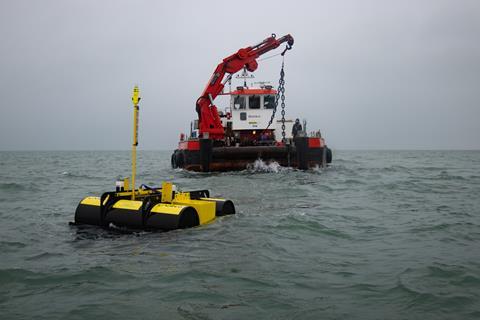
The Weco Kaizen 2.0 device deployed in the North Sea.
“Dedicated testing facilities are also crucial, as these provide the infrastructure needed to validate technologies and reduce technical risk,” he says.
“To build a viable business case for large-scale deployment, more mature technologies require revenue support mechanisms, such as contracts for difference or feed-in tariffs. Permitting and grid access are challenges shared with other renewable energy sectors and will require faster permitting processes and continued grid development.”
Erika Kemp, Communications Officer at EMEC, says testing wave energy systems at sea comes with ‘real challenges’ – with a combination of harsh and unpredictable conditions, strong waves, corrosive environments and complex seabed conditions all affecting how technologies perform.
“We are also working with technologies that are often first of a kind, which means uncertainty is part of the process. Projects can evolve as new issues are identified, and that requires flexibility in how we support testing programmes.”
Future priorities
Julia Baas says the wave energy sector faces challenges related to ‘reliability, survivability, cost reduction, financing, permitting and proving long-term performance’.
“Investors and project developers require confidence that systems can operate reliably for extended periods in harsh marine environments while producing electricity at competitive costs,” she says.
Overcoming these challenges will require continued demonstration projects, shared testing infrastructure, supportive public funding programmes, industry collaboration and greater standardisation across the sector.
Baas also believes wave energy will play an increasingly important role within the broader offshore renewable energy ecosystem, with trends likely to include hybrid offshore energy systems, power supply for offshore monitoring and autonomous systems, integration with offshore wind and growing demand for reliable renewable power in remote marine locations.
“In the coming years, reliability and cost reduction will remain the most important priorities for the sector,” she says.
“At the same time, as technologies mature and accumulate more operational data, the conversation is likely to shift increasingly from technical feasibility towards scalability, deployment efficiency and commercial viability. These developments will be critical in determining how quickly wave energy can contribute to Europe’s renewable energy ambitions.”
Gruet predicts technologies will mature and demonstration projects will transition to larger deployments. As POWER-Farm EU and other projects generate operational and performance data, he also believes confidence among banks, investors and insurers will increase.
“As technologies advance, financing is therefore likely to become less of a challenge than it is today,” he says. “Greater attention will instead shift towards creating the framework conditions needed for commercial deployment, particularly permitting and grid access.”